EUR/USD surges over 1.1100 as markets continue to bet on Fed rate cuts
- EUR/USD etches in new December high heading into the yearly rollover.
- US economic data continues to soften, markets lean further into Fed rate cut bets.
- After a 6.5% rally, the EUR/USD is less than 1.5% away from 2023’s high bid of 1.1275.

The EUR/USD is gaining ground in thin post-holiday markets as investors gear up for the new year and head towards 2024 with sentiment leaning notably risk-on, pushing the US Dollar (USD) down once more in the last partial trading week of the year.
Broad-market risk appetite is singularly focused on Federal Reserve (Fed) rate cut expectations, with investors currently piling into bets that the Fed will begin the next rate-cutting cycle as soon as next March.
Markets shrug off EU headlines to lean further into rate cut bets
Despite deepening cracks in the European Union and lopsided growth figures pointing towards recession across the Eurozone, markets are bidding the Euro (EUR) higher in the partial post-holiday trading week. Italy’s government is expected to reject reforms to the European Stability Mechanism, with Italian Economic Minister Giancarlo Giorgetti stating that there is no need for additional budget adjustments in order to comply with new EU fiscal policy rules. The Italian Economic Minister’s comments appear to be at odds with the fact that the overwhelming majority of Eurozone economies are currently overshooting EU debt and spending restrictions, with the gap only expected to widen in 2024 as European economies grapple with a looming economic downturn.
Declining economic macro indicators from the US are underpinning risk appetite, as economic softness from the US accelerates market bets of faster, longer, and deeper rate cuts from the US Federal Reserve.
The Richmond Fed Manufacturing Index for December printed -11 versus the forecast -7, backsliding even further from November’s -5 print.
Thursday will bring a fresh round of US data with Initial Jobless Claims for the week into December 22 expected to tick upwards from 205K to 210K. US Pending Home Sales are expected to rebound slightly in November, forecast to gain 1% after October’s -1.5% backslide.
EUR/USD Technical Outlook
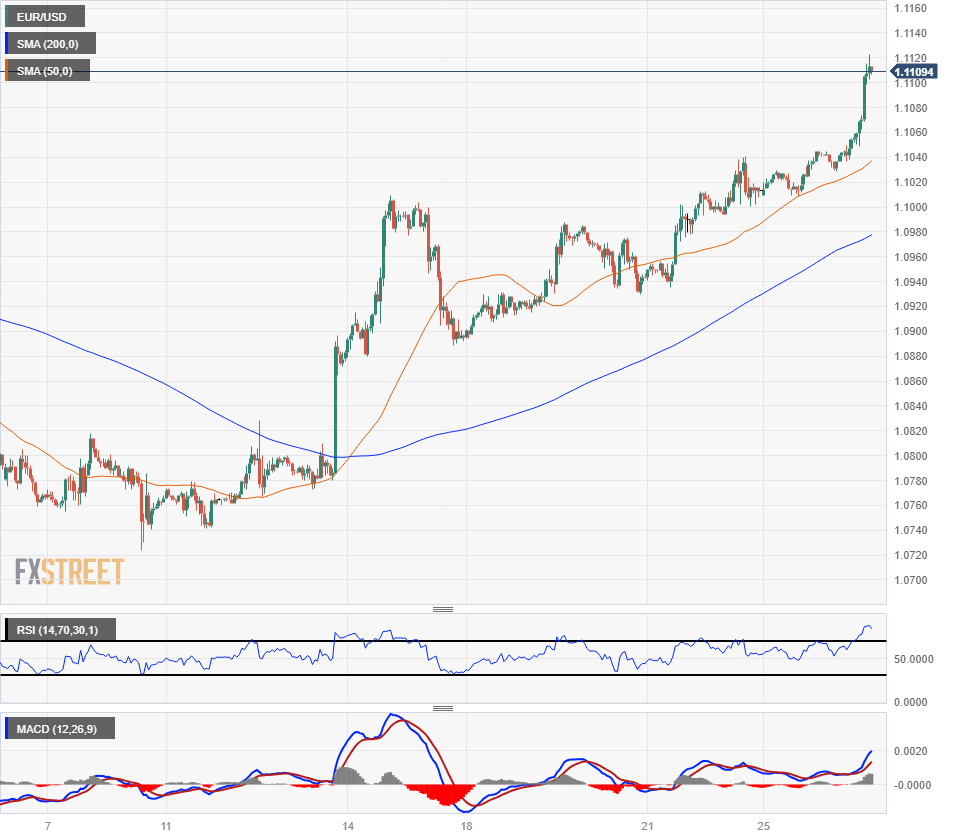
The Euro jumped on Wednesday as broad-market flows pull down the US Dollar, sending the EUR/USD to a near-term high of 1.1120, extending recent bullish action further into the top end with the pair trading well above the 200-hour Simple Moving Average (SMA) near 1.0980.
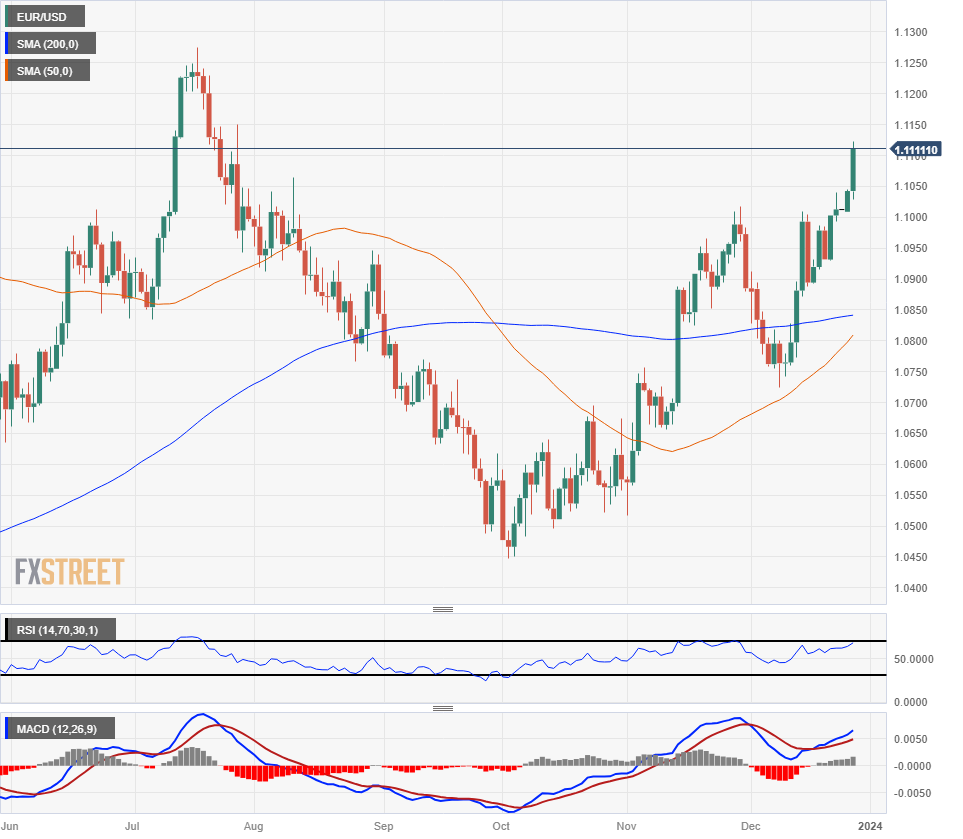
Wednesday’s EUR/USD gains puts the pair into its highest prices since late July, and the pair has climbed nearly 6.5% from October’s bottom bids of 1.0450.
On the daily candlesticks the EUR/USD is threatening to tip even deeper into overbought territory, extending from the 200-day SMA near 1.0850 and closing in the green for all but two of the last 12 consecutive trading days.
EUR/USD Hourly Chart
EUR/USD Daily Chart
EUR/USD Technical Levels
Author

Joshua Gibson
FXStreet
Joshua joins the FXStreet team as an Economics and Finance double major from Vancouver Island University with twelve years' experience as an independent trader focusing on technical analysis.















