EUR/USD falls back on hopes of lower Trump tariffs
- EUR/USD retreats to near 1.0900 as the US Dollar gains ahead of Trump's talks with his trading partners.
- Trump threatened to impose additional 50% tariffs on China for taking countermeasures against reciprocal levies announced last week.
- Investors await the meeting of Eurozone finance ministers to discuss measures against Trump’s tariffs.

EUR/USD surrenders its entire intraday gains and falls back to near 1.0900 in Tuesday’s North American trading session. The major currency pair turns flat after losing intraday gains as the US Dollar (USD) recovers on diminishing trade war tensions between the United States (US) and its trading partners. The US Dollar Index (DXY), which tracks the Greenback's value against six major currencies, recovers a majority of intraday gains and rebounds to near 103.35.
During North American trading hours, US Treasury Secretary Scott Bessent said in an interview with CNBC that a significant number of trading partners have urged Washington to negotiate on tariffs. Bessent added that the President will be personally involved in "negotiations," and if we're successful, the tariffs would be a "melting ice cube in a way". Separately, White House Economic Adviser Kevin Hassett said in an interview with Fox that the President wants "fair and reciprocal trade," and we are getting ready to present a plan to him on "who and when for tariff talks."
The removal of tariff and non-tariff barriers by targeted nations and a decline in import duties to be charged by the US than what Donald Trump had presented on the Liberation Day will diminish fears of domestic economic shocks.
Previously, market participants started anticipating a US recession in the aftermath of the reciprocal tariff announcement by President Donald Trump last week. Trump swept new levies in addition to a 10% universal baseline on Wednesday in an attempt to fix trade imbalances and ‘make America great again.’
This has also led to traders raising bets supporting an interest rate reduction by the Federal Reserve (Fed) in the June policy meeting. According to the CME FedWatch tool, traders are confident that the central bank will cut its key borrowing rates in June.
Going forward, investors will focus on the US Consumer Price Index (CPI) and Producer Price Index (PPI) data for March, which will be released on Thursday and Friday, respectively.
However, trade relations between the US and China are expected to remain ugly as the Chinese Ministry of Commerce has warned that the US President’s new tariff threats were "a mistake on top of a mistake" and China will “fight to the end” to protect its interest. These comments have come in Tuesday's Asian session against Trump's threat to hike import duty on China further by 50% if the country doesn’t withdraw its retaliatory response of 34% reciprocal tariffs on US goods already announced last Friday and coming into effect this Thursday.
Daily digest market movers: EUR/USD gains US Dollar
- EUR/USD falls back as the outlook of the Euro (EUR) has become uncertain on escalating European Central Bank (ECB) dovish bets. Some ECB officials, including Bank of Italy Governor Piero Cipollone, Bank of France Governor François Villeroy de Galhau, and Governor of Bank of Greece Yannis Stournaras, have all supported further policy easing. Stournaras said last week that US tariffs will not be an “obstacle to April rate cut” as the inflation path remains “unchanged”. He guided that US tariffs will “negatively impact” the Euro area Gross Domestic Product (GDP) growth rate by “0.3%-0.4%” in the first year.
- During European trading hours, Stournaras said that the monetary policy needs to be less “restrictive in 2025”. However, he warned of the possibility that the inflation rise might “delay the normalisation of monetary policy”.
- Additionally, market participants are concerned that countermeasures by the European Union (EU) in the face of reciprocal tariffs by Donald Trump could lead to a trade war between regions situated on the opposite sides of the Atlantic.
- Finance ministers of all Euro area countries are scheduled to meet in Warsaw on Friday to discuss measures to contain the likely consequences of tariffs imposed by the US. Ahead of the meeting, Poland Finance Minister Andrzej Domański said, "Disrupted supply chains and rising costs for companies will affect European growth ratios and currencies." He added that such a scenario will have “adverse social consequences” and “increasing prices for consumers”, leaving citizens more vulnerable, Reuters report.
- On Monday, European Union trade commissioner Maroš Šefčovič also stated that our continent has offered to the US “zero-for-zero tariffs” for “cars and all industrial goods". Investors considered the statement positive for the Euro as a cooperative deal would be prosperous for the Eurozone.
Technical Analysis: EUR/USD drops to near 1.0900
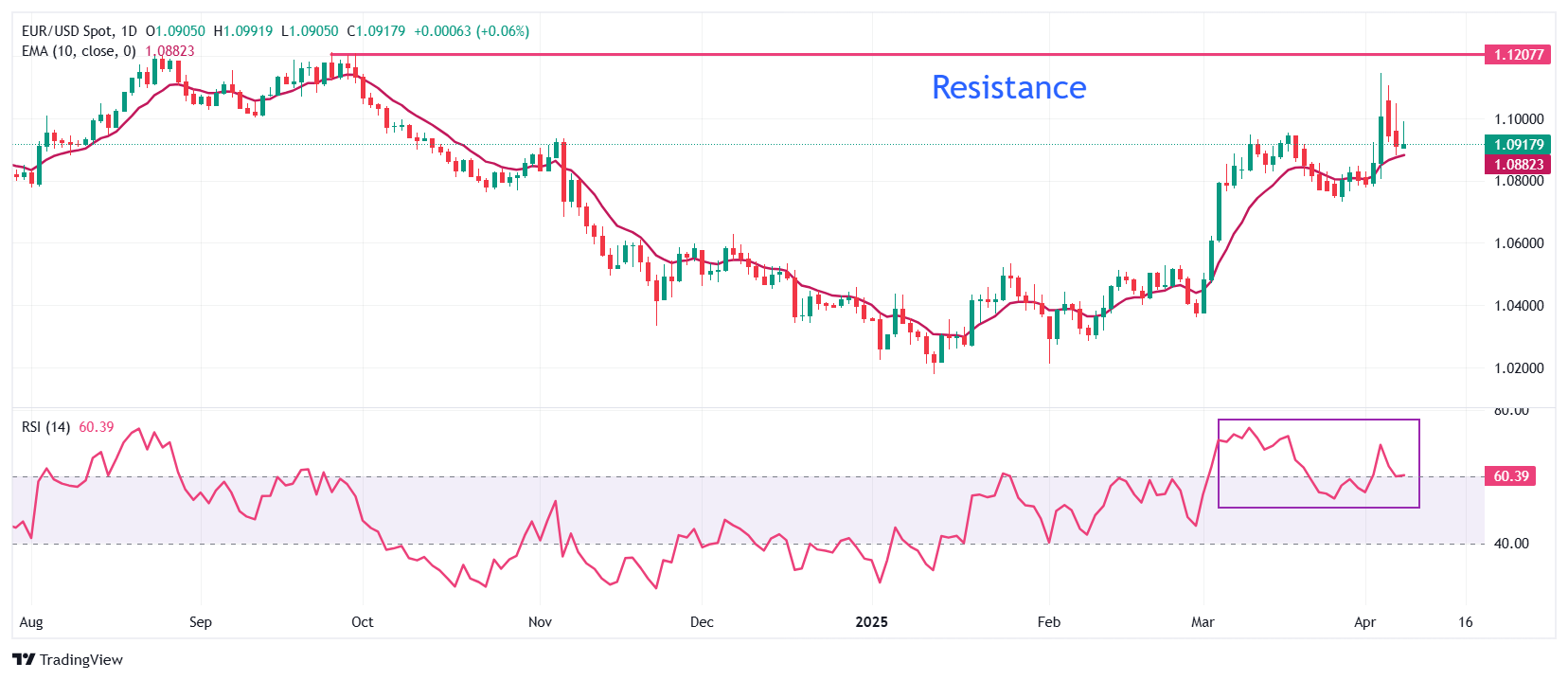
EUR/USD loses intraday gains and slide back to near 1.0900 during North American trading hours on Tuesday. The major currency pair holds the 10-day Exponential Moving Average (EMA) on Monday around 1.0888, suggesting that the near-term trend is still bullish.
The 14-day Relative Strength Index (RSI) holds the 60.00 level, suggesting that the bullish momentum is intact.
Looking down, the March 31 high of 1.0850 will act as the major support zone for the pair. Conversely, the September 25 high of 1.1214 will be the key barrier for the Euro bulls.
BRANDED CONTENT
Finding the right broker for trading EUR/USD is crucial, and we've identified the top choices for this major currency pair. Read about their unique features to make an informed decision.
Author

Sagar Dua
FXStreet
Sagar Dua is associated with the financial markets from his college days. Along with pursuing post-graduation in Commerce in 2014, he started his markets training with chart analysis.