EUR/USD steady amid soft EU’s data, ahead of US CPI report
- EUR/USD sees minimal change, impacted by unexpected fall in German industrial production and declining retail sales.
- Improvement in US trade deficit and small business sentiment offers mixed cues to traders ahead of Thursday's US inflation data.
- Market attention on Fed speakers' comments regarding interest rates, and upcoming speeches by ECB and Fed officials.

The EUR/USD is almost flat in early trading in the North American session on Tuesday as economic data in Europe was mixed while traders prepared for Thursday’s inflation report in the United States (US). At the time of writing, the major trades at around 1.0941, losing 0.09%, after hitting a daily high of 1.0966.
Germany’s data continued to weigh on the Euro
In the European session, Industrial Production dropped unexpectedly in November, which printed a -0.7% plunge, below forecasts of a 0.3% rise. Annually-based figures slipped by -4.87%, below forecasts of -4%. Analysts at Commerzbank said, “The unexpected fall in German industrial production in November shows that companies are increasingly reacting to falling order books.”
Given the backdrop, along with German Retail Sales falling more than expected in November, had increased the odds of Europe’s largest economy hitting a recession, following Q3 GDP fall by -0.1%.
That weighed in the Euro (EUR), which also felt the pain of European Central Bank (ECB) officials I the likes of Centeno, who said the ECB wouldn’t have to wait until May to make policy decisions.
Across the pond, the US Economic docket revealed that US small business sentiment rose for the first time in five months in December, though it remained below its 50-year average of 98 for 24 straight months, via Reuters.
Lately, the US Department of Commerce revealed the US Trade Balance deficit narrowed in November, with numbers improving from $-64.6 billion to $-63.2 billion, less than $-65 billion foreseen by street’s analysts.
Aside from this, Federal Reserve (Fed) speakers crossing the newswires stressed that interest rates are sufficiently restrictive at the 5.25%-5.50% range. Even though most had expressed there’s a chance of easing policy, their main focus remain curbing high inflation.
Ahead of the week, the US economic docket will feature Fed’s Michael Barr. On the Eurozone front, the calendar will feature a speech of ECB’s Francois Villeroy.
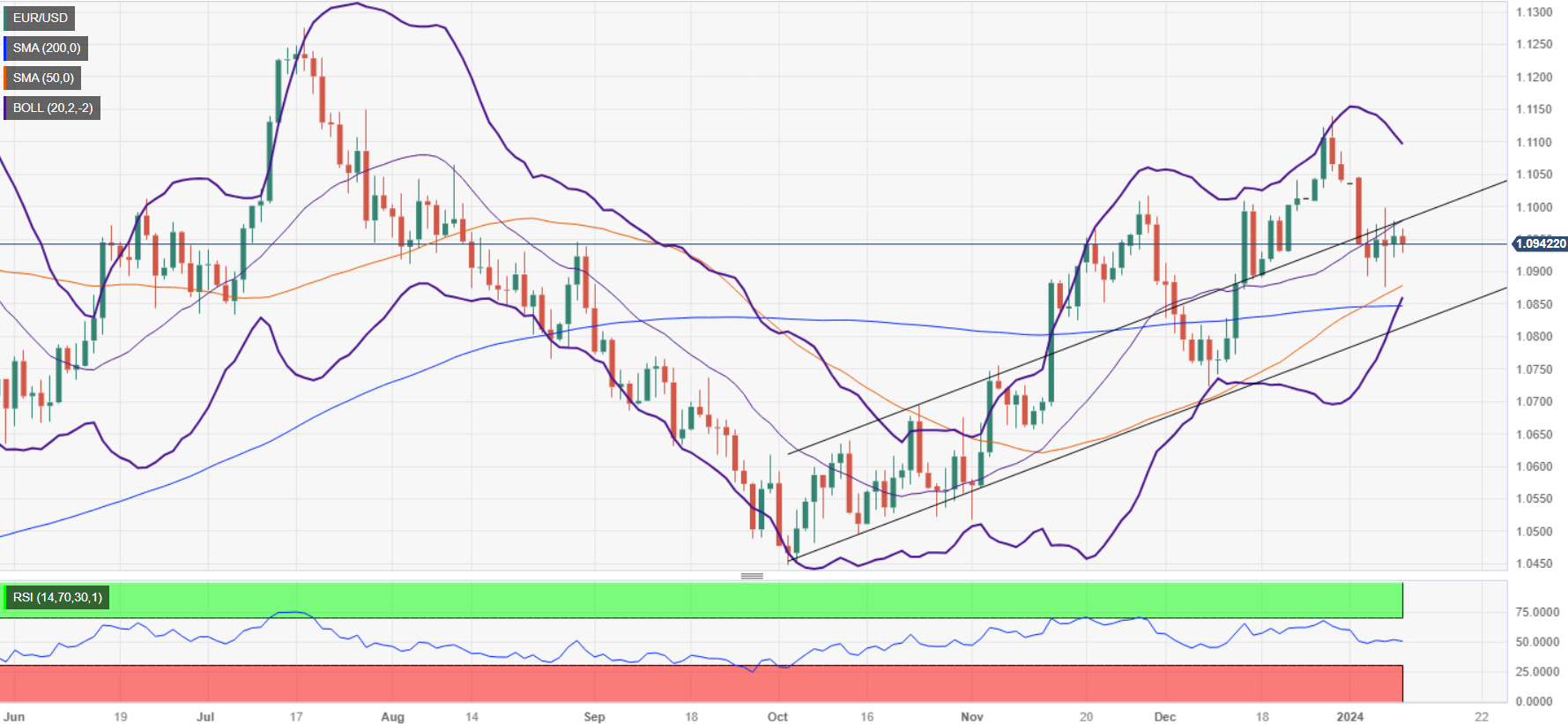
EUR/USD Price Analysis: Technical outlook
The major is trading sideways; even though a ‘golden cross’ in the daily chart would support a bullish scenario, buyers had remained unable to crack toward the 1.1000 figure. If bulls move in, they must reclaim Tuesday’s high of 1.0966 to test 1.1000. Further upside lies above a two-and-a-half-year resistance trendline at around 1.1030/50, followed by the 1.1100 figure. Conversely, if sellers step in around 1.0950 and drag prices towards the 1.0900 figure, that could pave the way to test the 50-day moving average (DMA) at 1.0877, followed by the 200-DMA at 1.0846.
Author

Christian Borjon Valencia
FXStreet
Markets analyst, news editor, and trading instructor with over 14 years of experience across FX, commodities, US equity indices, and global macro markets.

















