EUR/USD sinks to 2-month lows near 1.1940
- EUR/USD collapses to multi-week lows around 1.1940.
- The dollar keeps the buying pressure well and sound pos-FOMC.
- Final EMU CPI rose 2.0% YoY, Core CPI rose 1.0% YoY in May.

The selling bias intensifies around the European currency and drags EUR/USD to new 2-month lows in the 1.1940 region on Thursday.
EUR/USD much weaker after Fed meeting
EUR/USD tumbles to multi-week lows and already sheds around 1.50% since pre-FOMC hours on Wednesday, trading in levels last seen in mid-April.
In fact, the sharp leg lower in the pair was triggered by the unexpected shift from the Federal Reserve at its gathering on Wednesday. Indeed, the Committee now sees an interest rate hike by end of 2023, although it reiterated that current higher inflation remains temporary and is forecast to come back to the Fed’s 2% goal next year.
EUR/USD then broke below the consolidative phase seen in past sessions, as cautiousness was prevailing ahead of the Fed event. In the meantime, the optimism around the recovery in Europe on the back of the solid pace of the vaccine rollout continues to support the view of a strong rebound in the second half of the year.
Data wise in the region, final May inflation figures in Euroland noted the headline CPI rose 2.0% and the Core gauge rose 1.0% from a year earlier.
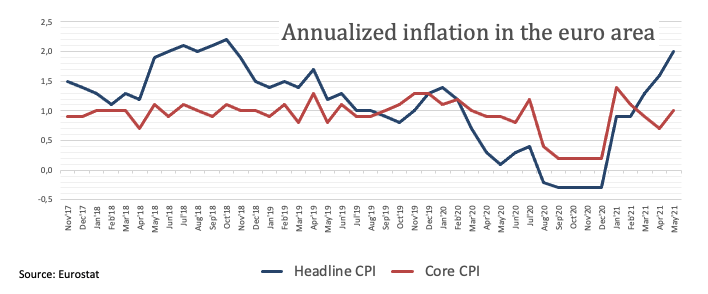
Across the pond, Initial Claims are up seconded by the Philly Fed index and the testimony by Treasury Secretary J.Yellen.
What to look for around EUR
EUR/USD plummets to fresh levels well south of the 1.2000 mark on Thursday, always in response to the investors’ shift to the greenback, exclusively following the FOMC event on Wednesday. In the meantime, support for the European currency comes in the form of auspicious results from fundamentals in the bloc coupled with higher morale, prospects of a strong rebound in the economic activity and the investors’ appetite for riskier assets.
Key events in the euro area this week: Final May Core CPI (Thursday).
Eminent issues on the back boiler: Asymmetric economic recovery in the region. Sustainability of the pick-up in inflation figures. Progress of the vaccine rollout. Probable political effervescence around the EU Recovery Fund. German elections. Investors’ shift to European equities.
EUR/USD levels to watch
So far, spot is losing 0.35% at 1.1951 and a breakdown of 1.1936 (monthly low Jun.17) would target 1.1887 (61.80% Fibo retracement of the November-January rally) en route to 1.1835 (low Mar.9). On the flip side, the next hurdle lines up at 1.2037 (100-day SMA) followed by 1.2064 (38.2% Fibo retracement of the November-January rally) and finally 1.2101 (weekly high Jun.15).
Author

Pablo Piovano
FXStreet
Born and bred in Argentina, Pablo has been carrying on with his passion for FX markets and trading since his first college years.