EUR/USD remains subdued as US Dollar recovers Fed-induced losses
- EUR/USD comes down slightly to 1.0740 as the US Dollar rises amid a light US economic calendar.
- The ECB is expected to opt for cutting interest rates in June.
- Fed’s Kashkari sees no rate cuts this year due to the strong housing market.

EUR/USD is slightly down to 1.0740 in Wednesday’s early American session. The major currency pair drops as the US Dollar rises as comments from central bank officials become the main market movers in the absence of top-tier economic data in the Eurozone and the United States. Also, dismal market mood has weighed on the Euro. The opening of the S&P 500 on a bearish note, suggests a decline in investors' risk appetite.
Investors underpinned the Euro against the US Dollar in the past few trading sessions as speculation for the Federal Reserve (Fed) pivoting to interest-rate cuts strengthened due to weak US economic data. However, the Euro struggles to hold strength amid firm expectations that the European Central Bank (ECB) will cut rates before the Fed.
Financial markets see the ECB starting to cut interest rates from the June meeting. Price pressures in the Eurozone economy are on course to return to the 2% target, and service inflation started softening after remaining steady at 4.0% for straight five months. A slew of ECB policymakers remain comfortable with interest rates coming down from June, provided there are no surprises. Also, the ECB is expected to cut interest rates three times this year, more than the Fed, which will widen the policy divergence between both central banks.
Contrary to majority of ECB policymakers which agreed to initiating the rate-cut cycle from June, policymaker Robert Holzmann said in Wednesday's early New York session that he doesn't see a reason to cut key interest rates "too quickly or too strongly," Reuters reported.
Daily digest market movers: EUR/USD is slightly down as US Dollar moves higher
- EUR/USD comes under pressure as the US Dollar rebounds, recovering losses inspired by the Federal Reserve’s less hawkish guidance on interest rates than feared and weak US economic data for April. The US Dollar Index (DXY), which tracks the Greenback’s value against six major currencies, advances to 105.60.
- Last week, Fed Chair Jerome Powell said after the monetary policy meeting that further policy tightening is not in the picture. His comments signalled that he continues to lean towards rate cuts this year. However, Powell acknowledged that progress in the disinflation process appears to be stalling.
- The US Nonfarm Payrolls (NFP) report for April showed that fewer jobs were added in April, and the Unemployment Rate rose to 3.9%. Average Earnings slowed more than expected, which pointed to a softening inflation outlook. The Services PMI fell below the 50.0 threshold, which separates expansion from contraction. The service sector's output fell to 49.4, missing estimates of 52.0 by a wide margin.
- Contrary to Powell’s intent of remaining hopeful for rate cuts, Minneapolis Federal Reserve (Fed) Bank President Neel Kashkari said on Tuesday that he sees interest rates remaining at their current levels for the entire year. Stalling progress in the disinflation process due to the strong housing market turned Kashkari hawkish on the interest rate outlook.
- The impact of Kashkari’s hawkish guidance on interest rates on speculation for the Fed to start reducing interest rates from the September meeting is expected to remain subdued as he is a non-voting member until 2026. The CME FedWatch tool shows that there is a 65% chance for interest rates to reduce from their current levels in September. The probability of the Fed lowering rates in September has increased from the 53% recorded a week ago.
Technical Analysis: EUR/USD consolidates around 1.0750
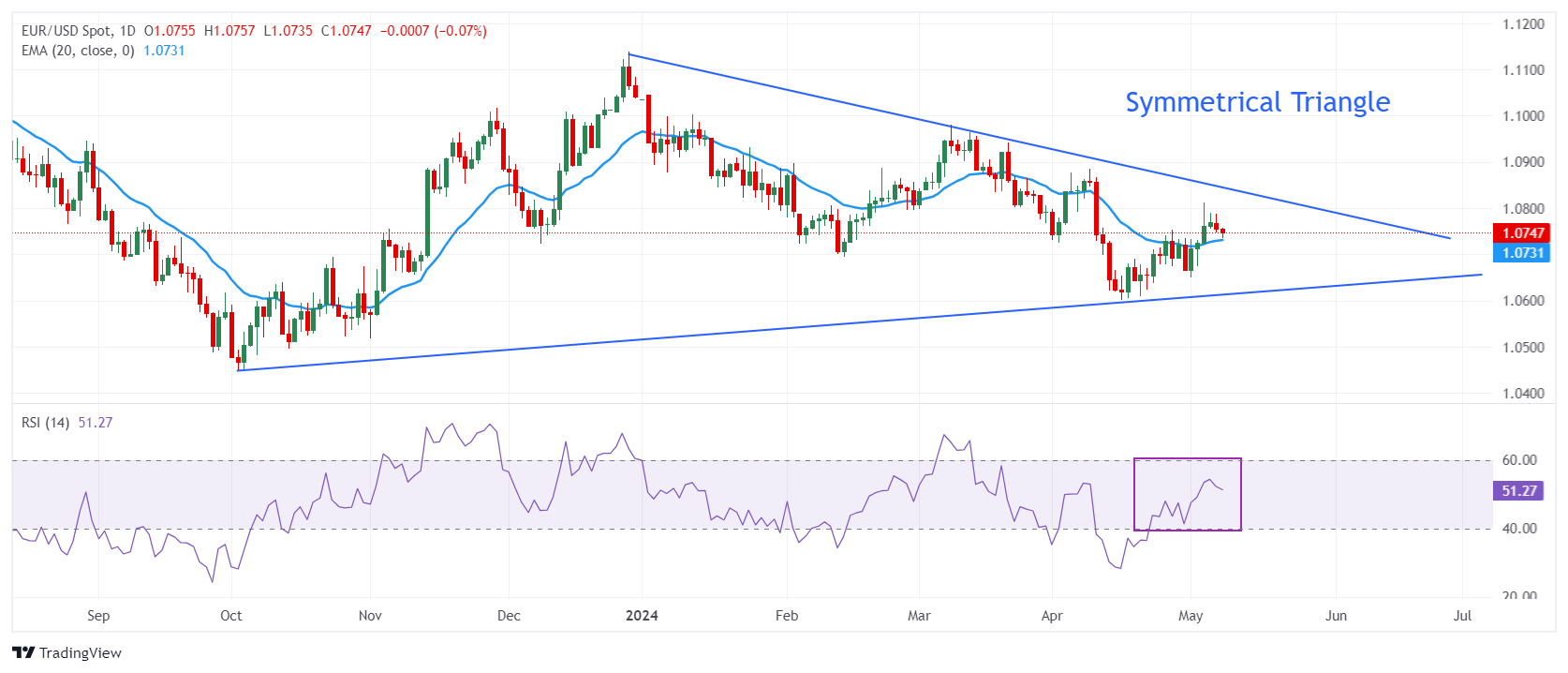
EUR/USD falls after failing to recapture the round-level resistance of 1.0800. The shared currency pair exhibits a sharp volatility contraction due to a Symmetrical Triangle formation on the daily time frame. The upward-sloping border of the triangle pattern is plotted from the October 3 low at 1.0448, and the downward-sloping border is placed from the December 28 high around 1.1140.
The 14-period Relative Strength Index (RSI) oscillates inside the 40.00-60.00 range, suggesting indecisiveness among market participants.
The asset trades above the 20-day Exponential Moving Average (EMA) near 1.0723, suggesting that the near-term outlook is bullish.
Euro FAQs
The Euro is the currency for the 20 European Union countries that belong to the Eurozone. It is the second most heavily traded currency in the world behind the US Dollar. In 2022, it accounted for 31% of all foreign exchange transactions, with an average daily turnover of over $2.2 trillion a day. EUR/USD is the most heavily traded currency pair in the world, accounting for an estimated 30% off all transactions, followed by EUR/JPY (4%), EUR/GBP (3%) and EUR/AUD (2%).
The European Central Bank (ECB) in Frankfurt, Germany, is the reserve bank for the Eurozone. The ECB sets interest rates and manages monetary policy. The ECB’s primary mandate is to maintain price stability, which means either controlling inflation or stimulating growth. Its primary tool is the raising or lowering of interest rates. Relatively high interest rates – or the expectation of higher rates – will usually benefit the Euro and vice versa. The ECB Governing Council makes monetary policy decisions at meetings held eight times a year. Decisions are made by heads of the Eurozone national banks and six permanent members, including the President of the ECB, Christine Lagarde.
Eurozone inflation data, measured by the Harmonized Index of Consumer Prices (HICP), is an important econometric for the Euro. If inflation rises more than expected, especially if above the ECB’s 2% target, it obliges the ECB to raise interest rates to bring it back under control. Relatively high interest rates compared to its counterparts will usually benefit the Euro, as it makes the region more attractive as a place for global investors to park their money.
Data releases gauge the health of the economy and can impact on the Euro. Indicators such as GDP, Manufacturing and Services PMIs, employment, and consumer sentiment surveys can all influence the direction of the single currency. A strong economy is good for the Euro. Not only does it attract more foreign investment but it may encourage the ECB to put up interest rates, which will directly strengthen the Euro. Otherwise, if economic data is weak, the Euro is likely to fall. Economic data for the four largest economies in the euro area (Germany, France, Italy and Spain) are especially significant, as they account for 75% of the Eurozone’s economy.
Another significant data release for the Euro is the Trade Balance. This indicator measures the difference between what a country earns from its exports and what it spends on imports over a given period. If a country produces highly sought after exports then its currency will gain in value purely from the extra demand created from foreign buyers seeking to purchase these goods. Therefore, a positive net Trade Balance strengthens a currency and vice versa for a negative balance.
Author

Sagar Dua
FXStreet
Sagar Dua is associated with the financial markets from his college days. Along with pursuing post-graduation in Commerce in 2014, he started his markets training with chart analysis.

















