EUR/USD ends NFP Friday near where it started after rejection from 1.1000
- EUR/USD whipped in hectic Friday action following Eurozone inflation, US labor data.
- European inflation continues to hamper the ECB, while US jobs data beat the street.
- EUR/USD wraps up the week near 1.0940.

The EUR/USD fell to a three-week low on Friday after European inflation rebounded higher in December, with the Eurozone Harmonized Index of Consumer Prices (HICP) for the year ended December climbing to 2.9% versus November’s YoY 2.4%. Markets were expecting a print of 3.0%, but higher inflation of any amount reduces the chances of the European Central Bank (ECB) cutting interest rates to reduce borrowing and lending costs.
After an inflation-fueled decline, the EUR/USD promptly rallied to a three-day high at the 1.1000 handle after US Nonfarm Payrolls (NFP) handily beat the street, adding 216K net new jobs to the US labor market in December versus the forecast 170K. US Average Hourly Earnings also climbed to 4.1% for the year through December, beating the forecast downtick to 3.9% and pushing slightly above November’s YoY 4.0% print.
US NFP surge hampers rate cut hopes
A firming-up US labor market threw cold water on market expectations of rate cuts, with the Federal Reserve (Fed) less likely to rush to cut rates as long as the US domestic economy continues to push towards stable growth and avert a potential recession in 2024. Money markets were pricing in a 90% chance of a rate cut from the Fed as soon as the US central bank’s meeting in March, but the NFP beat has sent those odds tumbling to around 60%.
Despite the firm labour beat, the US ISM Services Purchasing Managers’ Index (PMI) for December declined much further than expected, printing at 50.6 versus the forecast 52.6 and extending a slide from November’s 52.7 to close at a seven-month low.
Data revisions are also plaguing official labor figures, with the November NFP getting steeply revised lower from 199K to 173K, and October’s NFP print seeing further revisions down to 105K from 150K.
Next week kicks off with European Retail Sales as well as a slew of confidence and sentiment readings across consumers, manufacturers, and industrial sector participants. US data will remain thin until next Thursday’s US Consumer Price Index (CPI), with the headline annualized US CPI expected to tick upwards from 3.1% to 3.2%.
EUR/USD Technical Outlook
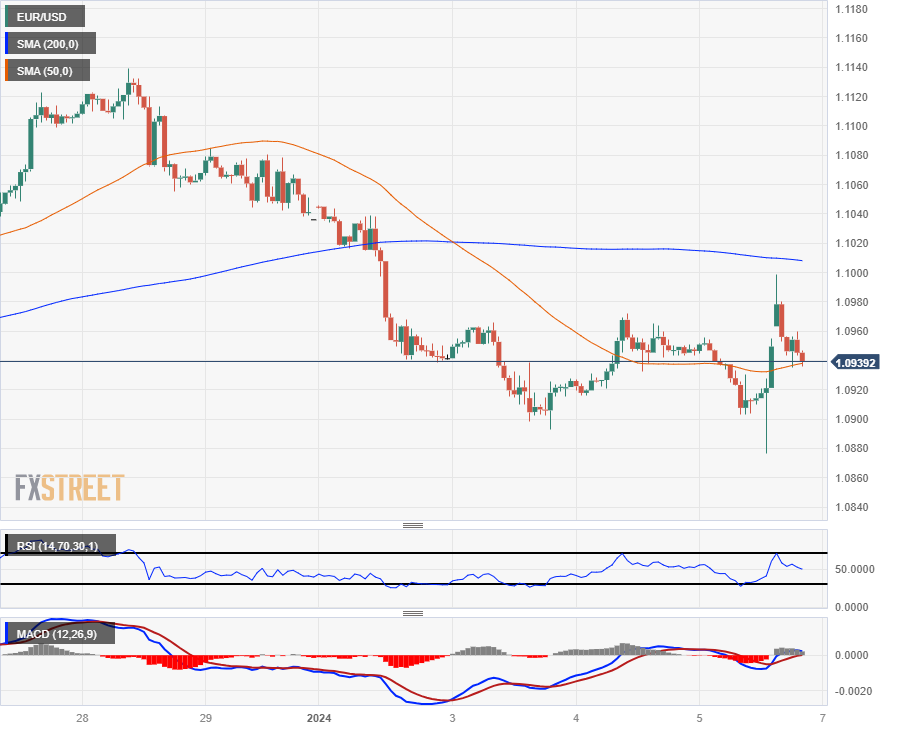
Despite the EUR/USD’s late break higher on Friday, the pair remains capped underneath the 200-hour Simple Moving Average (SMA) just above the 1.1000 major handle, with the EUR/USD bidding into the consolidation zone between the 200-hour SMA and the 50-hour SMA near 1.0940 as the back half of the trading week’s action drifts back into median prices.
Monday’s early decline from the 1.1040 region saw the EUR/USD weaken before grinding flat heading through Wednesday’s trading, and 1.0900 is baked in as a near-term technical barrier for further downside.
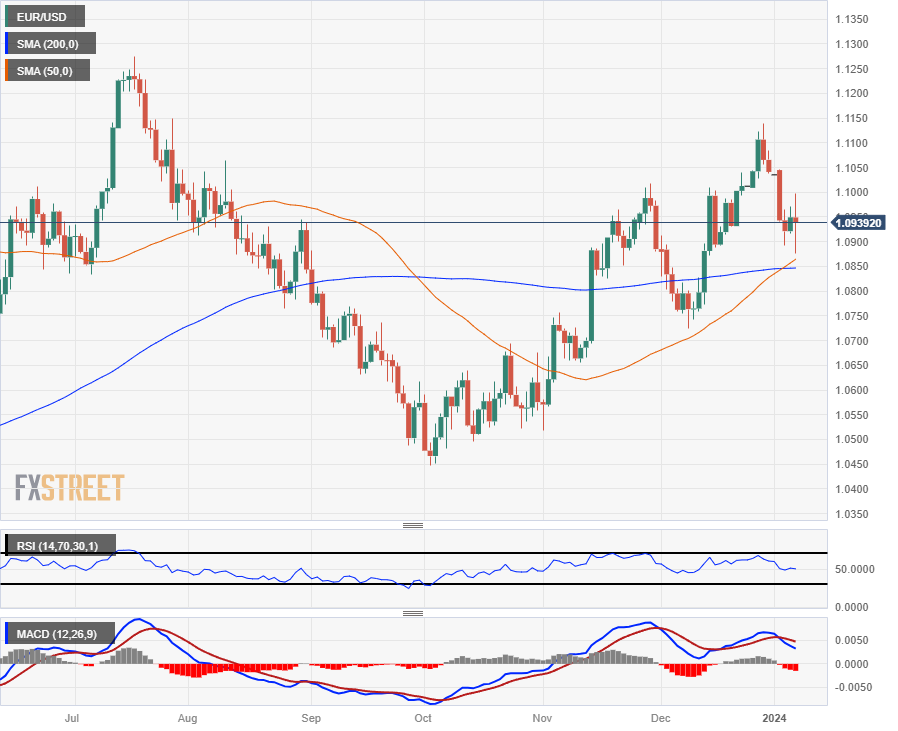
Daily candlesticks have the EUR/USD consolidating just above a bullish cross of the 50-day and 200-day SMAs near 1.0850, and bidders will be looking to capitalize on the technical confluence to gather momentum for another run at December’s peak near 1.1140.
EUR/USD Hourly Chart
EUR/USD Daily Chart
EUR/USD Technical Levels
Author

Joshua Gibson
FXStreet
Joshua joins the FXStreet team as an Economics and Finance double major from Vancouver Island University with twelve years' experience as an independent trader focusing on technical analysis.