|

EUR/USD clinches fresh tops around 1.2300

  • EUR/USD remains firm and tests the 1.2300 yardstick.
  • The selling bias around the greenback fuels the upside.
  • German, EMU Manufacturing PMI remained robust in December.
The upside momentum in the single currency remains well and sound at the beginning of the new year and pushes EUR/USD to fresh tops in the 1.2300 neighbourhood.

EUR/USD underpinned by risk-on mood

EUR/USD trades on a firm note in the first session of 2021 and approaches the key barrier at the 1.2300 mark against the backdrop of the continuation of the sell-off in the dollar.

Indeed, investors continue to favour the riskier assets amidst solid prospects of a sharp economic rebound this year. This view remains sustained by the looser stance of many G10 central banks and rising hopes following the vaccine rollout.

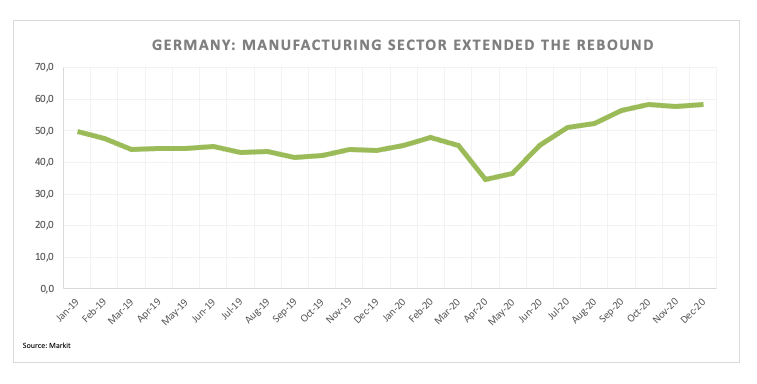
Data wise in Euroland, the final December Manufacturing PMI came in a tad lower than the preliminary reading at 55.2, while the German gauge followed suit at 58.3 vs. 58.6 from the advanced data.
What to look for around EUR

The upside momentum in EUR/USD regains fresh oxygen at the beginning of 2021 and is now refocused on the 1.2300 mark. So far, EUR/USD appears supported by prospects of a strong recovery in the region (and abroad) along with extra fiscal stimulus in the US as well as the accommodative stance from the ECB.

EUR/USD levels to watch

At the moment, the pair is gaining 0.68% at 1.2298 and a breakout of 1.2310 (2020 high Dec.30) would target 1.2413 (monthly high Apr.17 2018) en route to 1.2476 (monthly high Mar.27 2018). On the other hand, the next support emerges at 1.2129 (weekly low Dec.21) seconded by 1.2058 (weekly low Dec.9) and finally 1.2032 (23.6% Fibo of the 2017-2018 rally).

Author

Pablo Piovano

Born and bred in Argentina, Pablo has been carrying on with his passion for FX markets and trading since his first college years.


More from Pablo Piovano
Share:

Editor's Picks

EUR/USD onsolidates around mid-1.1800s as traders keenly await FOMC Minutes

The EUR/USD pair struggles to capitalize on the previous day's goodish rebound from the 1.1800 neighborhood, or a one-and-a-half-week low, and consolidates in a narrow band during the Asian session on Wednesday. Spot prices currently trade just below mid-1.1800s, nearly unchanged for the day.

GBP/USD bounces off lows, retargets 1.3550

After bottoming out just below the 1.3500 yardstick, GBP/USD now gathers some fresh bids and advances to the 1.3530-1.3540 band in the latter part of Tuesday’s session. Cable’s recovery comes as the Greenback surrenders part of its advance, although it keeps the bullish bias well in place for the day.

Gold bounces back toward $4,900, looks to FOMC Minutes

Gold is attempting a bounce from the $4,850 level, having touched a one-week low on Tuesday. Signs of progress in US–Iran talks dented demand for the traditional safe-haven bullion, weighing on Gold in early trades. However, rising bets for more Fed rate cuts keep the US Dollar bulls on the defensive and act as a tailwind for the non-yielding yellow metal. Traders now seem reluctant ahead of the FOMC Minutes, which would offer cues about the Fed's rate-cut path and provide some meaningful impetus.

DeFi could lift crypto market from current bear phase: Bitwise

Bitwise Chief Investment Officer Matt Hougan hinted that the decentralized finance sector could lead the crypto market out of the current bear phase, citing Aave Labs’ latest community proposal as a potential signal of good things to come.

UK jobs market weakens, bolstering rate cut hopes

In the UK, the latest jobs report made for difficult reading. Nonetheless, this represents yet another reminder for the Bank of England that they need to act swiftly given the collapse in inflation expected over the coming months. 

Ripple slides to $1.45 as downside risks surge

Ripple edges lower at the time of writing on Tuesday, from the daily open of $1.48, as headwinds persist across the crypto market. A short-term support is emerging at $1.45, but a buildup of bearish positions could further weaken the derivatives market and prolong the correction.