EUR/USD climbs sharply despite strong US PMIs, ahead of ECB’s decision
- EUR/USD gains momentum, , fueled by falling US Treasury yields and significant options expiry, despite mixed business activity in the EU.
- EU business activity remains in contraction, with the HCOB Composite PMI slightly improving but still in recessionary territory, reflecting challenges in demand and rising prices.
- US business activity surprisingly expanded, portraying a solid economy, a headwind for EUR/USD.

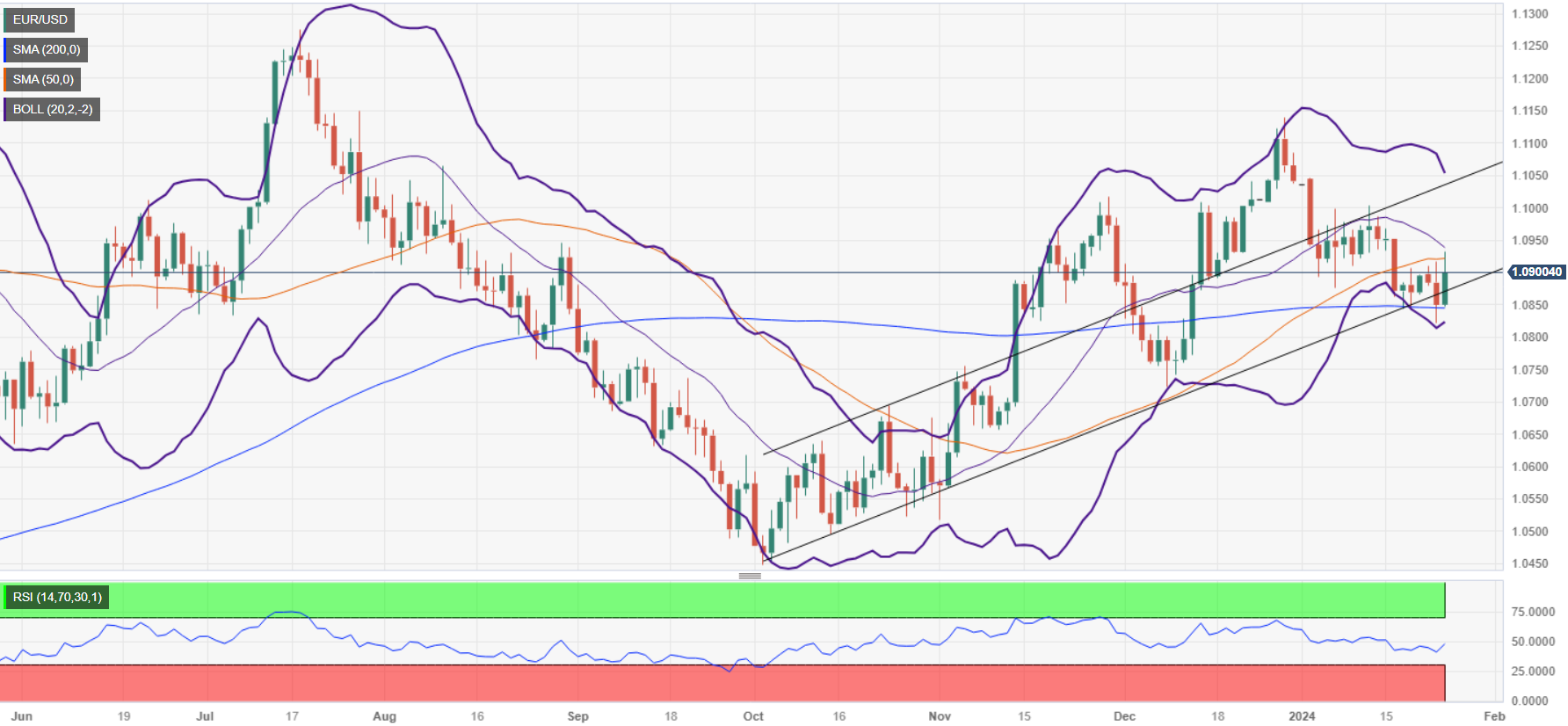
The EUR/USD resumed its uptrend on Wednesday amid the lack of a catalyst. Even though business activity improved in the Eurozone (EU), it is not the main reason behind the major’s advance. Falling US Treasury yields and a large option expiring on Thursday at 10:00 AM ET of 2.1 billion Euros linked to the major at around 1.0900 sponsored an uptick toward a daily high of 1.0932. At the time of writing, the EUR/USD trades at 1.0900, up 0.43%.
Divergence in business activity between the US and the EU, favors EUR/USD’s downside
Data-wise, business activity in the EU remained in contractionary territory as the HCOB Composite PMI, which encompasses the Services and Manufacturing PMIs, rose by 47.9 in January from December’s 47.6. However, it remained in recessionary territory for the eighth straight month. The report revealed that demand is falling, while prices rose courtesy of tensions in the Red Sea.
Across the pond, at around 14:45 GMT, S&P Global revealed that business activity in the US economy is picking up while prices abated. The US Flash Composite PMI rose to 52.3 its highest since June 2023, while the Services PMI expanded by 52.9 from 51.4. Meanwhile, manufacturing activity was the largest contributor to the composite index, which rebounded from 47.9 to 50.4, crushing estimates of 47.9.
S&P Global Chief Business Economist Chris Williamson said, “With the survey indicating that supply delays have intensified while labor markets remain tight, cost pressures will need to be monitored closely in the coming months, but for now, the survey sends a clear and welcome message of resilient economic growth and sharply waning inflation.”
The latest US Flash PMI report and last week’s data suggest the US economy remains solid and could deter the Federal Reserve (Fed) from easing policy, as the risks for inflation remain tilted to the upside. Next in the US economic docket are the Gross Domestic Product (GDP) report release, the Core Personal Consumption Expenditures (PCE) Price Index, Durable Goods Orders, and the unemployment claims.
On the Eurozone, the European Central Bank (ECB) monetary policy decision is awaited, followed by ECB’s President Christine Lagarde's press conference.
EUR/USD Price Analysis: Technical outlook
The EUR/USD dipped and formed a ‘bearish engulfing’ chart pattern, which is being invalidated by a leg-up that has breached the 50-day moving average at 1.0922 and tests the 61.8% Fibonacci retracement at 1.0931. A daily close above those two levels would expose the January 16 high at 1.0951, followed by the January 11 cycle high at 1.0999.
On the other hand, if prices tumble toward the 1.0900 figure, dropping beneath that, bears would regain control and could drag the pair below the 200-DMA at 1.0844, followed by a January 23 low of 1.0821 ahead of the 1.0800 figure.
Author

Christian Borjon Valencia
FXStreet
Markets analyst, news editor, and trading instructor with over 14 years of experience across FX, commodities, US equity indices, and global macro markets.