EUR/USD climbs due to US jobs data, despite EU’s recession
- US Initial Jobless Claims surge, sparking EUR/USD rally, Treasury yield slump.
- Technical recession in Eurozone overshadowed by hawkish ECB signals.
- Traders eye June 13 US inflation data, FOMC meeting.

EUR/USD soars sharply past the 1.0750 area on Thursday after less stellar jobs data in the United States (US) weakened the US Dollar (USD). That said, the EUR/USD is trading at around 1.0770s after hitting a daily low of 1.0692.
Euro thrives as US Dollar sags weight of soaring jobless claims.
Before Wall Street opened, the EUR/USD climbed on the back of data the US Bureau of Labor Statistics (BLS) revealed. Initial Jobless Claims for the week ending June 3 rose by 261K, up from 232K foreseen by analysts, the highest level since October 2021. That adds to an outstanding Nonfarm Payrolls report last Friday, which showed the economy created 339K jobs, but the rise in the Unemployment Rate was a prelude to the previous week’s data.
EUR/USD reacted upwards, while US Treasury bond yields exerted downward pressure on the greenback. The US 10-year benchmark note rate tumbled seven and a half basis points so far, down at 3.20%, as traders remain optimistic the Federal Reserve (Fed) will not hike rates at the June meeting. The CME FedWatch Tool odds for a 25 bps increase in June are 52%, up from yesterday’s 50.9%.
The US Dollar Index, which measures the performance of a basket of six currencies vs. the buck, collapses by 0.73% at 103.345.
Across the pond, the Eurozone (EU) economy fell into a technical recession, according to Q1 2023, with the Gross Domestic Product (GDP) sliding 0.1% QoQ, unchanged compared to last year’s Q4. On year-over-year data, the EU’s economy slowed to 1% from 1.2% consensus, below the latest quarter of 2022 reading of 1.8%.
Despite the report, recent hawkish commentary by European Central Bank (ECB) officials led by its President Christine Lagarde keeps traders eyeing a 25 bps hike in June and July. Klas Knot, the President of the Dutch central bank and ECB member commented on Wednesday that at least two more walks are needed, and then the ECB could become data-dependent.
Upcoming events
The EU’s agenda will feature the ECB Vice President Luis de Guindos on Friday. The US calendar is empty, with traders eyeing Tuesday, June 13, with the release of inflation data, alongside the beginning of the FOMC’s meeting.
EUR/USD Price Analysis: Technical outlook
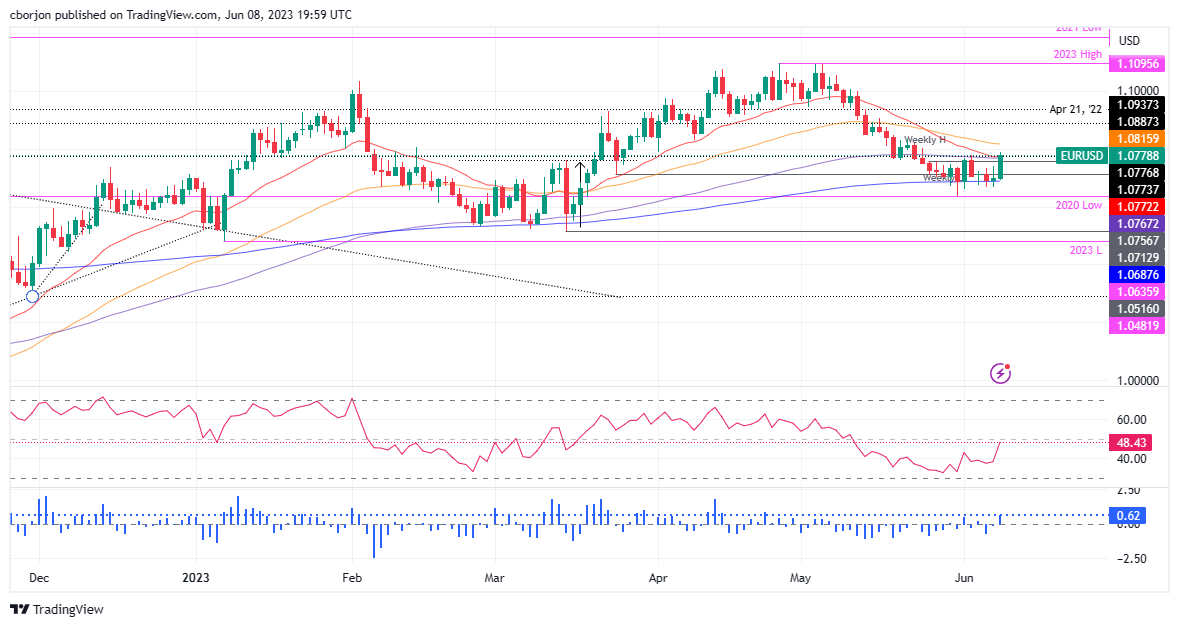
The EUR/USD has resumed its upward trajectory after trading sideways for the last nine days. On its way north, the pair claimed the 20-day Exponential Moving Average (EMA) at 1.0772, though they remain shy of cracking the 1.0800 mark. Although the Relative Strength Index (RSI) is about to cross over its bullish area, downside risks remain. If the RSI’s aiming north, the EUR/USD could test the 1.0800 figure, followed by the 50-day EMA at 1.0816. On the flip side, if the RSI shifts downward, the major could drop towards its weekly lows of 1.0660s but firstly must fall below 1.0700.
Author

Christian Borjon Valencia
FXStreet
Markets analyst, news editor, and trading instructor with over 14 years of experience across FX, commodities, US equity indices, and global macro markets.