EUR/SEK challenging weekly lows around 10.5800
- EUR/SEK comes under selling pressure near 10.5800.
- Sweden CPI disappointed for the month of June.
- Riksbank still seen raising rates by year-end.

The Swedish Krona is extending the appreciation vs. its European peer on Thursday and is dragging EUR/SEK to week lows in the 10.5800 zone.
EUR/SEK offered despite poor CPI
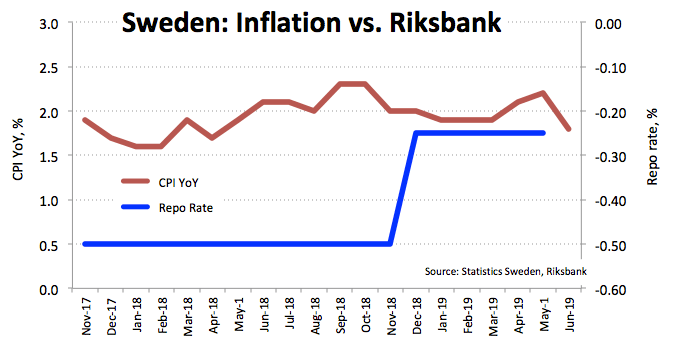
SEK remains bid in spite of today’s lacklustre results from domestic inflation figures in June. In fact, consumer prices tracked by the CPI contracted at a monthly 0.1% and rose 1.8% from a year earlier. In addition, prices measured by the CPIF (CPI at constant interest rates) also dropped 0.1% inter-month and gained 1.7% over the last twelve months
The knee-jerk in the CPI was in response to lower energy (electricity) prices from a year earlier, although the results appear to have been largely anticipated by the Riksbank.
In this regard, the Scandinavian central bank continues to consider the probability of a rate hike at some point by end of 2019, although the next steps by the ECB and the impact of developments from the trade front on the Nordic small economy carries the potential to alter that scenario.
What to look for around SEK
The Krona has reclaimed some ground lost after monthly lows near 10.6400 vs. the shared currency. June’s lower-than-expected inflation figures are unlikely to be a game changer for the Riksbank vs. its plans of tightening the monetary conditions later in the year. However, this view is most likely to be challenged in the medium term amidst the recent shift from the majority of G10 central banks to a more accommodative stance, particularly from the ECB, which the Riksbank monitors closely.
EUR/SEK levels to consider
As of writing the cross is losing 0.14% at 10.5123 and faces the next support at 10.4869 (low Jul.3) seconded by 10.4453 (200-day SMA) and finally 10.4018 (61.8% Fibo of the 2019 up move). On the flip side, a break above 10.7167 (high Jun.12) would aim for 10.8008 (high May 21) and then 10.8498 (2019 high May 13).
Author
Pablo Piovano
FXStreet
Born and bred in Argentina, Pablo has been carrying on with his passion for FX markets and trading since his first college years.