|

EUR/JPY Price Analysis: Refreshes multi-month top around mid-132.00s

  • EUR/JPY takes the bids to fresh high in 32 months.
  • Upbeat MACD, sustained trading beyond 200-SMA favor buyers.
  • Rising wedge resistance, September 2018 top test upside momentum.

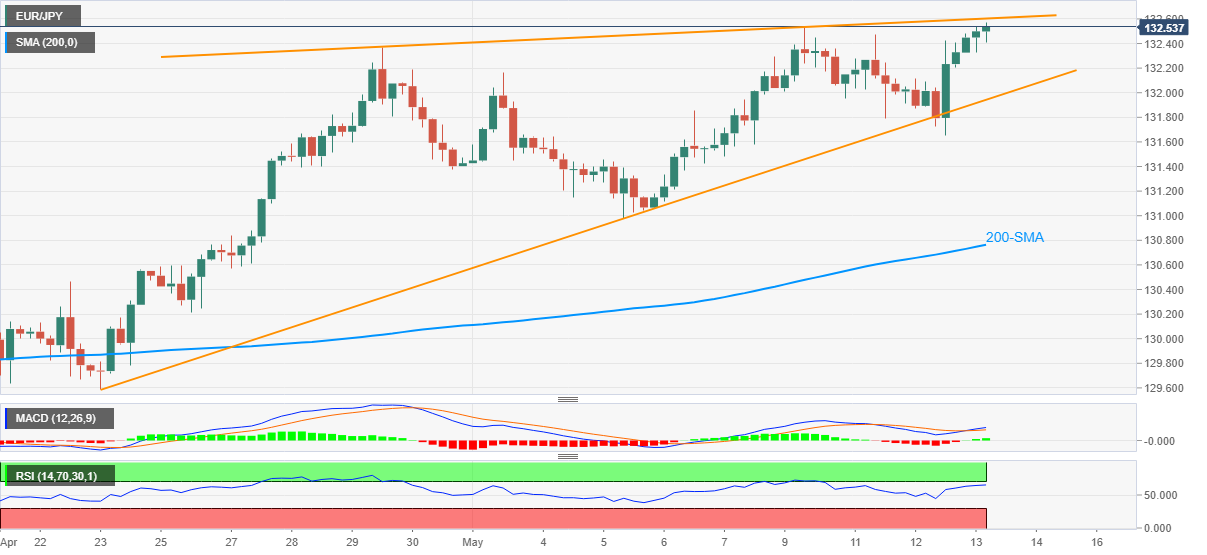
EUR/JPY rises to a fresh high since September 2018 while picking up the bids near 132.55, up 0.10% intraday, during early Thursday.

Although bullish MACD and the pair’s ability to stay firm beyond 200-SMA keep EUR/JPY buyers hopeful, a rising wedge bearish formation on the four-hour (4H) chart joins RSI’s run-up towards the overbought territory to challenges the upside.

Hence, the pair’s moves between 132.60 and 131.90, comprising the stated wedge’s extremes, seem less important. Also acting as the upside barriers are highest marked in September and April months of 2018, respectively around 133.15 and 133.50.

Meanwhile, a downside break of 131.90 will have to conquer the 200-SMA level close to 130.75 before directing EUR/JPY bears toward the theoretical target near 129.00.

During the fall, the monthly low near 131.00 and late April bottom close to 129.60 may act as intermediate halts.

EUR/JPY four-hour chart
Trend: Pullback expected

Additional important levels

Overview
Today last price132.51
Today Daily Change0.11
Today Daily Change %0.08%
Today daily open132.4
 
Trends
Daily SMA20131.13
Daily SMA50130.29
Daily SMA100128.61
Daily SMA200126.62
 
Levels
Previous Daily High132.48
Previous Daily Low131.65
Previous Weekly High132.29
Previous Weekly Low130.98
Previous Monthly High132.37
Previous Monthly Low129.57
Daily Fibonacci 38.2%132.16
Daily Fibonacci 61.8%131.97
Daily Pivot Point S1131.88
Daily Pivot Point S2131.35
Daily Pivot Point S3131.05
Daily Pivot Point R1132.7
Daily Pivot Point R2133
Daily Pivot Point R3133.53

Author

Anil Panchal

Anil Panchal

FXStreet

Anil Panchal has nearly 15 years of experience in tracking financial markets. With a keen interest in macroeconomics, Anil aptly tracks global news/updates and stays well-informed about the global financial moves and their implications.


More from Anil Panchal
Share:

Editor's Picks

AUD/USD recovers toward 0.7000 amid improving mood

AUD/USD is firming up toward 0.7000 in Asia on Tuesday, helped by improving market mood. A pause in the US Dollar rebound also aids the pair's upside. However, geopolitical risks and caution ahead of AI tech earnings report could limit the pair.

USD/JPY flatlines near 158.50 as markets seek direction

USD/JPY steadies around 158.50 in the Asian trading hours on Tuesday. Traders prefer to wait on the sidelines ahead of Japan’s National Consumer Price Index inflation data later on Friday. Meanwhile, elevated US bond yields provide some support to the US Dollar against the Japanese Yen.

Gold extends losses as rising Oil prices reinforce Fed rate hike bets

Gold (XAU/USD) drifts lower on Tuesday, extending losses for a third consecutive day as rising Oil prices linked to tensions in the Middle East keep global inflation risks tilted to the upside, reinforcing expectations that interest rates will remain higher for longer.

Crypto Today: Bitcoin, Ethereum, XRP tick lower amid mixed ETF flows

Bitcoin is trading above $81,000 on Tuesday, aligning with a lethargic tone in the broader cryptocurrency market. Altcoins, including Ethereum and Ripple, reflect Bitcoin’s lock-step price action, trading below $2,400 and $1.30, respectively.

Markets at a turning point: Bitcoin, Gold, FX and Tech react to a heavy macro week

The new trading week opens with a mixed but revealing picture across global markets. Indices, commodities, FX, tech stocks, and cryptocurrencies are all sending one message: risk appetite is alive, but it is cautious, selective, and highly sensitive to macro signals.

The US Dollar fell. Gold didn't rally. That tells you everything
Gold (XAU/USD) is struggling to capitalize on a weaker US Dollar (USD), after repeatedly failing to establish itself above the $4,200 level. The precious metal remains confined to a relatively narrow trading range despite a combination of developments that would normally support higher prices.