|

EUR/JPY hits fifteen-year high, 164.00 on deck

  • The EUR/JPY is trading into its highest bids since 2008, inches away from 164.00.
  • A rebound in broad market sentiment is sending safe havens firmly lower on Tuesday.
  • Up Next: Japan GDP in early Wednesday session.

The EUR/JPY has hit its highest prices since 2008, a fifteen-year high for the pair as the safe haven Japanese Yen (JPY) falls back against the Euro (EUR). A broad market recovery in risk appetite fueled by a worse-than-expected US Consumer Price Index (CPI) printing is giving investors renewed hopes that inflation could be receding faster than the Federal Reserve (Fed) expects, meaning the US central bank could be pushed towards rate cuts sooner than expected.

Pan-EU Gross Domestic Product (GDP) printed exactly as expected early Tuesday, with the quarter-on-quarter figure coming in at -0.1%. The annualized number printed steady at 0.1%.

The ZEW Economic Sentiment Survey for November improved appreciably, printing at 13.8 against October's 2.3.

The early Wednesday trading session sees Japanese GDP figures, and the QoQ figure is expected to decline from 1.2% to a -0.1% contraction.

Japanese Yen price today

The table below shows the percentage change of Japanese Yen (JPY) against listed major currencies today. Japanese Yen was the weakest against the New Zealand Dollar.

 USDEURGBPCADAUDJPYNZDCHF
USD -1.57%-1.68%-0.68%-1.86%-0.74%-1.96%-1.32%
EUR1.55% -0.11%0.88%-0.28%0.82%-0.38%0.25%
GBP1.65%0.10% 0.98%-0.18%0.92%-0.29%0.36%
CAD0.66%-0.90%-1.01% -1.18%-0.09%-1.29%-0.63%
AUD1.83%0.27%0.17%1.16% 1.09%-0.11%0.53%
JPY0.74%-0.82%-0.92%0.07%-1.11% -1.19%-0.57%
NZD1.93%0.38%0.28%1.29%0.12%1.18% 0.62%
CHF1.30%-0.25%-0.36%0.65%-0.52%0.57%-0.64% 

The heat map shows percentage changes of major currencies against each other. The base currency is picked from the left column, while the quote currency is picked from the top row. For example, if you pick the Euro from the left column and move along the horizontal line to the Japanese Yen, the percentage change displayed in the box will represent EUR (base)/JPY (quote).

EUR/JPY Technical Outlook

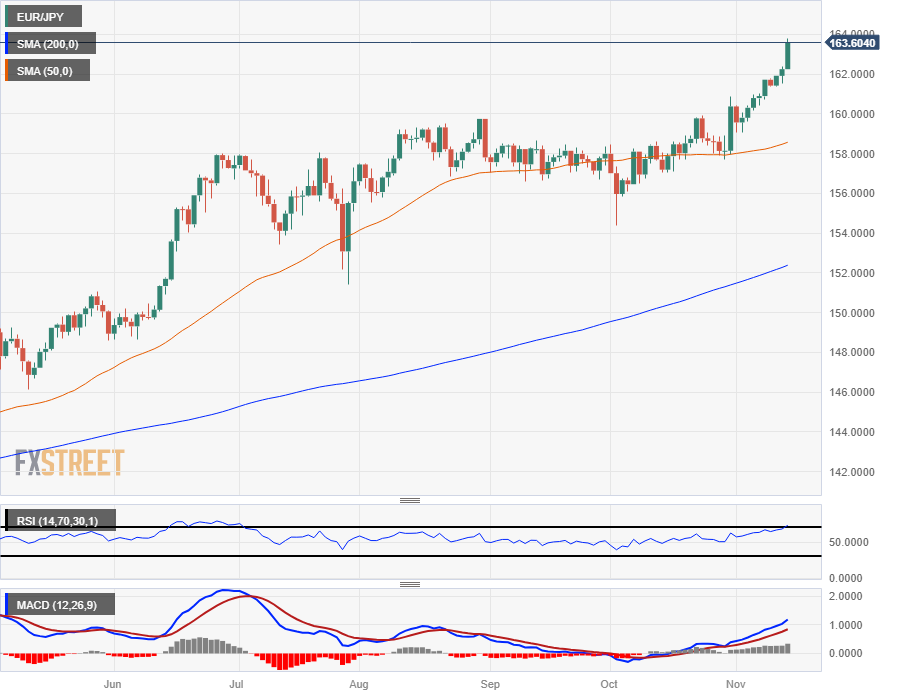
The Euro has extended a rally against the Yen, closing in the green for nine of the past eleven consecutive trading days. The EUR/JPY is now set for a challenge of the 164.00 major handle.

The EUR's latest bull run has seen the pair climb further away from the 50-day Simple Moving Average (SMA) currently lifting from the 158.00 handle, while long-term support is coming from the 200-day SMA near 152.00, far below current price action.

EUR/JPY Daily Chart
EUR/JPY Technical Level

EUR/JPY

Overview
Today last price163.63
Today Daily Change1.38
Today Daily Change %0.85
Today daily open162.25
 
Trends
Daily SMA20159.74
Daily SMA50158.47
Daily SMA100157.78
Daily SMA200152.27
 
Levels
Previous Daily High162.37
Previous Daily Low161.54
Previous Weekly High161.95
Previous Weekly Low160.15
Previous Monthly High160.85
Previous Monthly Low154.39
Daily Fibonacci 38.2%162.05
Daily Fibonacci 61.8%161.85
Daily Pivot Point S1161.73
Daily Pivot Point S2161.22
Daily Pivot Point S3160.9
Daily Pivot Point R1162.56
Daily Pivot Point R2162.88
Daily Pivot Point R3163.39

Author

Joshua Gibson

Joshua joins the FXStreet team as an Economics and Finance double major from Vancouver Island University with twelve years' experience as an independent trader focusing on technical analysis.


More from Joshua Gibson
Share:

Editor's Picks

AUD/USD sits near monthly high, around 0.7035 on hawkish RBA

AUD/USD trades around 0.7030-0.7035 in the Asian session on Thursday, near its monthly top, as recent hawkish comments from RBA officials continue to underpin the Australian Dollar. The US Dollar, meanwhile, struggles to lure buyers amid further declines in US bond yields, adding support to the pair. However, Fed rate-hike bets and geopolitical uncertainty help limit losses for the safe-haven buck, warranting caution for Aussie bulls.

USD/JPY remains confined in a familiar range; holds steady above 158.00

USD/JPY extends its consolidative price action through Thursday's Asian session, trading just above 158.00 amid diverging forces. Uncertainty over the timing of the next BoJ rate hike keeps Japanese Yen bulls on the defensive. The US Dollar, meanwhile, languishes near multi-week low amid declining US bond yields. Furthermore, looming intervention risks limit JPY losses and cap the pair. Traders also seem hesitant ahead of the Fed and BoJ meetings next week.

Gold hangs near one-week low; eyes $4,100 break amid Fed hike bets

Gold attracts fresh sellers in Thursday’s Asian session, sliding closer to a one-week low touched the previous day. Firming expectations for an imminent Fed rate hike, bolstered by oil-driven inflation risks, weigh on the non-yielding bullion. Meanwhile, declining US bond yields counter geopolitical uncertainty, keeping US Dollar bulls on the defensive. This helps XAU/USD defend $4,100.

Dogecoin Labs launches, resistance looms
Dogecoin (DOGE) Labs launched Wednesday in partnership with the Dogecoin Foundation, bringing together several product teams and technologies to expand the use of the memecoin (DOGE) across payments, decentralized finance (DeFi) and consumer applications. The launch will consolidate MyDoge, DogeOS and Such App under one business, led by Jordan Jefferson, founder of MyDoge and DogeOS.
What the midterm elections mean for Treasury yields, the Dollar and Gold
Democrats are priced to take the House, so November 3 comes down to the Senate and how much Washington can borrow without the other party. Treasury yields will show the answer first, then the Dollar and Gold. On November 3, Americans vote for all 435 House seats and 35 Senate seats. For bond prices, the result comes down to one thing: how much the government will borrow over the next two years.
The US Dollar fell. Gold didn't rally. That tells you everything
Gold (XAU/USD) is struggling to capitalize on a weaker US Dollar (USD), after repeatedly failing to establish itself above the $4,200 level. The precious metal remains confined to a relatively narrow trading range despite a combination of developments that would normally support higher prices.