|premium|

DAL Stock Price - Delta Air Lines rises as US domestic travel demand picks up

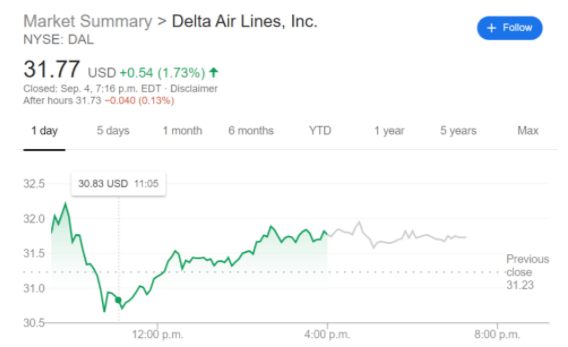
  • NYSE:DAL jumps by 1.76% to close the week amidst second straight day of broader market selloffs.
  • TSA reports an increase of over 800% for passenger screenings through U.S. airports. 

There have been fewer industries hit harder by the COVID-19 pandemic than the airline industry but a recent increase in stateside domestic travel demand has provided a small rally for airline companies. NYSE:DAL is now up 81% off its 52-week lows of $17.51 back in May but overall is still down over 46% from the 52-week, pre-COVID highs of $62. The Atlanta-based company recently warned of potential layoffs after the October 1st deadline from the federal bailout expires. Previously, Delta had reassured its employees that job security was safe, but the ongoing decline in world travel and presumed continuation of quarantine into 2021 has obviously changed the company’s tone.

Two of the other largest airline companies in the US United (NASDAQ:USL) and American Airlines (NASDAQ:AAL) are set to furlough 16,000 and 17,500 employees respectively after October 1st as the coronavirus continues to ravage the sector. While Delta has more or less avoided furloughs by issuing early retirement packages to many of its ageing employees – the firm still has plans to furlough nearly 2000 pilots as the volume of domestic and international flights has grounded to a halt. Despite the TSA reporting a near ten-fold increase in passenger travel on an average day in August compared to in mid-April, the airline industry advocacy group Airlines For America or A4A believes that normal domestic and international travel will not return to pre-COVID levels until 2024

DAL stock chart

DAL stock news

The A4A statement is a grim reminder to investors looking to get into the airline industry that there may never be a return to what we thought of as normal. Delta shares are up nearly 40% since the end of May but domestic travel threatens to stay at these depressed levels until the possibility of a coronavirus vaccine comes to light

Premium

You have reached your limit of 3 free articles for this month.

Start your subscription and get access to all our original articles.

Subscribe to PremiumSign In

Author

More from Stocks Reporter
Share:

Editor's Picks

GBP/USD bounces off lows, back above 1.3200

After bottoming out near 1.3160, GBP/USD manages to regain a bit of shine and reclaim the 1.3200 mark and beyond at the end of the week. Stronger-than-expected UK Retail Sales data seem to be helping the British Pound limit its losses, while the chaotic UK political environment keeps the bulls at bay for now.

EUR/USD looks consolidative around 1.1460

EUR/USD stages a modest rebound after slipping to a three-month low below 1.1420 at the end of the week. That said, the pair now looks to consolidate humble gains just above 1.1460 despite growing uncertainty surrounding the next round of US-Iran negotiations, which keeps the US Dollar’s downside contained.

Gold slips back to six-day lows, targets $4,100

Gold retreats for the third consecutive day on Friday, eroding gains seen in the first half of the week and approaching the key $4,100 mark per troy ounce. Indeed, the precious metal continues to face headwinds from the Fed's hawkish stance and renewed uncertainty surrounding the next round of US-Iran negotiations.

Breaking: Iran closes the Strait of Hormuz amid ceasefire deal violation
Iran says it is closing the Strait of Hormuz after accusing the United States (US) and Israel of violating the ceasefire. According to Iran, the decision came over the continued Israeli strikes in Lebanon. The Iranian Revolutionary Guard Corps Navy issued a warning to all vessels: "Do not approach the Strait of Hormuz; otherwise, your security will be jeopardized."
The Iran war didn't break the US economy, but what happens next?

Nearly four months after the start of the Iran war, the US economy remains remarkably resilient. While the conflict initially triggered a severe disruption to global energy markets and a sharp rise in Oil prices, recent diplomatic progress between Washington and Tehran has eased concerns about a prolonged supply shock.

Regime change: Inside Kevin Warsh's first move to make the Fed unreadable on purpose

The rate did not move. That was the least interesting thing about Kevin Warsh's first meeting in charge of the Fed. The FOMC held its benchmark at 3.50%-3.75% for the fourth straight meeting, exactly as priced, and then the new chair used his first press conference to dismantle the machinery the market has leaned on for a decade.