|

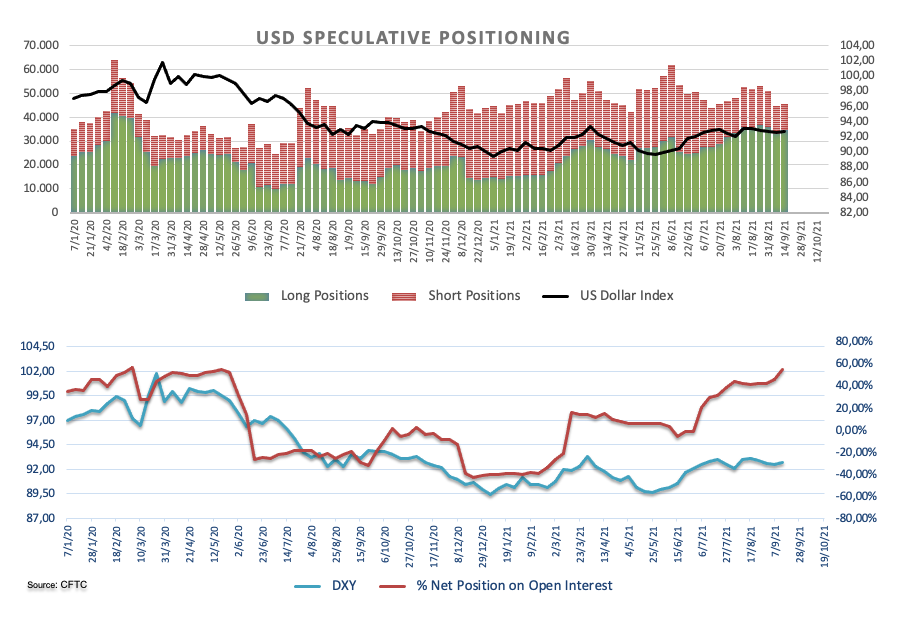
CFTC Positioning Report: USD net longs remained firm

These are the main highlights of the CFTC Positioning Report for the week ended on September 14th:

  • Speculative bullish bets in the dollar increased for the fourth consecutive week and now reached levels last seen back in late February 2020, on the verge of the coronavirus pandemic. In addition, the net longs/open interest ratio approached the 55% level, last seen in mid-May 2020. The US Dollar Index (DXY) traded within a consolidative mood during the week under scrutiny, as market participants were digesting the latest Payrolls figures, while Fed-speakers insisted on a sooner-than-anticipated QE tapering and US yields corrected lower from tops.
  • Net longs in the EUR climbed to 4-week highs and the percentage of net longs to open interest also rose to multi-week highs (above 4%), all in spite of the dovish “re-calibration” of the ECB at its meeting on September 9, as well as improved projections of inflation and growth for the next couple of years. EUR/USD, however, receded further from monthly tops and gyrated around the 1.1800 yardstick, which will eventually break in the subsequent sessions.
  • Looking at the safe haven universe, JPY net shorts shrank to the lowest level since early August, while speculators shifted to the bearish side on CHF for the first time since May 25.
  • After three weeks of navigating within the negative territory, GBP’s positioning turned positive. Cable managed to bounce off lows around 1.3730 sustained by market chatter surrounding a potential hawkish shift in the BoE tone at its next meeting. The EU-UK front coupled with Delta concerns continued to cap any serious bullish attempts the pair.
  • In the commodities’ galaxy, net longs in the WTI and gold rose to 2-week highs.
Author

Pablo Piovano

Born and bred in Argentina, Pablo has been carrying on with his passion for FX markets and trading since his first college years.

More from Pablo Piovano
Share:

Editor's Picks

EUR/USD flat lines below 1.1900; divergent Fed-ECB expectations offer support

The EUR/USD pair struggles to capitalize on the overnight bounce from the 1.1835-1.1830 region and oscillates in a narrow band during the Asian session on Thursday. Spot prices currently trade around the 1.1875 area, remaining nearly unchanged for the day and staying within striking distance of an over one-week high, reached on Tuesday, amid mixed cues.

GBP/USD bullish outlook prevails above 1.3600, UK GDP data looms

The GBP/USD pair gains ground near 1.3635, snapping the two-day losing streak during the early European session on Thursday. The preliminary reading of UK Gross Domestic Product for the fourth quarter will be closely watched later on Thursday. The UK economy is estimated to grow 0.2% QoQ in Q4, versus 0.1% in Q1. 

Gold down but not out as focus shifts to more US data

Gold is back in the red near $5,050 early Thursday, having faced strong offers at around the $5,100 mark once again. Buyers keep a close eye on the mid-tier US Jobless Claims data and US-Iran geopolitical developments to regain control.

UK GDP set to post weak growth as markets rise bets on March rate cut

Markets will be watching closely on Thursday, when the United Kingdom’s Office for National Statistics will release the advance estimate of Q4 Gross Domestic Product. If the data land in line with consensus, the UK economy would have continued to grow at an annualised pace of 1.2%, compared with 1.3% recorded the previous year. 

The market trades the path not the past

The payroll number did not just beat. It reset the tone. 130,000 vs. 65,000 expected, with a 35,000 whisper. 79 of 80 economists leaning the wrong way. Unemployment and underemployment are edging lower. For all the statistical fog around birth-death adjustments and seasonal quirks, the core message was unmistakable. The labour market is not cracking.

XRP sell-off deepens amid weak retail interest, risk-off sentiment

Ripple (XRP) is edging lower around $1.36 at the time of writing on Wednesday, weighed down by low retail interest and macroeconomic uncertainty, which is accelerating risk-off sentiment.