Canadian Dollar's remains on the defensive near 1.3550 ahead of US NFP
- Canadian Dollar remains positive although recent comments by Fed members have given some support to the USD.
- US Jobless Claims have increased above expectations, adding negative pressure to the US Dollar.
- The USD/CAD is gathering bearish traction and approaches an important support area at 1.3460.

The Canadian Dollar (CAD) is trading higher for the second consecutive day on Thursday although recent comments by Federal Reserve (Fed) officials Harker and Barking, warning that it might be too early to start cutting rates, have provided some support to the USD.
Earlioer today, US data revealed that claims for unemployment insurance increased at a larger-than-expected extent in the last week of March, which keeps the US Dollar on the defensive. These figures, coupled with the unexpectedly soft ISM Services PMI data seen on Wednesday had fed hopes that the Fed would stick to its plan of three rate hikes in 2024 which has capped the US Treasury yield's recovery, pushing the US Dollar lower against its main rivals.
In Canada, the trade surplus increased well beyond expectations in February due to a strong increase in exports, which has provided additional support to the CAD.
Daily digest market movers: USD/CAD depreciates further amid broad-based US Dollar weakness
- The Canadian Dollar's bullish momentum is gathering pace after having appreciated about 0.5% over the last two days to hit fresh two-week highs.
- Fed officials Harker and Barkin suggested that rates might have to stay at restrictive levels to confirm that inflation returns to target, which has allowed a minor US Dollar recovery.
- Earlier on Thursday, the US Initial Jobless Claims increased by 222K in the week of March 29, well above the 214K expected.
- Claims from the previous week have been revised up to 212K from the 210K previously estimated.
- Canadian trade surplus increased to $1.39 billion in February from $0.61 billion in January. Market experts had forecasted a shorter increase to about $0.8 billion.
- On Wednesday, the ISM Services PMI eased to 51.4 from 52.6 in February, against expectations of a slight increase to 52.7. The Prices Paid sub-index plunged to a four-year low, suggesting a negative contribution to inflation.
- US Nonfarm Payrolls are expected to have increased by 200K in March, down from February’s rise of 275K.
Canadian Dollar price this week
The table below shows the percentage change of Canadian Dollar (CAD) against listed major currencies this week. Canadian Dollar was the strongest against the Swiss Franc.
| USD | EUR | GBP | CAD | AUD | JPY | NZD | CHF | |
| USD | -0.63% | -0.22% | -0.10% | -1.26% | 0.19% | -0.96% | 0.29% | |
| EUR | 0.63% | 0.39% | 0.54% | -0.63% | 0.81% | -0.34% | 0.92% | |
| GBP | 0.22% | -0.41% | 0.12% | -1.03% | 0.39% | -0.74% | 0.51% | |
| CAD | 0.10% | -0.53% | -0.13% | -1.16% | 0.28% | -0.88% | 0.38% | |
| AUD | 1.24% | 0.62% | 1.03% | 1.13% | 1.42% | 0.29% | 1.52% | |
| JPY | -0.19% | -0.79% | -0.40% | -0.27% | -1.38% | -1.15% | 0.11% | |
| NZD | 0.95% | 0.34% | 0.74% | 0.87% | -0.29% | 1.13% | 1.23% | |
| CHF | -0.29% | -0.91% | -0.49% | -0.38% | -1.55% | -0.11% | -1.24% |
The heat map shows percentage changes of major currencies against each other. The base currency is picked from the left column, while the quote currency is picked from the top row. For example, if you pick the Euro from the left column and move along the horizontal line to the Japanese Yen, the percentage change displayed in the box will represent EUR (base)/JPY (quote).
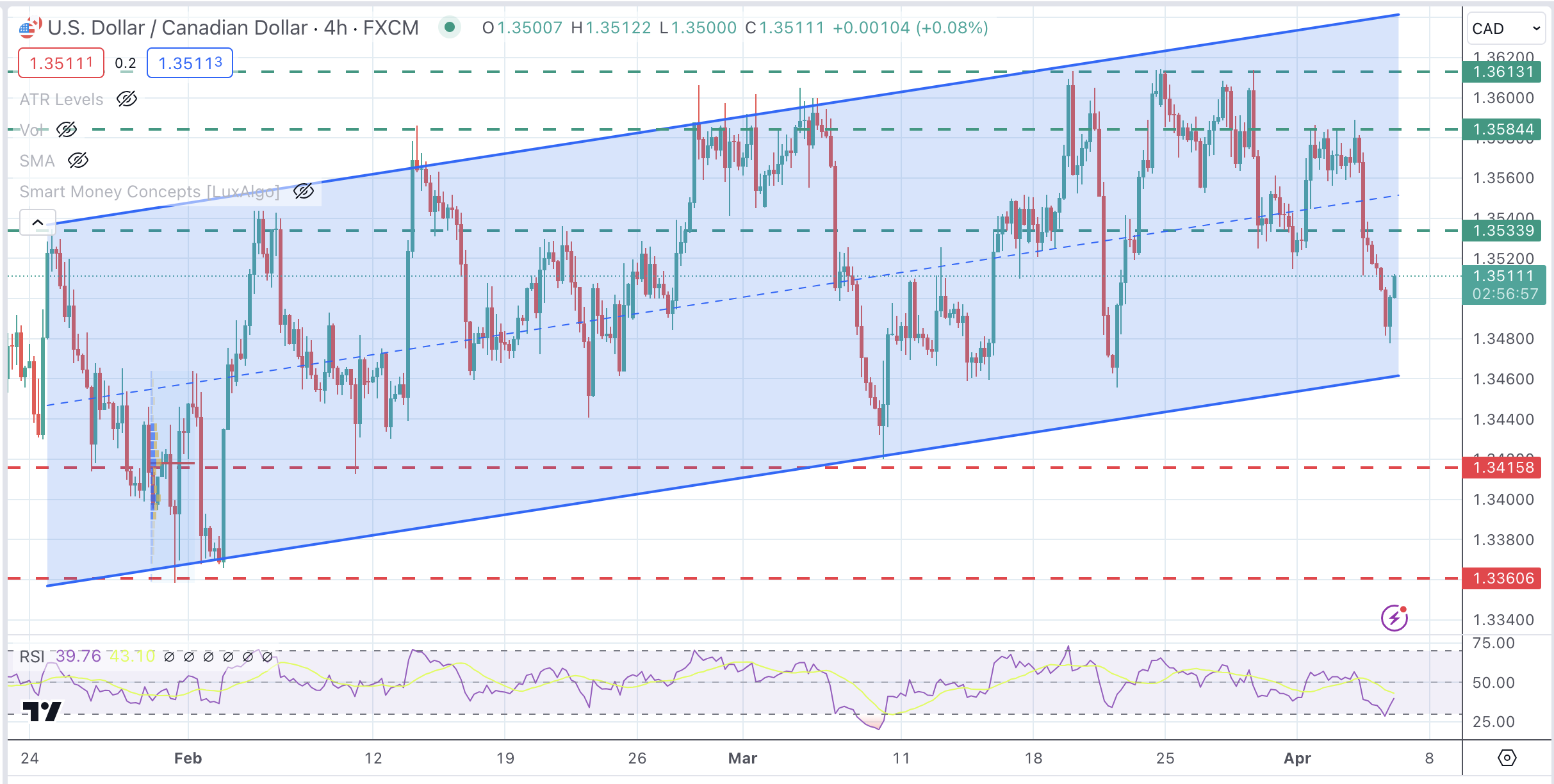
Technical analysis: USD/CAD approaches trendline support at 1.3460
The technical analysis indicates that the USD/CAD currency pair is approaching the trendline support level at 1.3460.The strong USD/CAD bearish reversal following the release of the ISM Services PMI extended on Thursday after another disappointing reading, this time with US Jobless claims.
The pair keeps trading within an ascending channel as prices approach the bottom of the channel at 1.3460. The Loonie would need help from a soft US NFP report to break that level and set its focus on 1.3415 ahead of 1.3360. On the upside, resistances are 1.3530 and 1.3585.
USD/CAD 4-Hour Chart
Canadian Dollar FAQs
The key factors driving the Canadian Dollar (CAD) are the level of interest rates set by the Bank of Canada (BoC), the price of Oil, Canada’s largest export, the health of its economy, inflation and the Trade Balance, which is the difference between the value of Canada’s exports versus its imports. Other factors include market sentiment – whether investors are taking on more risky assets (risk-on) or seeking safe-havens (risk-off) – with risk-on being CAD-positive. As its largest trading partner, the health of the US economy is also a key factor influencing the Canadian Dollar.
The Bank of Canada (BoC) has a significant influence on the Canadian Dollar by setting the level of interest rates that banks can lend to one another. This influences the level of interest rates for everyone. The main goal of the BoC is to maintain inflation at 1-3% by adjusting interest rates up or down. Relatively higher interest rates tend to be positive for the CAD. The Bank of Canada can also use quantitative easing and tightening to influence credit conditions, with the former CAD-negative and the latter CAD-positive.
The price of Oil is a key factor impacting the value of the Canadian Dollar. Petroleum is Canada’s biggest export, so Oil price tends to have an immediate impact on the CAD value. Generally, if Oil price rises CAD also goes up, as aggregate demand for the currency increases. The opposite is the case if the price of Oil falls. Higher Oil prices also tend to result in a greater likelihood of a positive Trade Balance, which is also supportive of the CAD.
While inflation had always traditionally been thought of as a negative factor for a currency since it lowers the value of money, the opposite has actually been the case in modern times with the relaxation of cross-border capital controls. Higher inflation tends to lead central banks to put up interest rates which attracts more capital inflows from global investors seeking a lucrative place to keep their money. This increases demand for the local currency, which in Canada’s case is the Canadian Dollar.
Macroeconomic data releases gauge the health of the economy and can have an impact on the Canadian Dollar. Indicators such as GDP, Manufacturing and Services PMIs, employment, and consumer sentiment surveys can all influence the direction of the CAD. A strong economy is good for the Canadian Dollar. Not only does it attract more foreign investment but it may encourage the Bank of Canada to put up interest rates, leading to a stronger currency. If economic data is weak, however, the CAD is likely to fall.
(This story was corrected on April 4 at 16:21 GMT to say in the Market Movers subheadline that the USD/CAD "depreciates" rather than "appreciates".)
Author

Guillermo Alcala
FXStreet
Graduated in Communication Sciences at the Universidad del Pais Vasco and Universiteit van Amsterdam, Guillermo has been working as financial news editor and copywriter in diverse Forex-related firms, like FXStreet and Kantox.