Canadian Dollar flubs Greenback challenge as buck bids bounce back on Thursday
- Canadian Dollar rises, but USD rises faster.
- Canada brings Retail Sales data to fore on Friday.
- US PMIs came in mixed on Thursday.

The Canadian Dollar (CAD) was broadly higher on Thursday, climbing against most of its major currency peers, but the US Dollar (USD) was bid higher, faster. Investors are paring back Greenback selling after a Fed-fueled midweek splurge, bolstering the US Dollar across the board.
Canada will return to the economic calendar with meaningful data on Friday. Retail Sales figures for January are expected to decline around half a percent after rising nearly a full percent in December.
Daily digest market movers: US Dollar dominates on US data flows
- US S&P Global Purchasing Managers Index (PMI) figures printed a split on Thursday.
- March’s US Manufacturing PMI rose to 52.5 from the previous 52.2, easily vaulting over the forecasted decline to 51.7.
- The Services PMI for March fell more than expected, declining to 51.7 from the previous month’s 52.3, falling more than the forecast 52.0.
- US Initial Jobless Claims slipped to 210K for the week ended March 15, missing the forecasted increase to 215K from the previous week’s 212K (revised upward from 209K).
- Analysts from Scotiabank have noted that the month of April tends to be the Canadian Dollar’s best-performing month against the Greenback.
- Scotiabank: April is the CAD’s best month of the calendar year against the USD
Canadian Dollar price today
The table below shows the percentage change of Canadian Dollar (CAD) against listed major currencies today. Canadian Dollar was the weakest against the US Dollar.
| USD | EUR | GBP | CAD | AUD | JPY | NZD | CHF | |
| USD | 0.71% | 1.03% | 0.45% | 0.39% | 0.61% | 0.71% | 1.50% | |
| EUR | -0.72% | 0.32% | -0.26% | -0.33% | -0.12% | 0.01% | 0.79% | |
| GBP | -1.05% | -0.33% | -0.59% | -0.63% | -0.45% | -0.32% | 0.46% | |
| CAD | -0.47% | 0.26% | 0.59% | -0.05% | 0.13% | 0.26% | 1.04% | |
| AUD | -0.40% | 0.32% | 0.64% | 0.06% | 0.19% | 0.33% | 1.10% | |
| JPY | -0.58% | 0.13% | 0.45% | -0.16% | -0.19% | 0.14% | 0.91% | |
| NZD | -0.71% | 0.00% | 0.32% | -0.26% | -0.33% | -0.10% | 0.80% | |
| CHF | -1.51% | -0.79% | -0.47% | -1.06% | -1.12% | -0.90% | -0.80% |
The heat map shows percentage changes of major currencies against each other. The base currency is picked from the left column, while the quote currency is picked from the top row. For example, if you pick the Euro from the left column and move along the horizontal line to the Japanese Yen, the percentage change displayed in the box will represent EUR (base)/JPY (quote).
Technical analysis: US Dollar rebounds, bullish CAD gets outperformed
The Canadian Dollar (CAD) is broadly higher on Thursday, gaining ground against nearly all of its major currency peers despite falling around four-tenths of a percent against the US Dollar. The CAD is struggling to hold flat against the day’s other over-performing currency, the Australian Dollar (AUD).
The USD/CAD is on the rise in Thursday trading, cutting in approximately 0.6% in bullish momentum bottom-to-top. The pair caught a bounce from the 1.3460 region, reclaiming the familiar 1.3500 handle in intraday trading.
Thursday’s recovery etches in a technical rejection from the 200-day Simple Moving Average (SMA) at 1.3485. A rangebound USD/CAD pattern looks set to continue in the near term.
USD/CAD hourly chart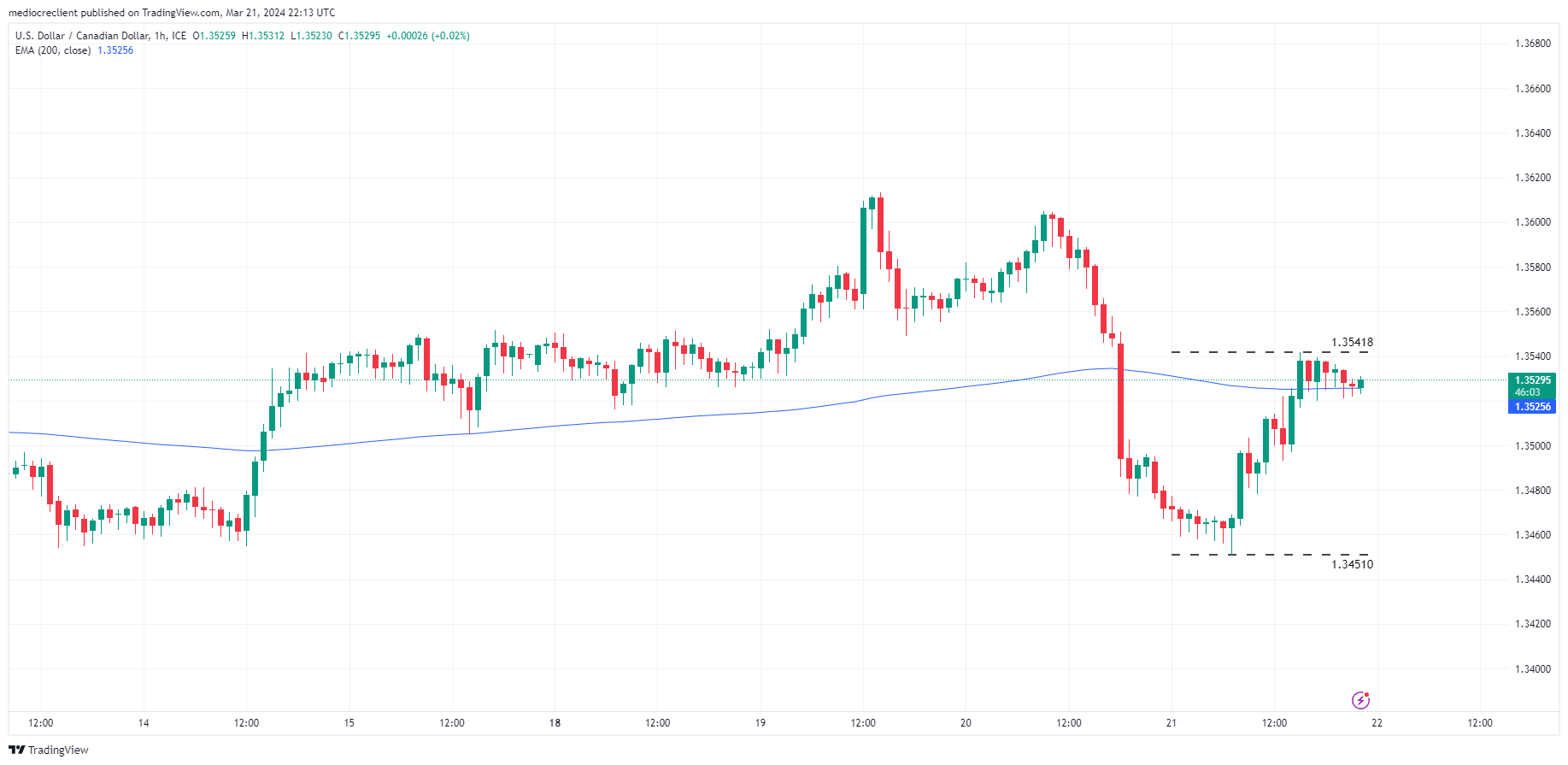
USD/CAD daily chart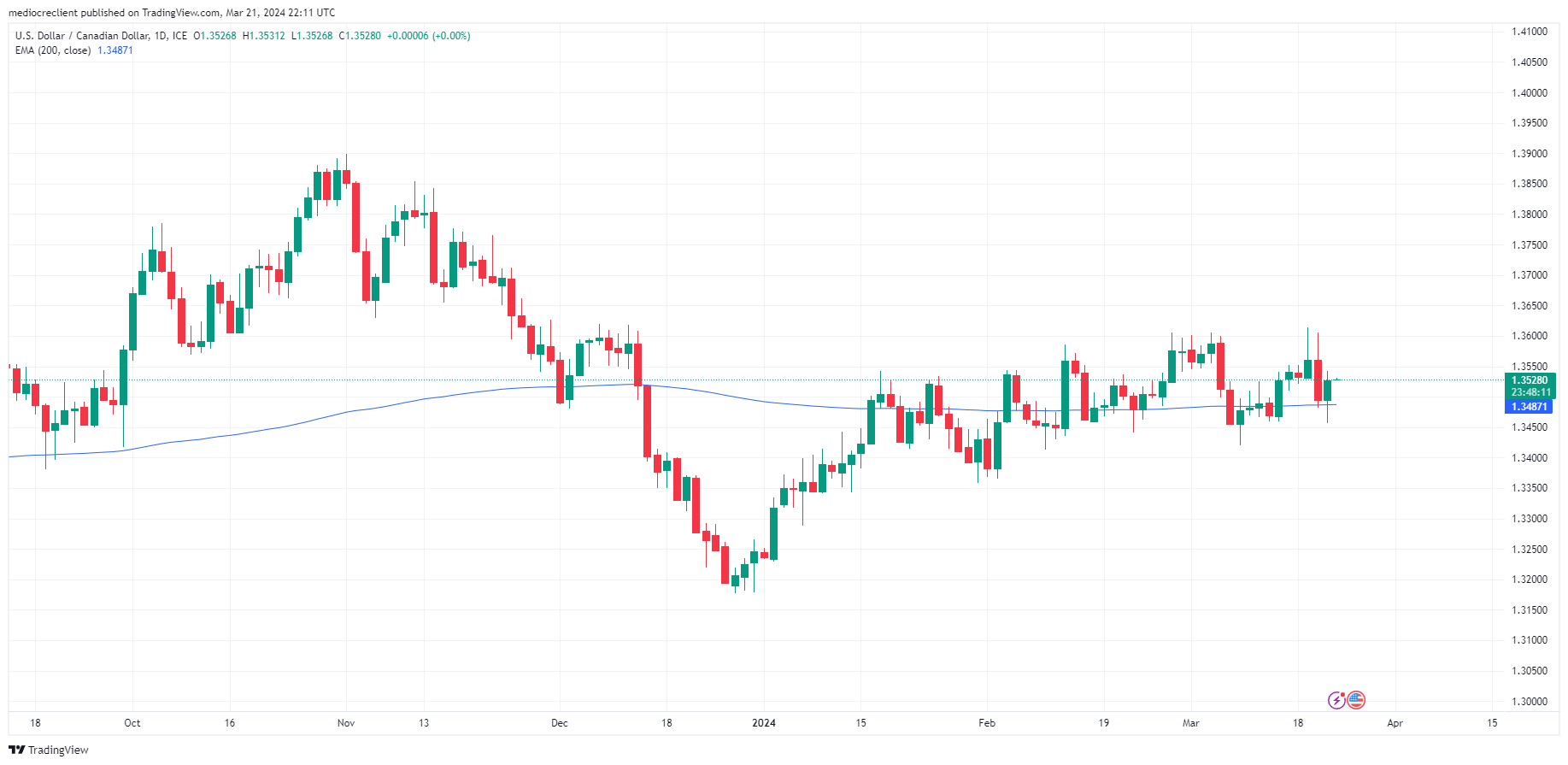
Canadian Dollar FAQs
The key factors driving the Canadian Dollar (CAD) are the level of interest rates set by the Bank of Canada (BoC), the price of Oil, Canada’s largest export, the health of its economy, inflation and the Trade Balance, which is the difference between the value of Canada’s exports versus its imports. Other factors include market sentiment – whether investors are taking on more risky assets (risk-on) or seeking safe-havens (risk-off) – with risk-on being CAD-positive. As its largest trading partner, the health of the US economy is also a key factor influencing the Canadian Dollar.
The Bank of Canada (BoC) has a significant influence on the Canadian Dollar by setting the level of interest rates that banks can lend to one another. This influences the level of interest rates for everyone. The main goal of the BoC is to maintain inflation at 1-3% by adjusting interest rates up or down. Relatively higher interest rates tend to be positive for the CAD. The Bank of Canada can also use quantitative easing and tightening to influence credit conditions, with the former CAD-negative and the latter CAD-positive.
The price of Oil is a key factor impacting the value of the Canadian Dollar. Petroleum is Canada’s biggest export, so Oil price tends to have an immediate impact on the CAD value. Generally, if Oil price rises CAD also goes up, as aggregate demand for the currency increases. The opposite is the case if the price of Oil falls. Higher Oil prices also tend to result in a greater likelihood of a positive Trade Balance, which is also supportive of the CAD.
While inflation had always traditionally been thought of as a negative factor for a currency since it lowers the value of money, the opposite has actually been the case in modern times with the relaxation of cross-border capital controls. Higher inflation tends to lead central banks to put up interest rates which attracts more capital inflows from global investors seeking a lucrative place to keep their money. This increases demand for the local currency, which in Canada’s case is the Canadian Dollar.
Macroeconomic data releases gauge the health of the economy and can have an impact on the Canadian Dollar. Indicators such as GDP, Manufacturing and Services PMIs, employment, and consumer sentiment surveys can all influence the direction of the CAD. A strong economy is good for the Canadian Dollar. Not only does it attract more foreign investment but it may encourage the Bank of Canada to put up interest rates, leading to a stronger currency. If economic data is weak, however, the CAD is likely to fall.
Author

Joshua Gibson
FXStreet
Joshua joins the FXStreet team as an Economics and Finance double major from Vancouver Island University with twelve years' experience as an independent trader focusing on technical analysis.