Canadian Dollar goes mixed in quiet Monday, Loonie eases against Greenback amidst holiday trading
- The Canadian Dollar is broadly mixed on the day but slides against US Dollar.
- Bank of Canada Business Outlook Survey shows further declines in sentiment.
- Canada CPI inflation is due out Tuesday.

The Canadian Dollar (CAD) is mixed against its major currency peers on Monday but shed weight against the US Dollar (USD) with market volumes thinned out by a US market holiday.
Canada Wholesale & Manufacturing Sales data beat expectations but is still recovering from recent slumps. The Bank of Canada’s (BoC) Business Outlook Survey also showed that business sentiment soured at an accelerated pace in the fourth quarter of 2023, and investors will look ahead to Tuesday’s Canadian Consumer Price Index (CPI) inflation, which is expected to tick slightly higher YoY.
Daily digest market movers: Canadian Dollar softens against Greenback to kick off new trading week
- Market volumes are notably thin with US markets off for the Federal holiday on Monday.
- Canada Wholesale Sales in November beat expectations to print at a three-month high of 0.9%, beating the market forecast of 0.8% and recovering from the previous month’s -0.3% (revised upward from -0.5%).
- Canada Manufacturing Sales rebounded more than expected, printing at a four-month high of 1.2% in November compared to the forecast for 1.0%, but still well back from October’s -2.9% contraction (revised down slightly from -2.8%).
- The BoC’s latest Business Outlook Survey showed firms’ outlooks have broadly swung to concerns about declining sales volumes and ongoing price pressures with higher interest rates cited as a major roadblock to continued investment.
- US markets are dark on Monday in observation of Martin Luther King Day.
- NA market session sees trading volumes draw tight.
- CAD traders will be looking forward to Tuesday’s Canada CPI print, forecast to tick higher from 3.1% to 3.3% on an annualized basis.
- MoM Canada CPI is expected to decline MoM, with December’s CPI forecast to print at -0.3% versus the previous month’s 0.1%.
- Canada CPI Preview: Forecasts from five major banks
- US Retail Sales figures due Wednesday, expected to show limited growth in December.
Canadian Dollar price today
The table below shows the percentage change of Canadian Dollar (CAD) against listed major currencies today. Canadian Dollar was the weakest against the Euro.
| USD | EUR | GBP | CAD | AUD | JPY | NZD | CHF | |
| USD | -0.05% | 0.05% | 0.22% | 0.43% | 0.38% | 0.48% | 0.27% | |
| EUR | 0.05% | 0.09% | 0.27% | 0.48% | 0.43% | 0.54% | 0.31% | |
| GBP | -0.06% | -0.10% | 0.17% | 0.38% | 0.33% | 0.44% | 0.21% | |
| CAD | -0.23% | -0.28% | -0.17% | 0.20% | 0.16% | 0.26% | 0.04% | |
| AUD | -0.43% | -0.48% | -0.37% | -0.21% | -0.04% | 0.07% | -0.16% | |
| JPY | -0.39% | -0.44% | -0.46% | -0.16% | 0.05% | 0.10% | -0.12% | |
| NZD | -0.48% | -0.54% | -0.44% | -0.26% | -0.06% | -0.11% | -0.22% | |
| CHF | -0.27% | -0.32% | -0.22% | -0.05% | 0.16% | 0.11% | 0.21% |
The heat map shows percentage changes of major currencies against each other. The base currency is picked from the left column, while the quote currency is picked from the top row. For example, if you pick the Euro from the left column and move along the horizontal line to the Japanese Yen, the percentage change displayed in the box will represent EUR (base)/JPY (quote).
Technical Analysis: Canadian Dollar sees limited topside, USD/CAD tests back into 1.3440
The Canadian Dollar (CAD) sees some gains against the Pacific currency bloc, gaining around four-tenths of a percent against the New Zealand Kiwi (NZD) and about a quarter of a percent against the Australian Dollar (AUD) and the Japanese Yen (JPY). The CAD is down about a quarter of a percent against the Pound Sterling, and in the red about a fifth of a percent against both the US Dollar and the Euro (EUR).
With the US Dollar broadly higher on Monday, the USD/CAD pair is retesting into the 1.3440 region, taking a run at setting a new high for 2024 as the Canadian Dollar continues to shed weight in choppy trading against the USD.
The USD/CAD is now up 2% from December’s swing low into 1.3177, and ongoing bullish momentum has the pair running straight into a technical ceiling at the 200-day Simple Moving Average (SMA) just below the 1.3500 handle.
USD/CAD Hourly Chart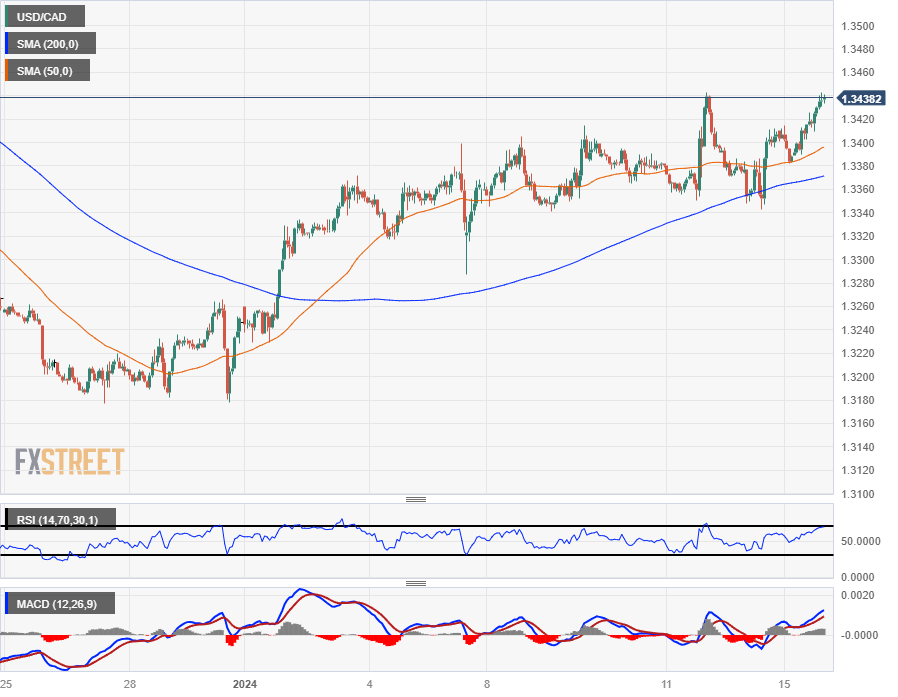
USD/CAD Daily Chart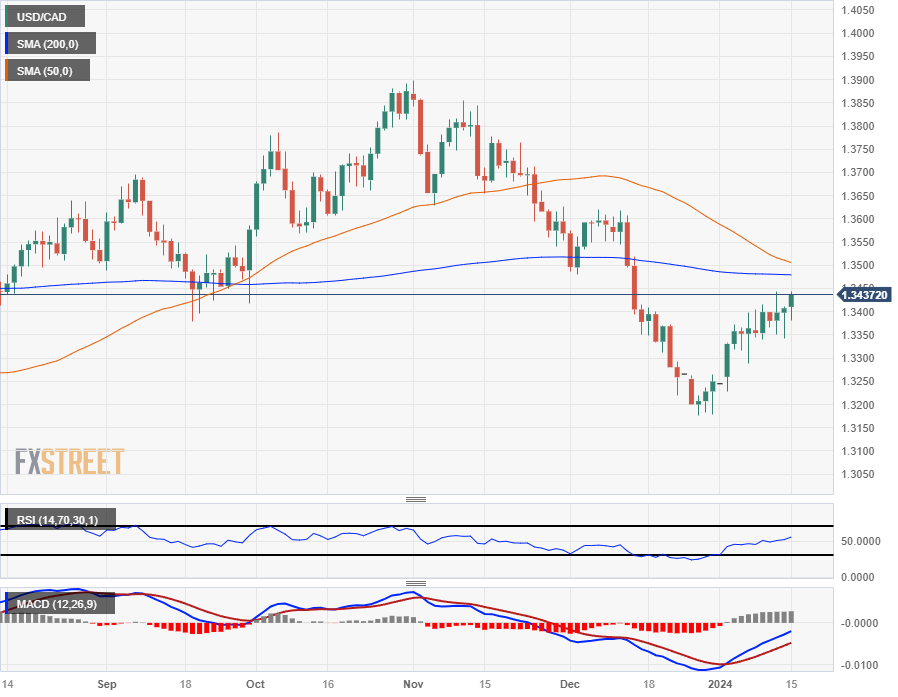
Canadian Dollar FAQs
What key factors drive the Canadian Dollar?
The key factors driving the Canadian Dollar (CAD) are the level of interest rates set by the Bank of Canada (BoC), the price of Oil, Canada’s largest export, the health of its economy, inflation and the Trade Balance, which is the difference between the value of Canada’s exports versus its imports. Other factors include market sentiment – whether investors are taking on more risky assets (risk-on) or seeking safe-havens (risk-off) – with risk-on being CAD-positive. As its largest trading partner, the health of the US economy is also a key factor influencing the Canadian Dollar.
How do the decisions of the Bank of Canada impact the Canadian Dollar?
The Bank of Canada (BoC) has a significant influence on the Canadian Dollar by setting the level of interest rates that banks can lend to one another. This influences the level of interest rates for everyone. The main goal of the BoC is to maintain inflation at 1-3% by adjusting interest rates up or down. Relatively higher interest rates tend to be positive for the CAD. The Bank of Canada can also use quantitative easing and tightening to influence credit conditions, with the former CAD-negative and the latter CAD-positive.
How does the price of Oil impact the Canadian Dollar?
The price of Oil is a key factor impacting the value of the Canadian Dollar. Petroleum is Canada’s biggest export, so Oil price tends to have an immediate impact on the CAD value. Generally, if Oil price rises CAD also goes up, as aggregate demand for the currency increases. The opposite is the case if the price of Oil falls. Higher Oil prices also tend to result in a greater likelihood of a positive Trade Balance, which is also supportive of the CAD.
How does inflation data impact the value of the Canadian Dollar?
While inflation had always traditionally been thought of as a negative factor for a currency since it lowers the value of money, the opposite has actually been the case in modern times with the relaxation of cross-border capital controls. Higher inflation tends to lead central banks to put up interest rates which attracts more capital inflows from global investors seeking a lucrative place to keep their money. This increases demand for the local currency, which in Canada’s case is the Canadian Dollar.
How does economic data influence the value of the Canadian Dollar?
Macroeconomic data releases gauge the health of the economy and can have an impact on the Canadian Dollar. Indicators such as GDP, Manufacturing and Services PMIs, employment, and consumer sentiment surveys can all influence the direction of the CAD. A strong economy is good for the Canadian Dollar. Not only does it attract more foreign investment but it may encourage the Bank of Canada to put up interest rates, leading to a stronger currency. If economic data is weak, however, the CAD is likely to fall.
Author

Joshua Gibson
FXStreet
Joshua joins the FXStreet team as an Economics and Finance double major from Vancouver Island University with twelve years' experience as an independent trader focusing on technical analysis.

















