Canada CPI bounced in the last month of 2023
- Canada annual CPI rises 3.4% in December.
- Canadian Dollar picks up traction after the report.
- USD/CAD comes down from the 1.3500 zone.

Statistics Canada informed that the Consumer Price Index (CPI) rose 3.4% on a year-over-year basis in December, above the 3.1% increase recorded in November. The reading was in line with market consensus. On a monthly basis, the CPI contracted 0.3% in December, matching expectations and coming down from the 0.1% increase seen in the previous month.
The Core CPI tracked by the Bank of Canada (BoC) dropped by 0.5% from a month earlier and rose 2.6% over the last twelve months, slightly below the 2.8% recorded in November.
Market reaction to Canada inflation data
The Canadian Dollar appreciated soon after the release, forcing USD/CAD to retreat from earlier five-week highs around 1.3500.
Canadian Dollar price today
The table below shows the percentage change of Canadian Dollar (CAD) against listed major currencies today. Canadian Dollar was the strongest against the Australian Dollar.
Australian Dollar ▲0.43%
Euro ▲0.36%
Japanese Yen ▲0.32%
Swiss Franc ▲0.31%
(An earlier version of this story incorrectly said that the Canadian CPI surprised to the upside. This was corrected on January 16 at 13:46 GMT to say that inflation met market expectations.)
This section below was published as a preview of the Canadian December inflation report at 07:00 GMT.
- The Canadian Consumer Price Index is seen growing 3.3% YoY in December.
- The BoC released its Business Outlook Survey (BOS).
- The Canadian Dollar navigates the area of four-week lows against the US Dollar.
Canada is set to release important inflation-related data on Tuesday. Statistics Canada will publish Consumer Price Index (CPI) for December, which is expected to show a year-on-year increase of 3.3%, slightly higher than the 3.1% recorded in November. On a monthly basis, the index is anticipated to decline by 0.3% following a 0.1% increase in the previous month. The data release has the potential to move the Canadian Dollar (CAD), which has remained weak against the US Dollar (USD) and is currently trading around four-week lows near the 1.3400 zone.
In addition to the CPI data, the Bank of Canada (BoC) will also publish the Core Consumer Price Index. This index excludes volatile components such as food and energy prices. In November, the BoC Core CPI showed a monthly increase of 0.1% and a year-on-year increase of 2.8%. These figures will be closely watched as they have the potential to impact the direction of the Canadian Dollar (CAD) and shape expectations for the Bank of Canada's monetary policy.
What to expect from Canada’s inflation rate?
Analysts anticipate additional softening of price pressures across Canada in December. Inflation, as quantified by annual shifts in the Consumer Price Index, is projected to resume the uptrend in the last month of the year, in line with what happened in most of Canada’s G10 peers, particularly its neighbour, the US. Following August's uptick to 4%, the CPI has trended downward, while all inflation gauges, such as the Core CPI, are expected to have moderated as well, signaling more tempered cost increases but persistence above the Bank of Canada's 2% objective.
If the impending data validates the expected loss of momentum in disinflationary pressures, investors may factor in the likelihood that the central bank could maintain the current rates for longer than initially anticipated, although extra tightening of the monetary conditions appears to be off the table.
With the global discussion centered on prospective interest rate reductions by monetary authorities in 2024, the unexpected pick-up of inflationary pressures would, at this point, prompt central banks to maintain their ongoing restrictive stance rather than lean towards further tightening. The latter scenario should require a sharp and persistent resurgence of price pressures and a sudden bout of consumers’ demand, all of which appear highly unlikely for the foreseeable future.
In his final remarks of the year in December, BoC Governor Tiff Macklem reported that the Governing Council would continue discussing whether monetary policy is sufficiently restrictive and the duration it should remain in that state. He anticipated that growth and employment would show improvement later in 2024, with inflation approaching the 2% target. Acknowledging the economic growth slowdown until mid-2023, he projected it to persist into 2024. Macklem mentioned that it was premature to contemplate reducing the policy rate, emphasizing that although inflation had decreased, it remained elevated.
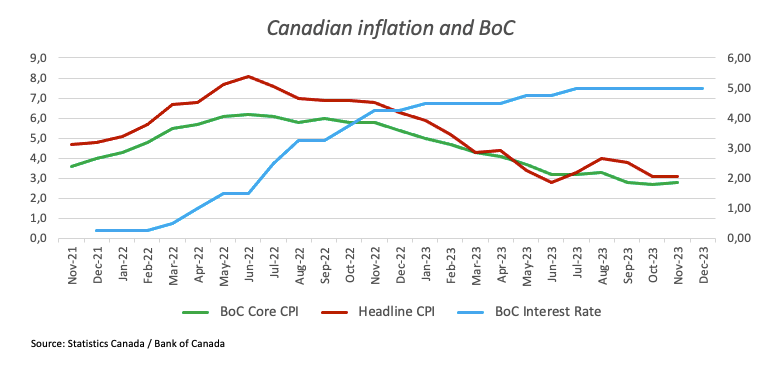
When is the Canada CPI data due and how could it affect USD/CAD?
Canada is scheduled to unveil the Consumer Price Index for December 2023 on Tuesday at 13:30 GMT. The potential influence on the Canadian Dollar stems from shifts in monetary policy expectations by the Bank of Canada. Nevertheless, the impact may be restrained, given that – similar to the Federal Reserve and other central banks – the Bank of Canada is anticipated to have completed rate hikes amid declining inflation and a slowdown in economic growth.
The USD/CAD has started the new trading year in quite a bullish fashion, although the uptrend appears to have met a decent barrier around the 1.3450 zone. This initial area of resistance also looks underpinned by the proximity of the critical 200-day Simple Moving Average (SMA) around 1.3480.
According to Pablo Piovano, FXStreet’s Senior Analyst, “USD/CAD would likely face the prospects for extra losses as long as it trades below the significant 200-day SMA. The bearish tone is also seen intensifying in the event of a sustainable breach of the December low of 1.3177 (December 27).”
Pablo adds: “A substantial pick-up of market activity in CAD would necessitate surprising inflation figures. While below-expectation numbers might favour the view of potential interest rate cuts by the BoC in the next month and hence put the Loonie under further selling pressure, the rebound in the CPI – in line with its neighbour, the US – could lend some wings to the Canadian Dollar, albeit to a moderate extent. A higher-than-expected inflation reading would increase pressure on the Bank of Canada to sustain elevated rates for an extended period, potentially resulting in a prolonged period of many Canadians facing challenges with higher interest rates, as underscored by Bank of Canada Governor Macklem in his December remarks.”
Economic Indicator
Canada Consumer Price Index - Core (MoM)
The core Consumer Price Index, released by Statistics Canada on a monthly basis, represents changes in prices for Canadian consumers by comparing the cost of a fixed basket of goods and services. The core CPI excludes the more-volatile food and energy categories and it is considered a measure of underlying inflation. The MoM figure compares the prices of goods in the reference month to the previous month. Generally, a high reading is seen as bullish for the Canadian Dollar (CAD), while a low reading is seen as bearish.
Read more.Author

FXStreet Team
FXStreet
Composed of a group of economic journalists and FX experts, the FXStreet content team produces and oversees all content published on FXStreet. It provides a purely journalistic approach to the Forex market.