|

Breaking: RBNZ hikes OCR by 50bps as expected, Kiwi jumps

The Reserve Bank of New Zealand raised the OCR by 50 bps to 4.75% in February.

NZD/USD has rallied to 0.6245 as markets look past the Cyclone Gabrielle-led damage and the prospects of a more hawkish Federal Reserve. Instead, investors are wary of the RBNZ's higher inflation expectations from 3.8% to 4.2% by March 2024. 

Key notes

  • RBNZ sees the OCR at 5.14% in June 2023 (previous 5.41%)
  • Employment remains above its maximum sustainable level, and short-term inflation expectations remain high.
  • Demand continues to outstrip supply.
  • 50 and 75 bps increases were discussed.
  • RBNZ still expects the cash rate to peak at 5.5%.
  • While there are early signs of lessening pricing pressures, core consumer price inflation remains excessive.
  • Core inflation remains too high.
  • Monetary conditions must be tightened even more.
  • Sees the OCR at 5.14% in June 2023 (previous 5.41%)
  • There are early signs of lessening price pressures.
  • Committee members agreed that monetary conditions needed to tighten much more.
  • The committee remains committed to implementing monetary policy.
  • RBNZ expects annual cpi to be 4.2% by March 2024 (previous 3.8%).
  • Expects the official cash rate to be 4.05% in March 2026.

NZD/USD update

NZD/USD is showing signs of resilience to US Dollar strength on the interest rate decision:
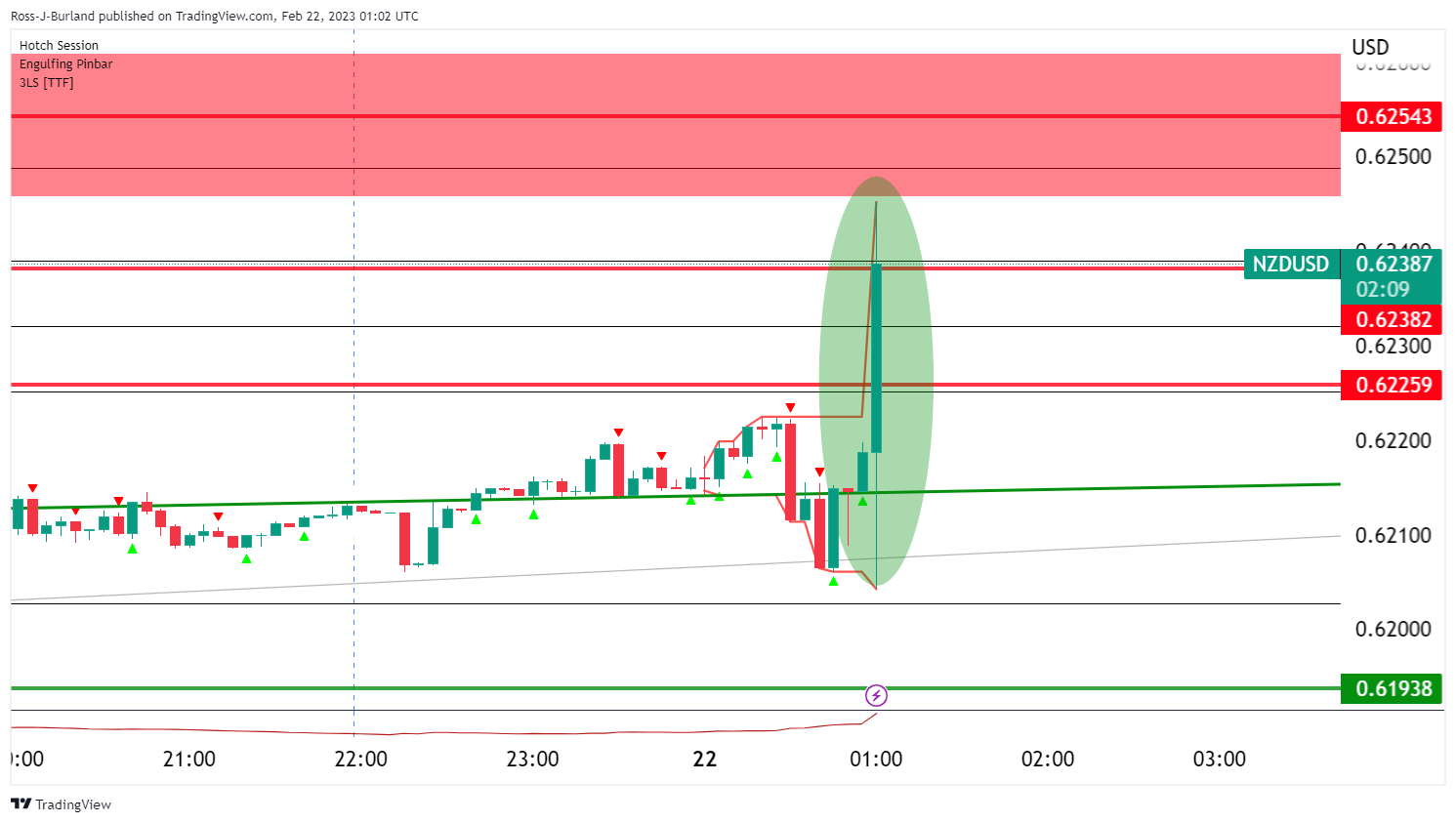
Traders are looking to the RBNZ’s peak rate forecast and Governor Adrian Orr’s press conference later today. These will likely hold the key for NZD in the short term. 

About the RBNZ interest rate decision

RBNZ Interest Rate Decision is announced by the Reserve Bank of New Zealand. If the RBNZ is hawkish about the inflationary outlook of the economy and rises the interest rates it is positive, or bullish, for the NZD.

Author

FXStreet Team

Composed of a group of economic journalists and FX experts, the FXStreet content team produces and oversees all content published on FXStreet. It provides a purely journalistic approach to the Forex market.


More from FXStreet Team
Share:

Editor's Picks

GBP/USD: Sustenance above 20-day EMA backs further upside above 1.3400

The GBP/USD pair trades almost flat at around 1.3355 during the European trading session. The Cable consolidates as investors await the Federal Open Market Committee minutes of the June policy meeting, which will be published at 18:00 GMT. At press time trades marginally lower to near 101.05.

EUR/USD gains as the Dollar moves sideways amid market caution

EUR/USD maintains its position after registering modest losses in the previous day, trading around 1.1410 during the Asian hours. Traders’ attention is focused on Wednesday's release of the US Federal Reserve Meeting Minutes, the first under newly appointed Chairman Kevin Warsh, for crucial clues regarding the future path of US interest rates.

Gold regains $4,100 despite Iran risks, ahead of Fed Minutes

Gold is fading in the tepid rebound above $4,100 early Wednesday, having reversed a part of the previous sell-off. Traders eagerly await the Minutes of the US Federal Reserve June monetary policy meeting, due later in the day, for fresh trading impetus.

Pi Network crashes to a record low amid broader market stress

Pi Network (PI) price edges toward $0.1000 extending losses for the fifth straight day. Retail sentiment remains bearish as Open Interest and the funding rate decline. The technical outlook for PI is bearish as selling pressure mounts, despite oversold conditions.

WTI holds above $72.00, near two-week high amid fresh US-Iran tensions

West Texas Intermediate (WTI) struggles to capitalize on the previous day's strong move up and enters a bullish consolidation phase near a two-week high, touched during the Asian session this Wednesday. The black liquid currently trades just above the $72.00 mark, with bulls awaiting a sustained strength beyond a technically significant 200-day SMA amid renewed US-Iran hostilities.

Bye, forward guidance: How to trade when central banks choose silence

Central banks have spent years telling markets what might come next. Now, traders face the possibility that they say a lot less. From the Federal Reserve to the European Central Bank and the Bank of England, policymakers are pushing back against forward guidance.














