Breaking: AUD/USD prints fresh cycle high on big-beat jobs data


The highly anticipated Australian labour market data has been released, boosting the Aussie to new cycle highs.
Employment was expected to have risen by just 50k, driven by Victoria, but that has been smashed and the unemployment has also improved slightly.
Figures from the Australian Bureau of Statistics (ABS) on Thursday showed employment jumped by a stellar 90,000 in November, following an impressive rise in October, and the jobless rate eased to 6.8%.
Aussie jobs key data points
- Australia Nov Employment +90.0k s/adj (Reuters poll: +50.0k).
- Australia Nov Unemployment rate +6.8 pct, s/adj (Reuters poll: +7.0).
- Australia Nov Full-time employment +84.2k s/adj
- Australia Nov Participation rate +66.1 pct, s/adj (Reuters poll: +66.0 pct).
''Australian jobs surpassed expectations again in November, pushing the unemployment rate lower in a sign massive monetary and fiscal stimulus was bearing fruit after the country brought the coronavirus pandemic under control,'' Reuters analysts commented.
AUD/USD Update
AUD/USD was somewhat capped by the Fed overnight in a less dovish than expected outcome, although the bulls have not thrown in the towel just yet in pursuit of fresh cycle highs which were made on the data to 0.7587.
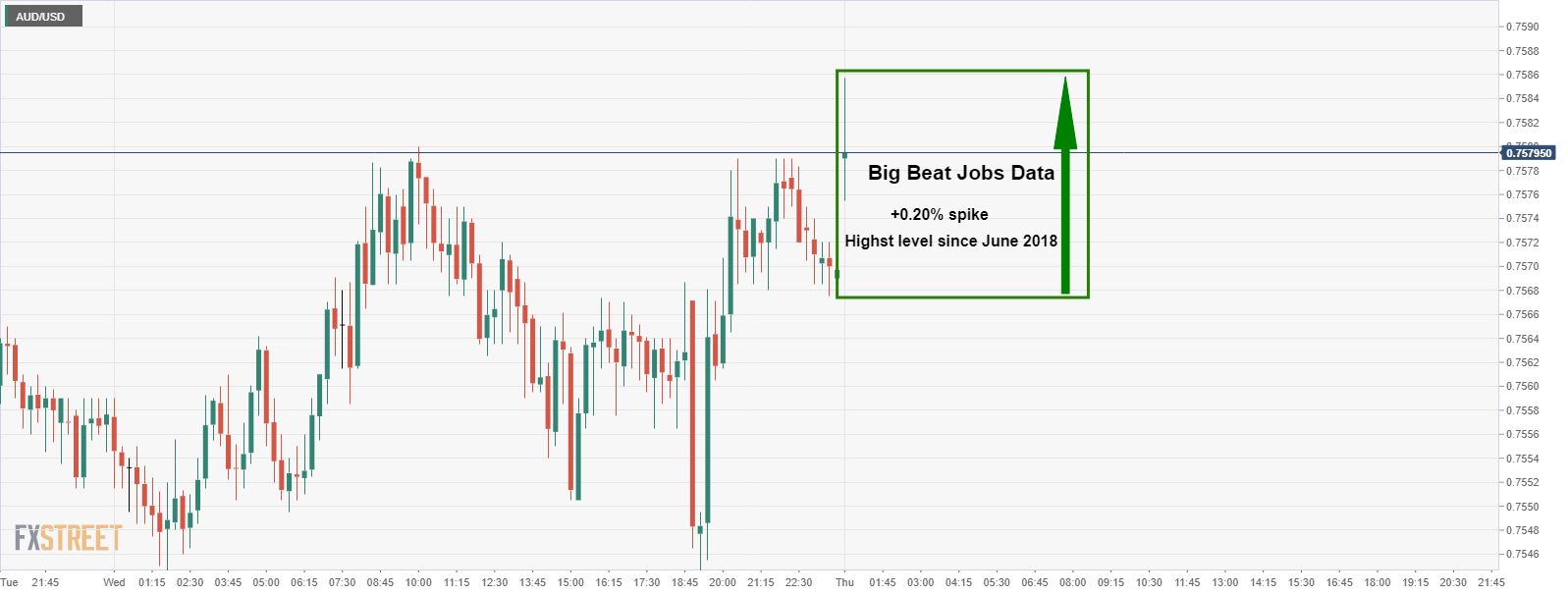
The improvement in risk sentiment has prompted some short-trimming effect on AUD which may underpin spot while the DXY melts away to fresh lows below the prior days low of 90.42.
There is still some room for USD net shorts to increase before aggregate positioning reaches the -18% lows seen in late September.
The CRB index (commodities) also points to higher highs in support of the Aussie.
Editor's notes
Australian Employment Preview: Positive surprise despite tepid forecasts
Australia is expected to have added 50,000 new jobs in November. RBA Minutes showed that the country has a “significant amount” of spare capacity. AUD/USD is consolidating at two-year highs and poised to extend its rally.
Description
The Unemployment Rate release by the Australian Bureau of Statistics is the number of unemployed workers divided by the total civilian labor force. If the rate hikes, indicates a lack of expansion within the Australian labor market. As a result, a rise leads to weaken the Australian economy. A decrease of the figure is seen as positive (or bullish) for the AUD, while an increase is seen as negative (or bearish).
Author
FXStreet Team
FXStreet

















