|

Blackberry (BB) Stock Price & News: Finishes strong after an early morning spike continues its momentum

  • NYSE:BB added 4.01% on Monday as broader markets continue to hit all-time highs.
  • BlackBerry’s strong fundamentals are keeping it afloat as other meme stocks deflate.
  • BlackBerry is still up over 100% in 2021, despite crashing back down to Earth.

NYSE:BB investors are still trying to catch their collective breathes as the Canadian company was dragged into the great Reddit war between retail investors and Wall Street. BlackBerry surged to a 52-week high of $28.77 at one point in late January before falling back down to its current price levels. On Monday, as the broader markets continued their February rally, BlackBerry added 4.01% to close the trading session at $13.76. While BlackBerry continues to trade in a volatile matter, it has still managed to return 118% to investors over the past 52-weeks, and at one point was trading for as low as $2.70.

While BlackBerry has managed to stay relatively steady throughout the recent chaos, other meme stocks like AMC (NYSE:AMC) and GameStop (NYSE:GME) have tumbled, losing nearly 70% and 90% respectively since the late January highs. The difference between these stocks and BlackBerry is that the former smartphone maker has legitimate business partnerships lined up for this year, including the notable relationship with Amazon (NASDAQ:AMZN) and its AWS platform, as well as other prominent companies like Hitachi and Salesforce.com (NYSE:CRM) branch Tableau Software. 

BB stock forecast
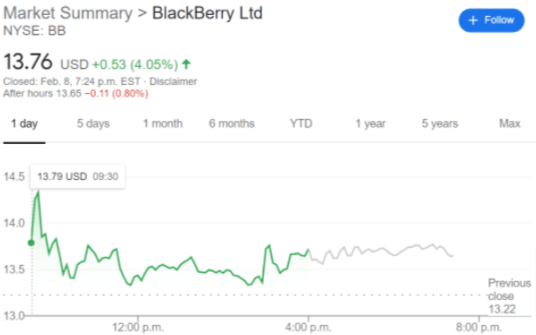
BB stock price chart

The biggest issue BlackBerry continues to struggle with is to distance itself from its smartphone past. If anything, BlackBerry should be looked at as a cybersecurity company like CrowdStrike (NASDAQ:CRWD), which currently trades at around 60 times sales, while BlackBerry is trading at a sales multiple of less than ten. Needless to say, BlackBerry will emerge as a company that is much stronger than the other meme stocks that it was grouped in with. 

Author

More from Stocks Reporter
Share:

Editor's Picks

AUD/USD sticks to positive bias above 0.7100; lacks bullish conviction

AUD/USD trades with a positive bias for the second straight day, holding above 0.7100 in the Asian session on Friday as softer US bond yields keep US Dollar bulls on the back foot. Furthermore, hawkish RBA Governor Bullock's comments boost rate hike bets and support the Aussie. However, the Fed's hawkish outlook, along with geopolitical uncertainties, limits USD losses and caps the pair.

USD/JPY approaches 158.00 as Japanese Yen resumes decline

USD/JPY is resuming its upside in the European session on Friday, refreshing two-week highs and nearing 158.00. The Japanese Yen extends losses, despite the Bank of Japan's (BoJ) expected rate hike to 1.25% and hawkish Governor Ueda's comments, as two surprise dissents against the rate hike weigh on it.

Gold keeps the bid tone in place; still below $4,400

Gold adds to the optimism seen in the second half of the week, trading with decent gains just below the $4,400 mark per troy ounce on Friday. The precious metal’s advance finds traction in declining crude oil prices and fresh selling pressure on the US Dollar.

Why altcoin season isn't coming back — and what stole its capital
If, after two years of being frozen in ice, Katara and Sokka woke you up to the crypto market, it would seem like 100 years have passed. With Bitcoin soaring to record highs just over a year ago, everyone expected a routine altcoin season, where investors take profits from the top crypto to chase higher returns in altcoins.
BoJ Recap: Not as hawkish as expected

The BoJ raised its short-term interest-rate target to 1.25% from 1.00% in a 7-2 vote, marking another step in the normalisation of monetary policy and widely matching what everyone has been expecting for weeks. Governor Kazuo Ueda said the policy phase had changed.

BoJ Recap: Not as hawkish as expected

The Bank of Japan (BoJ) raised its short-term interest-rate target to 1.25% from 1.00% in a 7-2 vote, marking another step in the normalisation of monetary policy and widely matching what everyone has been expecting for weeks.














