Australian Dollar extends gains on positive Chinese GDP, focus on US housing data
- Australian Dollar extends gains on the third day amid upbeat Chinese economic data.
- Aussie Dollar receives pressure as the Australian demand and per capita consumption decelerate.
- Governor Bullock mentioned taking responsive policy measures if inflation persists.
- US Retail Sales (MoM) rose by 0.7% in September, surpassing expectations of 0.3%.

The Australian Dollar (AUD) recovered the intraday losses, extending the gains on the third day as China has reported unexpectedly positive data across various indicators. However, the AUD/USD pair halted its two-day winning streak earlier in the day. This shift followed a speech by Reserve Bank of Australia (RBA) Governor Michele Bullock on Wednesday, coupled with upbeat economic data from the United States (US).
Australia's central bank expresses heightened concern about the inflation impact stemming from supply shocks. Governor Bullock stated that if inflation persists above projections, the RBA will take responsive policy measures. There is an observable deceleration in demand, and per capita consumption is on the decline.
Bullock mentioned that the full impact of previous rate increases on consumption has not materialized yet. In the face of persistent higher-than-anticipated inflation, the RBA acknowledges the necessity to act and emphasizes a cautious approach, remaining vigilant to potential upside inflation risks.
The US Dollar Index (DXY) attempts to recover from the previous losses, and this is attributed to the upbeat economic data from the United States (US). However, the dovish remarks from many Federal Reserve (Fed) officials suggest a cautious approach by the central bank, emphasizing a reluctance to tighten monetary policy in the current economic environment.
Richmond Fed President Thomas Barkin noted that current policy is already restrictive. Barkin expressed uncertainty about the upcoming FOMC monetary policy meeting in November. He emphasized that the US central bank cannot depend on longer-term higher bond yields alone to tighten monetary conditions.
Daily Digest Market Movers: Australian Dollar extends gains on upbeat Chinese data
- Australian Weekly ANZ Roy Morgan Consumer Confidence survey, released on Tuesday, indicates a decline in the nation's Consumer Confidence. The reading fell to 76.4 compared to the previous figure of 80.1. The decline is observed across all sub-indices, reflecting a more cautious or negative sentiment among consumers.
- RBA’s board members acknowledged in October's meeting minutes that there were significant concerns about upside risks to inflation. This suggests that the board is cautious about potential factors that could lead to an increase in inflation.
- China's Gross Domestic Product surpassed expectations, showing a growth of 1.3% compared to the anticipated 1.0%. The annual report for the same quarter revealed an increase of 4.9%, exceeding the expected 4.4%.
- Furthermore, China's Retail Sales (YoY) demonstrated a rise of 5.5%, surpassing both the previous figure of 4.6% and the expected 4.9%.
- RBA could introduce a central bank digital currency (CBDC). Brad Jones, Assistant Governor (Financial System) at the RBA, discussed the tokenization of assets and money in the digital era at The Australian Financial Review Cryptocurrency Summit.
- The ongoing conflict in the Middle East introduces an additional layer of complexity to the situation. This geopolitical factor could potentially prompt the RBA to implement a 25 basis points (bps) interest rate hike, reaching 4.35% by the end of the year.
- The US Bureau of Economic Analysis (BEA) disclosed that Retail Sales exceeded expectations of 0.3% MoM, which increased to 0.7% in September. While Retail Sales Control Group rose by 0.6% compared to the previous hike of 0.2%.
- This robust performance underscores the resilience of consumers. Subsequently, the Federal Reserve reported that Industrial Production showed improvement by 0.3%, which was expected to remain at 0.0%.
- Federal Reserve Bank of Philadelphia President Patrick Harker stated on Monday that the central bank should avoid creating new pressures in the economy by increasing the cost of borrowing. Harker further expressed the view that in the absence of a significant shift in the data, the Fed should maintain interest rates at their current levels.
- Investors adopt caution in making aggressive bets on the US Dollar (USD), given the uncertainty surrounding the Fed policy rate trajectory. The lack of a clear direction from the Fed on interest rates is influencing market sentiment and contributing to hesitancy among investors.
- The higher US Treasury yields from recent losses could provide support to the US Dollar. The 10-year US Treasury bond yield stands at 4.83%, by the press time.
- Additionally, the USD continues to benefit from safe-haven flows amid rising geopolitical tensions between Israel and Palestine. Safe-haven currencies, including the US Dollar, tend to attract demand during periods of heightened uncertainty and geopolitical risks.
- Investors will likely focus on the housing data and speeches from Fed officials on Wednesday, which could offer some hints about further monetary policy paths.
Technical Analysis: Australian Dollar hovers above the 0.6350 major level
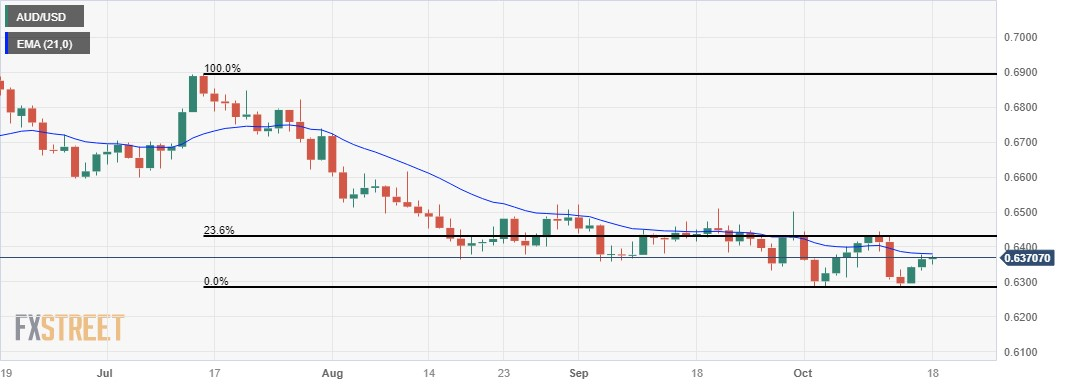
The Australian Dollar trades above the major level of 0.6350 during the Asian session on Wednesday. The 0.6300 emerges as the significant support level, which aligns with the monthly low at 0.6285. On the upside, a crucial resistance is observed at the 21-day Exponential Moving Average (EMA) around the 0.6379 level aligned with the major level of 0.6400. A break above the level could reach the region around the 23.6% Fibonacci retracement level at 0.6429. These technical indicators provide traders with insights into potential resistance zones that could influence the direction of the Australian Dollar.
AUD/USD: Daily Chart
Australian Dollar price today
The table below shows the percentage change of Australian Dollar (AUD) against listed major currencies today. Australian Dollar was the strongest against the US Dollar.
| USD | EUR | GBP | CAD | AUD | JPY | NZD | CHF | |
| USD | -0.09% | -0.24% | -0.23% | -0.31% | -0.04% | -0.16% | -0.19% | |
| EUR | 0.07% | -0.17% | -0.15% | -0.23% | 0.05% | -0.08% | -0.09% | |
| GBP | 0.24% | 0.16% | 0.02% | -0.06% | 0.20% | 0.08% | 0.06% | |
| CAD | 0.25% | 0.16% | -0.02% | -0.08% | 0.18% | 0.08% | 0.05% | |
| AUD | 0.31% | 0.21% | 0.06% | 0.08% | 0.25% | 0.15% | 0.11% | |
| JPY | 0.04% | -0.03% | -0.21% | -0.19% | -0.25% | -0.13% | -0.15% | |
| NZD | 0.15% | 0.08% | -0.08% | -0.06% | -0.15% | 0.12% | -0.03% | |
| CHF | 0.20% | 0.12% | -0.04% | -0.04% | -0.11% | 0.15% | 0.04% |
The heat map shows percentage changes of major currencies against each other. The base currency is picked from the left column, while the quote currency is picked from the top row. For example, if you pick the Euro from the left column and move along the horizontal line to the Japanese Yen, the percentage change displayed in the box will represent EUR (base)/JPY (quote).
Economic Indicator
United States Building Permits (MoM)
The Building Permits released by the US Census Bureau, at the Department of Commerce shows the number of permits for new construction projects. It implies the movement of corporate investments (US economic development). It tends to cause some volatility to the USD. Normally, the more growing number of permits, the more positive (or bullish) for the USD.
Read more.Author

Akhtar Faruqui
FXStreet
Akhtar Faruqui is a Forex Analyst based in New Delhi, India. With a keen eye for market trends and a passion for dissecting complex financial dynamics, he is dedicated to delivering accurate and insightful Forex news and analysis.
















