Australian Dollar falls amid a steady US Dollar, Fed decision awaited
- Australian Dollar could lose ground amid a volatile ASX 200 index on Wednesday.
- RBA’s Bullock emphasized that the fight against inflation is still ongoing.
- PBoC has kept the interest rate unchanged at 3.45%.
- FOMC could maintain its key cash rates within a range of 5.25% to 5.50%.

The Australian Dollar (AUD) has rebounded from intraday losses and is striving to shift into positive territory on Wednesday. The volatile ASX 200 may have lent support to the AUD, thereby bolstering the AUD/USD pair. However, the robust US Dollar could be exerting downward pressure on the pair.
The Reserve Bank of Australia (RBA) has chosen to maintain interest rates at a 12-year high of 4.35% on Tuesday, consistent with its stance for the third consecutive meeting. RBA Governor Michele Bullock emphasized that the battle against inflation is ongoing. While acknowledging persistently high inflation, she refrained from providing specific details regarding the timing or likelihood of rate adjustments, indicating that the bank remains open to various possibilities.
The US Dollar Index (DXY) continues its recent uptrend, which was initiated on Thursday. The strength of the US Dollar is attributed to improved US Treasury yields. Investors eagerly await the interest rate decision from the US Federal Reserve (Fed) scheduled for Wednesday. The Federal Open Market Committee (FOMC) is widely anticipated to maintain its key federal funds interest rate within a range of 5.25% to 5.5%.
Daily Digest Market Movers: Australian Dollar depreciates amid fluctuated equity market
- The ANZ-Roy Morgan Australian Consumer Confidence index, which is published weekly, stands at 81.7, compared to the previous week's reading of 82.2.
- People’s Bank of China (PBoC) has kept its interest rate unchanged at 3.45%.
- Chinese Foreign Minister Wang Yi met Australia's Foreign Affairs Minister Penny Wong. The Chinese side emphasized their substantial potential. They stressed that China-Australia relations are progressing positively and urged against any hesitation, deviation, or reversal in this forward momentum.
- According to the CME FedWatch Tool, the probability of a rate cut in May stands at 6.3%. The likelihood of a rate cut in June and July is increased, at 59.2% and 76.0%, respectively.
- US Building Permits (MoM) increased to 1.518 million in February, against the expected 1.495 million and 1.489 million prior.
- US Housing Starts (MoM) rose to 1.521M from the previous figure of 1.374M, exceeding the market expectation of 1.425M in February.
- The preliminary US Michigan Consumer Sentiment Index for March decreased to 76.5, from the previous reading of 76.9. This decline comes in contrast to expectations of it remaining unchanged.
- The Board of Governors of the Federal Reserve released Industrial Production (MoM), which increased by 0.1% in February, against the expected reading of flat 0.0% and from the previous decline of 0.5%.
- The US Core Producer Price Index (PPI) remained consistent with the rise of 2.0% year-over-year in February, maintaining its position above the 1.9% expected. The monthly report showed an increase of 0.3% against 0.5% prior, exceeding the expected 0.2% reading.
- US PPI (YoY) increased by 1.6% in February, surpassing the expected 1.1% and 1.0% prior. PPI (MoM) rose by 0.6% above the market expectation and the previous increase of 0.3%.
Technical Analysis: Australian Dollar hovers below the major barrier of 0.6550
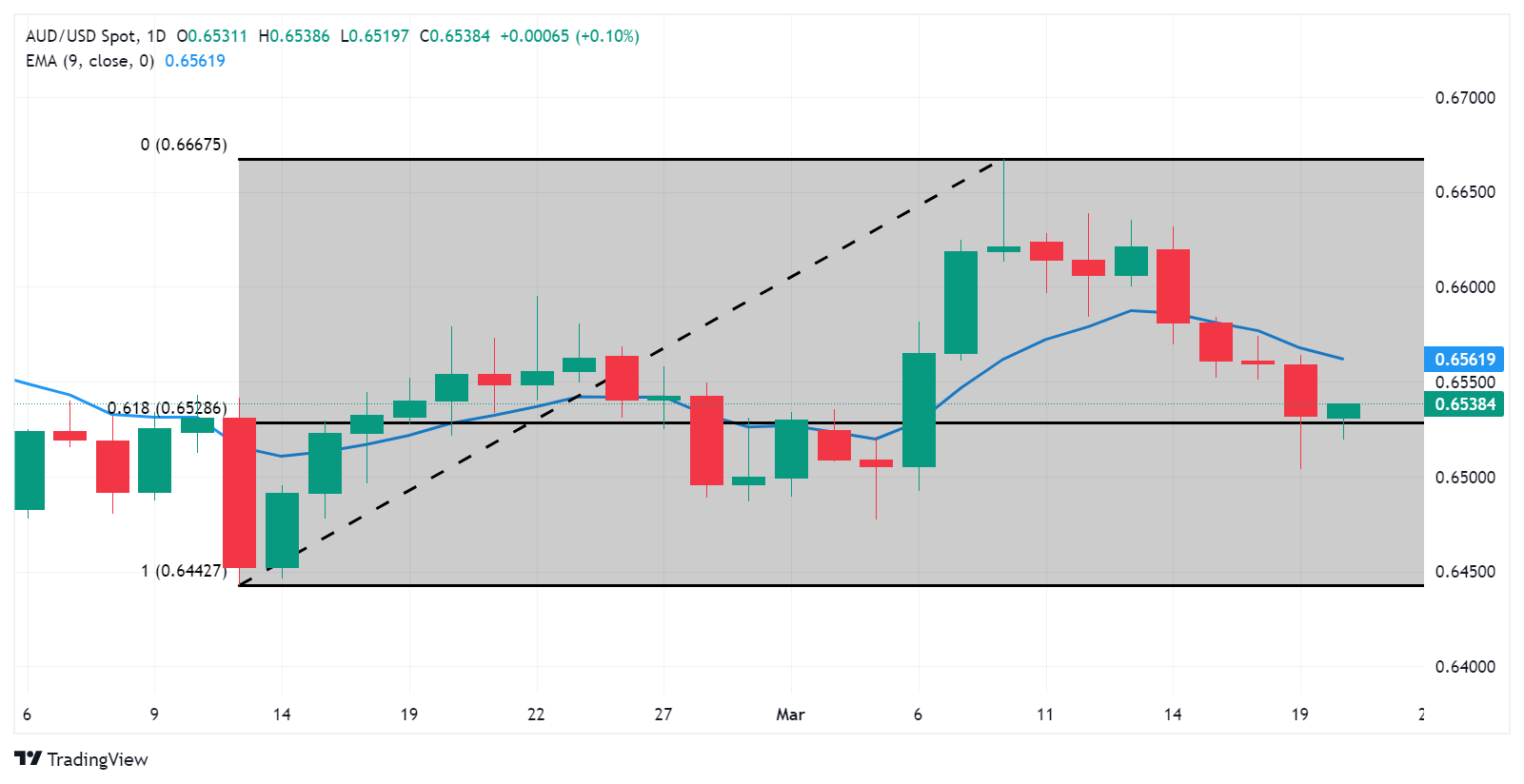
The Australian Dollar trades near 0.6540 on Wednesday. Immediate resistance is noted at the major level of 0.6550, followed by the nine-day Exponential Moving Average (EMA) at 0.6561. A breakthrough above this level could potentially propel the AUD/USD pair towards the psychological level of 0.6600. On the downside, the 61.8% Fibonacci retracement level of 0.6528 acts as an immediate support before the psychological level of 0.6500. A breach below this support zone might exert pressure on the AUD/USD pair, potentially leading to a retest of March’s low at the 0.6477 level.
AUD/USD: Daily Chart
Australian Dollar price today
The table below shows the percentage change of Australian Dollar (AUD) against listed major currencies today. Australian Dollar was the weakest against the Euro.
| USD | EUR | GBP | CAD | AUD | JPY | NZD | CHF | |
| USD | -0.04% | 0.01% | 0.04% | -0.08% | 0.30% | 0.05% | 0.09% | |
| EUR | 0.04% | 0.06% | 0.10% | -0.03% | 0.35% | 0.09% | 0.14% | |
| GBP | 0.00% | -0.05% | 0.02% | -0.09% | 0.29% | 0.02% | 0.08% | |
| CAD | -0.04% | -0.08% | -0.01% | -0.13% | 0.26% | 0.00% | 0.06% | |
| AUD | 0.06% | 0.04% | 0.10% | 0.12% | 0.37% | 0.13% | 0.17% | |
| JPY | -0.30% | -0.33% | -0.29% | -0.27% | -0.37% | -0.27% | -0.20% | |
| NZD | -0.06% | -0.10% | -0.04% | -0.01% | -0.13% | 0.25% | 0.04% | |
| CHF | -0.10% | -0.14% | -0.04% | -0.06% | -0.16% | 0.21% | -0.01% |
The heat map shows percentage changes of major currencies against each other. The base currency is picked from the left column, while the quote currency is picked from the top row. For example, if you pick the Euro from the left column and move along the horizontal line to the Japanese Yen, the percentage change displayed in the box will represent EUR (base)/JPY (quote).
Australian Dollar FAQs
One of the most significant factors for the Australian Dollar (AUD) is the level of interest rates set by the Reserve Bank of Australia (RBA). Because Australia is a resource-rich country another key driver is the price of its biggest export, Iron Ore. The health of the Chinese economy, its largest trading partner, is a factor, as well as inflation in Australia, its growth rate, and Trade Balance. Market sentiment – whether investors are taking on more risky assets (risk-on) or seeking safe havens (risk-off) – is also a factor, with risk-on positive for AUD.
The Reserve Bank of Australia (RBA) influences the Australian Dollar (AUD) by setting the level of interest rates that Australian banks can lend to each other. This influences the level of interest rates in the economy as a whole. The main goal of the RBA is to maintain a stable inflation rate of 2-3% by adjusting interest rates up or down. Relatively high interest rates compared to other major central banks support the AUD, and the opposite for relatively low. The RBA can also use quantitative easing and tightening to influence credit conditions, with the former AUD-negative and the latter AUD-positive.
China is Australia’s largest trading partner so the health of the Chinese economy is a major influence on the value of the Australian Dollar (AUD). When the Chinese economy is doing well it purchases more raw materials, goods and services from Australia, lifting demand for the AUD, and pushing up its value. The opposite is the case when the Chinese economy is not growing as fast as expected. Positive or negative surprises in Chinese growth data, therefore, often have a direct impact on the Australian Dollar and its pairs.
Iron Ore is Australia’s largest export, accounting for $118 billion a year according to data from 2021, with China as its primary destination. The price of Iron Ore, therefore, can be a driver of the Australian Dollar. Generally, if the price of Iron Ore rises, AUD also goes up, as aggregate demand for the currency increases. The opposite is the case if the price of Iron Ore falls. Higher Iron Ore prices also tend to result in a greater likelihood of a positive Trade Balance for Australia, which is also positive of the AUD.
The Trade Balance, which is the difference between what a country earns from its exports versus what it pays for its imports, is another factor that can influence the value of the Australian Dollar. If Australia produces highly sought after exports, then its currency will gain in value purely from the surplus demand created from foreign buyers seeking to purchase its exports versus what it spends to purchase imports. Therefore, a positive net Trade Balance strengthens the AUD, with the opposite effect if the Trade Balance is negative.
Author

Akhtar Faruqui
FXStreet
Akhtar Faruqui is a Forex Analyst based in New Delhi, India. With a keen eye for market trends and a passion for dissecting complex financial dynamics, he is dedicated to delivering accurate and insightful Forex news and analysis.
















