AUD/USD Price Analysis: Turns volatile as US Dollar bounces back after strong US PMI report
- AUD/USD gives up majority of intraday gains as the US Dollar revives after upbeat US early PMI report for May.
- The pace at which the US PMI expanded was the fastest pace in more than two years.
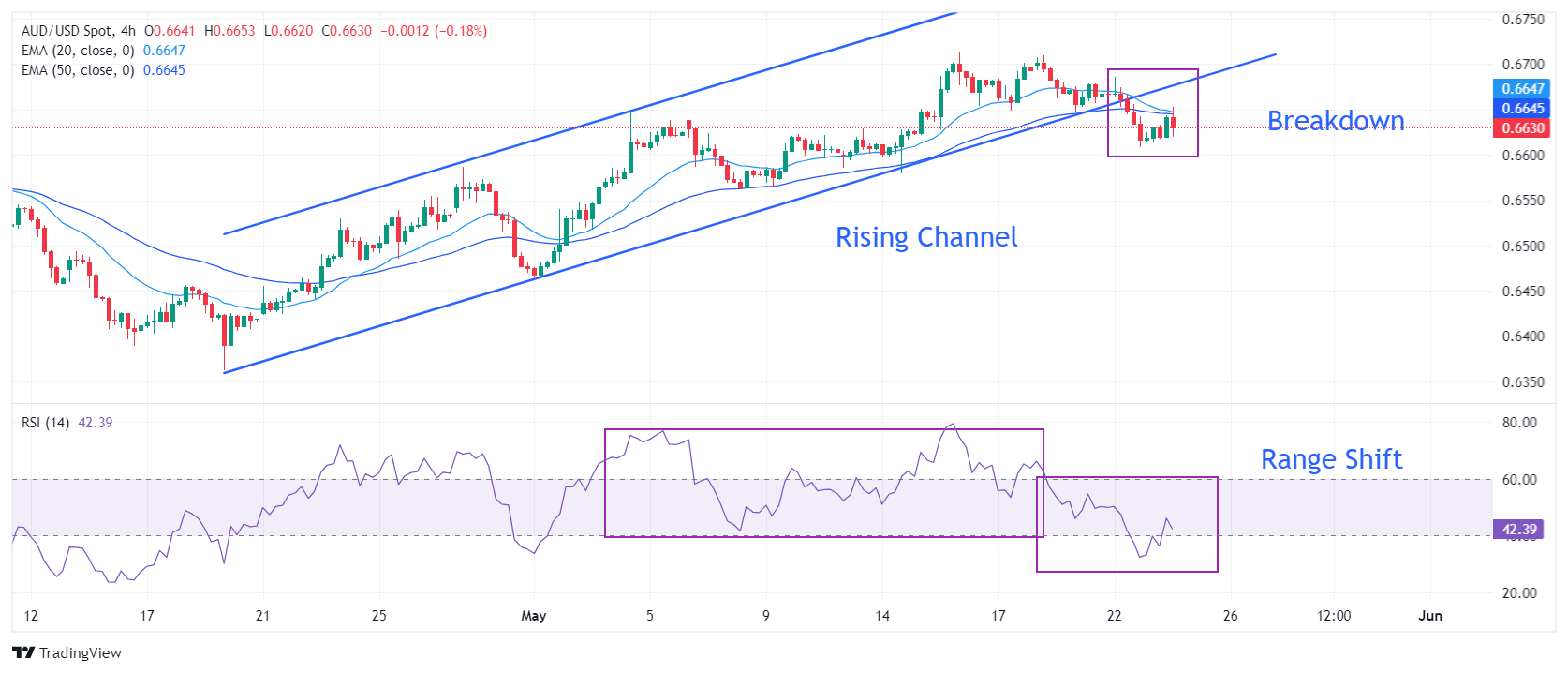
- AUD/USD turns volatile after a Rising Channel breakdown.

The AUD/USD pair retreats from the intraday high of 0.6650 in Thursday’s New York session. The Aussie asset comes under pressure as the US Dollar witnesses a strong buying interest after the S&P Global published an upbeat preliminary United States (US) PMI report for May. The US Dollar Index (DXY), which tracks the Greenback’s value against six major currencies, recovers entire intraday losses and jumps to 104.90.
According to the early US PMI report, Manufacturing PMI rose to 50.9, outperforming expectations and the prior reading of 50.0. The Services PMI also beat the consensus, jumped to 54.8 from the estimates and the former release of 51.3. The agency noted that the pace at which PMI increased was fastest in more than two years and the economy is on track to post a strong Gross Domestic Product (GDP) gain.
Strong preliminary PMI reading has dent investors’ confidence about the Federal Reserve (Fed) that it will begin reducing interest rates from their current levels in the September meeting. The CME FedWatch tool shows that traders see a 53% chance for the Fed lowering borrowing rates in September, which has come down from 58% after the release of the early PMI report.
Meanwhile, the Australian Dollar fails to maintain a firm-footing despite the communication from Reserve Bank of Australia (RBA) policymakers through May policy minutes was hawkish. The RBA minutes indicated that the board also discussed raising interest rates again.
AUD/USD has come under pressure after a breakdown of the Rising Channel chart pattern formed on a four-hour timeframe. A breakdown of the above-mentioned pattern suggests an establishment of a bearish reversal. The near-term outlook of the Aussie asset would worsen as the 20- and 50-period Exponential Moving Averages (EMAs) are on the verge of delivering a bearish crossover.
The 14-period Relative Strength Index (RSI) has shifted into the 20.00-60.00 range from the 40.00-80.00 zone, suggesting a bearish reversal.
More downside will appear if he major breaks below May 22 low at 0.6608, which will expose it to May 14 low at 0.6580, followed by May 1 high at 0.6540.
On the flip side, a decisive move above May’s high at 0.6714 will drive the asset towards January 3 high at 0.6771 and the round-level resistance of 0.6800
AUD/USD four-hour chart
Economic Indicator
S&P Global Composite PMI
The S&P Global Composite Purchasing Managers Index (PMI), released on a monthly basis, is a leading indicator gauging US private-business activity in the manufacturing and services sector. The data is derived from surveys to senior executives. Each response is weighted according to the size of the company and its contribution to total manufacturing or services output accounted for by the sub-sector to which that company belongs. Survey responses reflect the change, if any, in the current month compared to the previous month and can anticipate changing trends in official data series such as Gross Domestic Product (GDP), industrial production, employment and inflation. The index varies between 0 and 100, with levels of 50.0 signaling no change over the previous month. A reading above 50 indicates that the private economy is generally expanding, a bullish sign for the US Dollar (USD). Meanwhile, a reading below 50 signals that activity is generally declining, which is seen as bearish for USD.
Read more.Last release: Thu May 23, 2024 13:45 (Prel)
Frequency: Monthly
Actual: 54.4
Consensus: 51.1
Previous: 51.3
Source: S&P Global
Author

Sagar Dua
FXStreet
Sagar Dua is associated with the financial markets from his college days. Along with pursuing post-graduation in Commerce in 2014, he started his markets training with chart analysis.