|

AUD/USD Price Analysis: Seems vulnerable amid a potential bear flag on daily chart

  • AUD/USD off lows around 0.7350, but not out of the woods yet.
  • Bears are testing the bullish commitments at critical daily support.
  • Escalating covid concerns remain a drop, with all eyes on the RBA decision.

AUD/USD has bounced back above 0.7350, tracking the rally in the S&P 500 futures amid a recovery in the risk appetite.

Expectations of more monetary stimulus support likely from China combined with the progress on the US infrastructure bill boost the market mood, weighing negatively on the safe-haven US dollar.

Despite the rebound in the aussie, its bearish potential appears intact amid surging covid cases in Australia and extension of the lockdowns across the country. Traders also remain on the back foot ahead of the US ISM Manufacturing PMI and Reserve Bank of Australia’s (RBA) monetary policy decision.

As observed on AUD/USD’s daily chart, the aussie is testing the critical rising trendline support at 0.7330.

A daily closing below the latter could validate a bear flag formation, with a sell-off towards 0.7200 likely on the cards. Ahead of that the spot could test the 0.7300 level.

The 14-day Relative Strength Index (RSI) remains below the midline, allowing room for more declines.

AUD/USD: Daily chart
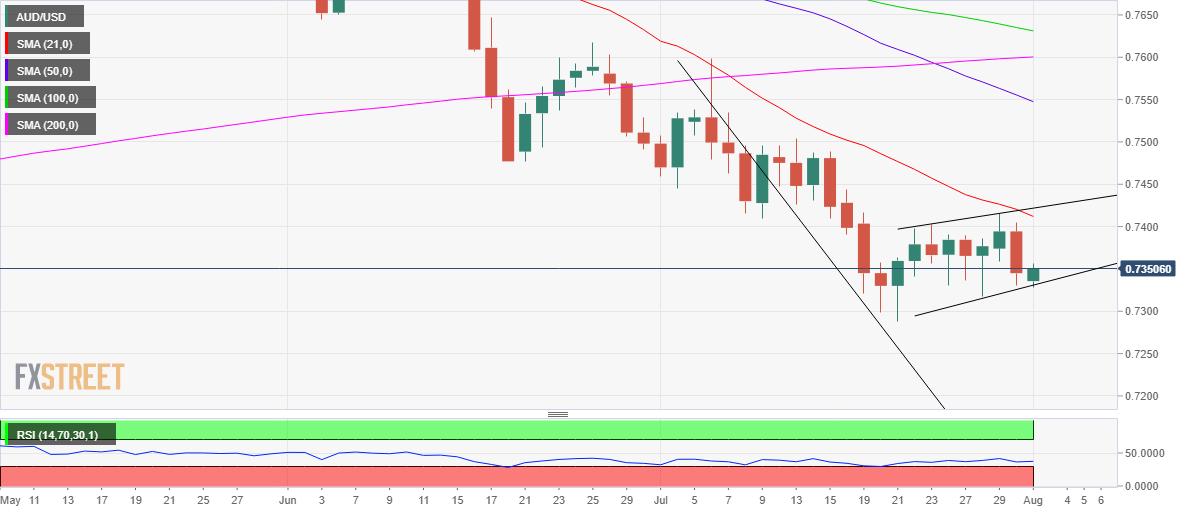
Meanwhile, any recovery attempts could face stiff resistance around 0.7420, where the bearish 21-Daily Moving Average (DMA) and rising trendline hurdle intersect.

A sustained break above the latter could negate the bearish momentum in the near term.

AUD/USD: Additional levels to consider

AUD/USD

Overview
Today last price0.7352
Today Daily Change0.0007
Today Daily Change %0.10
Today daily open0.7345
 
Trends
Daily SMA200.7415
Daily SMA500.7556
Daily SMA1000.7635
Daily SMA2000.7599
 
Levels
Previous Daily High0.7405
Previous Daily Low0.733
Previous Weekly High0.7415
Previous Weekly Low0.7317
Previous Monthly High0.7599
Previous Monthly Low0.7288
Daily Fibonacci 38.2%0.7359
Daily Fibonacci 61.8%0.7376
Daily Pivot Point S10.7315
Daily Pivot Point S20.7285
Daily Pivot Point S30.724
Daily Pivot Point R10.739
Daily Pivot Point R20.7435
Daily Pivot Point R30.7465

Author

Dhwani Mehta

Dhwani Mehta

FXStreet

Residing in Mumbai (India), Dhwani is a Senior Analyst and Manager of the Asian session at FXStreet. She has over 10 years of experience in analyzing and covering the global financial markets, with specialization in Forex and commodities markets.


More from Dhwani Mehta
Share:

Editor's Picks

USD/JPY stays below 160.50 as markets assess BoJ decision

USD/JPY fluctuates in a relatively narrow range above 160.00 on Tuesday as markets assess the Bank of Japan's (BoJ) decision to raise the policy rate by 25 at the June meeting. Meanwhile, investors keep a close eye on news coming out of the Middle East, while preparing for the critical Fed meeting.

AUD/USD trades in tight channel near 0.7050 despite hawkish RBA message

AUD/USD trades modestly lower on the day at around 0.7050 on Tuesday as markets adopt a cautious stance amid a lack of details surrounding the US-Iran peace agreement. The Reserve Bank of Australia (RBA) left the door open for possible policy tightening after leaving the interest rate unchanged, as expected, at the June meeting but failed to boost the Australian Dollar.

Gold trims gains, approaches $4,300

Gold now surrenders part of its initial advance and recedes to the vicinity of the $4,350 mark per troy ounce on Tuesday. The early enthusiasm sparked by the US-Iran peace deal has faded somewhat, prompting investors to adopt a more prudent stance as they await further details of the agreement and key guidance from the Fed.

Why a hawkish RBA is no longer enough to lift the Australian Dollar

The Reserve Bank of Australia delivered more than what markets expected: a hawkish hold that should have supported the Aussie. But markets widely ignored it.

BoJ just hiked and US-Iran deal is on the table: Why Japanese Yen is still around 160.00

The Bank of Japan lifted interest rates from 0.75% to 1.00%, its highest level in more than three decades. The landmark move aims to stabilize a sharply weakening Japanese Yen, but by looking at the immediate market reaction, it doesn’t look like it’s going to work.

Why a hawkish RBA is no longer enough to lift the Australian Dollar

The Reserve Bank of Australia delivered more than what markets expected: a hawkish hold that should have supported the Aussie. But markets widely ignored it, focusing instead on slowing economic growth and proving that central bank messaging alone isn’t always enough to drive currencies.