AUD/USD Price Analysis: Retreats from daily tops around 0.7390s towards 0.7330s
- After the US CPI report, the AUD/USD seesawed around the 0.7320-0.7392 range during the day.
- US CPI increased the most since 1990, topping 6.2%.
- AUD/USD Technical outlook: DMA’s above the spot price and the RSI indicate a downward bias in the near term.


The Australian dollar slides during the New York session, down 0.64%, trading at 0.7334 at the time of writing. Earlier in the Asian Pacific session, the pair edged slightly lower, around the 0.7350 area, in choppy trading conditions, sideways. When US inflation figures crossed the wires, the AUD/USD fluctuated around the 0.7339-92 range.
US CPI increased the most since 1990, topping 6.2%
The Labour Department reported on Wednesday that the US Consumer Price Index (CPI) for October increased by 6.2%, on annual base numbers, higher than the 5.3% foreseen by analysts. Additionally, unveiled that the Core CPI that excludes energy and food volatile items increased by 4.6% for the same period, more than the 4.3% estimated by economists.
According to the report, prices in energy, shelter, food, and vehicles triggered the spike in the CPI. Also, inflation is broadening beyond areas associated with a reopening.
AUD/USD Price Forecast: Technical outlook
Daily chart
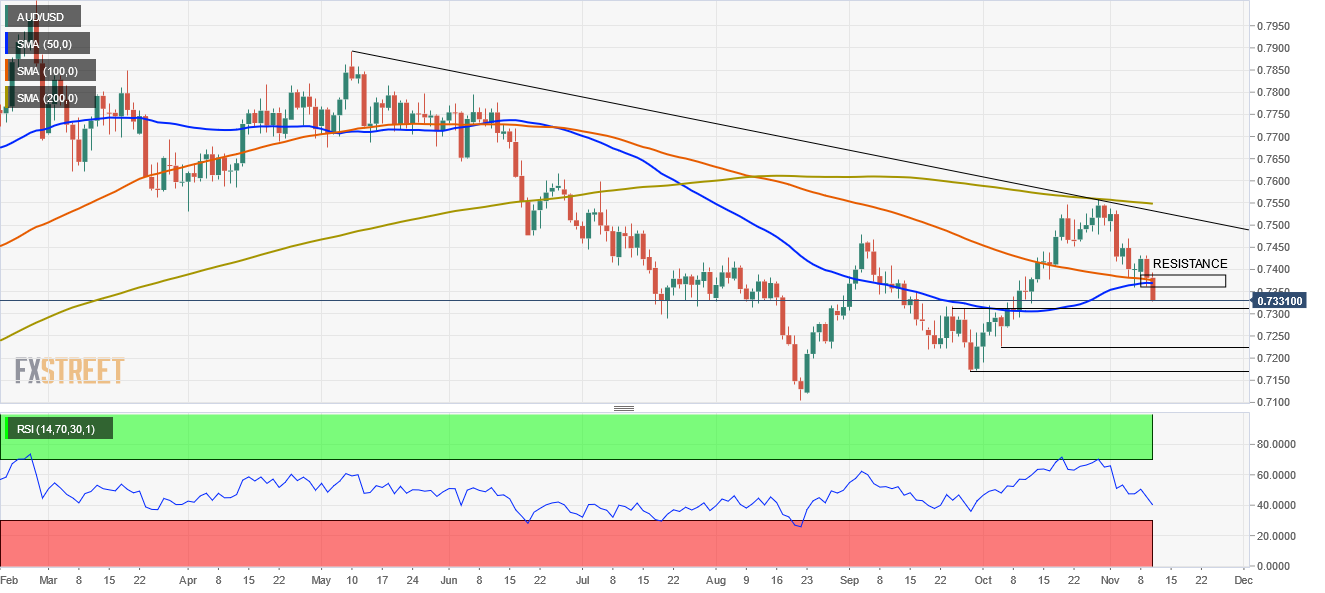
At press time, after the flurry of US CPI, the AUD/USD settled around the 0.7330 area. The daily moving averages (DMA’s) reside above the spot price, confirming in the near-term a downward bias, acting as resistance levels.
Also, the Relative Strength Index (RSI) at 39, below the 50-central line and with enough room before reaching oversold levels, adds another signal to the bearish bias.
To accelerate the downtrend, AUD/USD sellers will need a break below the September 24 high at 0.7316. In that outcome, the pair could travel south towards the October 6 low at 0.7225.
Author
Christian Borjon Valencia
FXStreet
Markets analyst, news editor, and trading instructor with over 14 years of experience across FX, commodities, US equity indices, and global macro markets.