|

AUD/USD Price Analysis: Likely test Ascending Triangle’s breakdown near 0.6520

  • AUD/USD finds a temporary support near 0.6500 though downside remains favored.
  • RBA’s high interest rates have deepened Australia’s cost of living crisis.
  • The US Dollar retreats from a six-week high despite upwardly revised Q4 GDP estimates.

The AUD/USD pair finds support slightly below the psychological support of 0.6500 in the early American session on Thursday. The Aussie asset discovers some buying interest as the US Dollar retreats after refreshing six-week high. However, the broader appeal of the Aussie asset is still downbeat as investors remain uncertain ahead of the United States core Personal Consumption Expenditure Price Index (PCE) data for February, which will be published on Friday.

The core PCE will provide cues about when the Federal Reserve (Fed) will begin reducing interest rates. The annual underlying inflation data is estimated to have grown steadily by 2.8%, with monthly growth declining to 0.3% from 0.4% in January.

The US Dollar Index failed to sustain six-week highs near 104.72 despite the final estimate from the US Bureau of Economic Analysis (BEA) for the final quarter of 2023 showing that the economy grew by 3.4%. As per the preliminary estimates, the economy expanded by 3.2%.

Meanwhile, the Australian Dollar broadly remains on the backfoot as the Reserve Bank of Australia's (RBA) higher Official Cash Rate (OCR) has deepened the cost-of-living crisis. The Australian Bureau of Statistics reported that monthly Retail Sales grew at a slower pace of 0.3% in February, against expectations of 0.4% and the former reading of 1.1%.

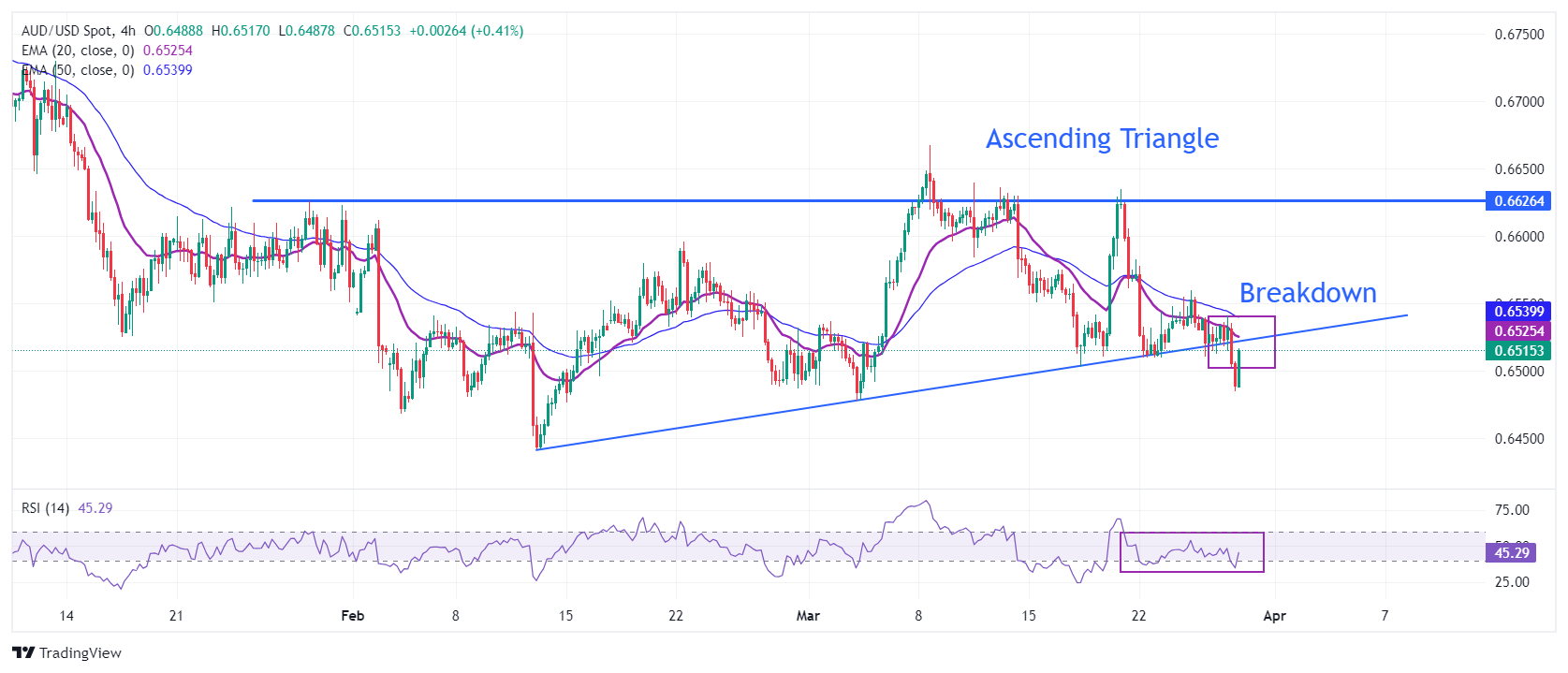
AUD/USD is expected to test the breakdown of the Ascending Triangle chart pattern near 0.6520 formed on a four-hour timeframe. The upward-sloping border of the aforementioned pattern is plotted from February 13 low at 0.6442 while the horizontal resistance is placed from January 30 high at 0.6626.

Downward-sloping 20- and 50-period Exponential Moving Averages (EMAs) at 0.6525 and 0.6538, respectively, indicate that near-term demand is weak.

The 14-period Relative Strength Index (RSI) oscillates inside the 40.00-60.00 range, indicating indecisiveness among market participants.

Investors might build fresh shorts after a pullback move near 0.6530. Profits on shorts would be booked near the psychological support of 0.6500 and February 13 low near 0.6440.

On the contrary, a sharp recovery move above March 26 high at 0.6560 will drive the asset toward the round-level resistance of 0.6600, followed by March 12 high at 0.6640.

AUD/USD four-hour chart
AUD/USD

Overview
Today last price0.6514
Today Daily Change-0.0020
Today Daily Change %-0.31
Today daily open0.6534
 
Trends
Daily SMA200.656
Daily SMA500.6551
Daily SMA1000.6596
Daily SMA2000.655
 
Levels
Previous Daily High0.6539
Previous Daily Low0.6511
Previous Weekly High0.6634
Previous Weekly Low0.6504
Previous Monthly High0.661
Previous Monthly Low0.6443
Daily Fibonacci 38.2%0.6528
Daily Fibonacci 61.8%0.6522
Daily Pivot Point S10.6518
Daily Pivot Point S20.6501
Daily Pivot Point S30.649
Daily Pivot Point R10.6545
Daily Pivot Point R20.6556
Daily Pivot Point R30.6573

Author

Sagar Dua

Sagar Dua

FXStreet

Sagar Dua is associated with the financial markets from his college days. Along with pursuing post-graduation in Commerce in 2014, he started his markets training with chart analysis.


More from Sagar Dua
Share:

Editor's Picks

AUD/USD renews two-month lows near 0.6950 after Australian CPI data

AUD/USD is renewing two-month lows near 0.6950 in the Asian session on Wednesday, as below-expectations August Australian underlying CPI data pours cold water on expectations for further RBA interest rate hikes. Chinese PMI data also fail to inspire the Australian Dollar, despite a pause in the US Dollar advance.

USD/JPY drops below 157.00 as intervention risks counter Japan's weak data

USD/JPY keeps losses below 157.00 in the Asian session on Wednesday, as hawkish BoJ expectations, along with intervention risks, underpin the Japanese Yen, countering dismal domestic factory output and retail sales data. Meanwhile, a broad US Dollar retreat also collaborates to the pair's downside.

Gold consolidates below $4,200, looks to US ADP and PCE

Gold struggles to capitalize on the previous day's recovery from an eight-week low, consolidating below $4,200 in the Asian session on Wednesday. The overnight slide in oil prices eased the US Treasury bond rout, supporting the bullion. However, Fed rate-hike bets and inflationary concerns keep bond yields near multi-year highs. Moreover, geopolitical uncertainties underpin the safe-haven US Dollar, which, in turn, limits bullion.

Ethereum sees profit-taking near $2,700 ahead of key US economic data
Ethereum (ETH) has shown signs of profit-taking near $2,700 over the past few days, with rising exchange deposits and a slowdown in exchange-traded fund (ETF) inflows ahead of US inflation and labor market data releases. The top altcoin's Exchange Reserves, which track the total amount of a crypto asset held across exchange wallets, have increased by roughly 125K ETH since Friday.
Silver is more volatile than Gold ahead of PCE and NFP. This chart shows the positioning gap
The market’s attention is focused on American data this week, but there’s something only those with a trained eye may be looking at: Gold and Silver positioning gap. Financial markets are moving on fears, mostly related to persistently high energy prices driven by the Middle East war. Sure, the US Dollar (USD) is strong, but at what cost?
Silver is more volatile than Gold ahead of PCE and NFP. This chart shows the positioning gap
The market’s attention is focused on American data this week, but there’s something only those with a trained eye may be looking at: Gold and Silver positioning gap. Financial markets are moving on fears, mostly related to persistently high energy prices driven by the Middle East war. Sure, the US Dollar (USD) is strong, but at what cost?