|

AUD/USD hovers near 0.6600 as markets await Aussie’s Business, Consumer Confidence data

  • AUD/USD up due to better sentiment, USD dip amid mixed Wall Street results.
  • US inflation steady; Fed's positive economy outlook influences currencies.
  • US inflation, Australian consumer confidence data critical for economic assessment.

The Australian Dollar posted solid gains on Monday, rising 0.42% against the US Dollar amid an improvement in risk appetite and a light economic calendar. The AUD/USD pair trades at 0.6604, virtually flat, as Tuesday’s Asian session begins.

AUD/USD sees a modest uptick after gaining on Monday, ahead of US CPI

Wall Street’s session concluded with a mixed bag of results. While the S&P 500 and the Dow Jones registered losses, the Nasdaq Composite saw a rise. This divergence was accompanied by a 0.16% decline in the Greenback, as indicated by the US Dollar Index (DXY), which stands at 104.12.

The US economic docket was light, except for the New York Fed Consumer Inflation Expectations for March, rising by 3%, unchanged compared to February’s data. Chicago’s Fed President Austan Goolsbee began the Fed parade on Monday, saying that the economy is on golden path, while emphasizing the economy remains strong due to a tight labor market.

US and Aussie economic data

In the meantime, traders are awaiting the latest inflation report in the United States (US), to have a better grasp of the disinflation process. If prices continue to trend lower, that would be negative for the buck and positive for risk-perceived assets, like the Aussie Dollar.

On Australia’s front, market players would be entertained by the Westpac Consumer Confidence and the NAB Business Confidence, both figures from March.

AUD/USD Price Analysis: Technical outlook

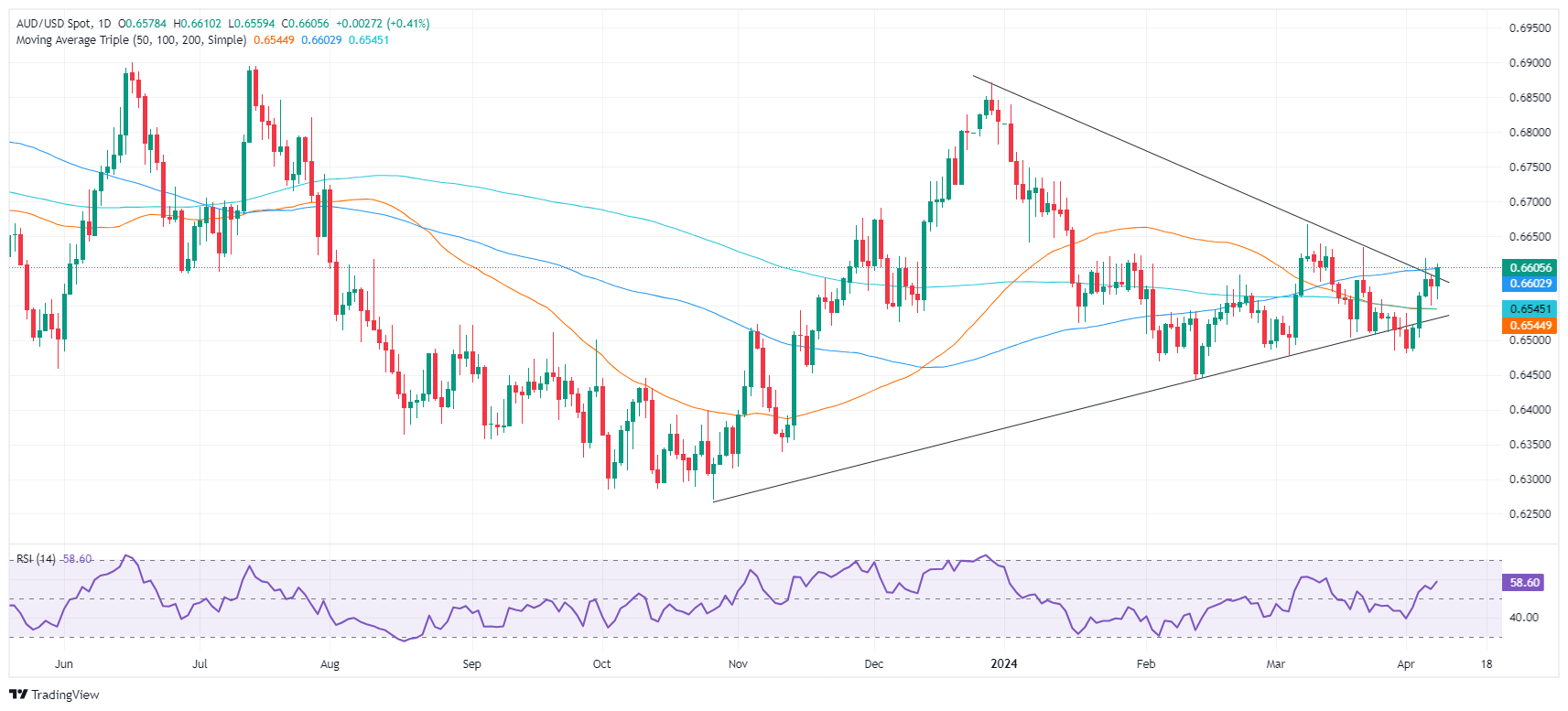
On Monday, the AUD/USD had risen above a downslope resistance trendline at around the 0.6580/90 area, which opened the door for buyers to reclaim 0.6600. They’re gathering momentum, as depicted by the Relative Strength Index (RSI), aiming north, with enough room to enter overbought conditions. If the pair surpasses the April 4 high of 0.6619, the next stop would be intermediate resistance at 0.634, the March 21 high ahead of March 8, and the latest higher high at 0.6667.

On the other hand, the AUD/USD first support would be the 100-day moving average (DMA) at 0.6600. A breach of the latter will expose the April 5 low of 0.6549, followed by the confluence of the 50/200-DMA at 0.6543.
AUD/USD

Overview
Today last price0.6604
Today Daily Change0.0026
Today Daily Change %0.40
Today daily open0.6578
 
Trends
Daily SMA200.6556
Daily SMA500.6545
Daily SMA1000.6603
Daily SMA2000.6545
 
Levels
Previous Daily High0.6594
Previous Daily Low0.6549
Previous Weekly High0.6619
Previous Weekly Low0.6481
Previous Monthly High0.6667
Previous Monthly Low0.6478
Daily Fibonacci 38.2%0.6566
Daily Fibonacci 61.8%0.6577
Daily Pivot Point S10.6554
Daily Pivot Point S20.6529
Daily Pivot Point S30.6509
Daily Pivot Point R10.6598
Daily Pivot Point R20.6618
Daily Pivot Point R30.6643

Author

Christian Borjon Valencia

Markets analyst, news editor, and trading instructor with over 14 years of experience across FX, commodities, US equity indices, and global macro markets.


More from Christian Borjon Valencia
Share:

Editor's Picks

AUD/USD sits near a one-month top, above 0.7000 amid fresh USD selling

AUD/USD holds above 0.7000 through the Asian session, trading near a one-month high touched earlier this Monday amid renewed US Dollar selling. US bond yields decline further amid a modest pullback in crude oil prices, capping the USD recovery from a three-week low. Moreover, bets for a November RBA rate hike support the Aussie, though upside seems capped ahead of the crucial two-day FOMC meeting, starting Tuesday.

USD/JPY struggles below 157.00 on weak USD; holds above one-month low ahead of Fed, BoJ meetings

USD/JPY attracts fresh sellers during the Asian session on Monday, stalling its recovery from the lowest level since September 18, touched Friday as a further decline in US bond yields weighs on the US Dollar. Meanwhile, the Japanese Yen benefits from a more hawkish BoJ, further weighing on the currency pair. The downside, however, seems limited as traders keenly await Fed and BoJ policy meetings later this week.

Gold sticks to modest recovery gains above $4,000 as Fed hike bets cap upside

Gold stages a modest recovery from the vicinity of a three-month low, trading above the $4,000 psychological mark through Monday’s Asian session amid a softer US Dollar. US President Donald Trump has ruled out immediate military action against Iran, triggering a modest pullback in crude oil prices. Furthermore, Federal Reserve officials have signaled no urgency to raise interest rates immediately.

Cardano's derivatives and on-chain data confirm bears in control

Cardano extends losses, trading below $0.202 after three consecutive weeks of more than 20% declines since early October. Selling pressure continues to build as weakening derivatives metrics, bearish on-chain signals and a deteriorating technical outlook point to further downside risks. Derivatives data shows a bearish bias for Cardano.

Flight to safety meets a high earnings bar as central bank week begins

Treasuries rallied again, equities are struggling, and central banks and earnings are on the horizon. Last week, US Treasuries rallied for a second consecutive week. This pushed 10s and 30s to 5% and 5.33%, respectively, flattening the curve even as Brent crude rallied about 7% to within striking distance of March peaks at US$119.50, and tech stocks posted a second straight week of losses.

What November 3 means for the Fed's rate path and the US Dollar

The USD faces a decisive period ahead of the November 3 midterm elections. While markets anticipate another interest rate increase from the Fed in December, the battle for control of Congress could reshape fiscal policy expectations and, indirectly, the path of US monetary policy in 2027.