AUD/USD hovers below 0.6500 weekly lows amid strong US data, RBA in focus
- AUD/USD stays at 0.6490, pressured by surging US Treasury yields and a strengthening US economic outlook.
- Mixed manufacturing PMI readings highlight contrasting economic narratives between the US and Australia.
- Upcoming RBA minutes and comments from central bank officials to offer insights into Australia's monetary policy trajectory.

On Monday, the Australian Dollar registered losses of 0.4% against the US Dollar, sponsored by an improvement in business activity in the United States (US). However, with the Tuesday Asian session beginning, the AUD/USD is virtually unchanged at 0.6490, near the weekly lows at the time of writing.
Australian Dollar struggles for direction against a robust US Dollar, with market eyes on RBA minutes and policy cues.
The economic docket features essential data driving financial markets' price action. Firstly, the Institute for Supply Management (ISM) revealed that March’s Manufacturing PMI improved to expansionary territory for the first time in nearly eighteen months. Figures came at 50.3, exceeding estimates of 48.4 and February’s 47.8. Before the ISM release, S&P Global depicted the US economy as beginning to slow down, as the March number came at 51.9, down from 52.2.
Following the data release, US Treasury yields soared, underpinning the Greenback. The US Dollar Index (DXY), which measures the currency against six peers, aims up 0.42% at 104.96, after briefly peaking above 105.00.
The market reaction is linked to traders cutting bets for a quarter of a percentage point by the Federal Reserve’s June meeting.
Delving into over-the-weekend data, Fed Chair Jerome Powell commented that the US Core PCE aligned with their estimates. He said they need more evidence before cutting rates, adding they aren’t in a hurry to cut rates.
In addition, the Aussie’s Jibun Bank Manufacturing PMI reading for March was 47.3, below estimates of 47.8. According to the report, conditions deteriorated due to falls in new work inflows, leading to a reduction in manufacturing output. This is the second consecutive negative reading in the manufacturing segment.
Upbeat data from China keep the AUD/USD from further sliding, as China’s Caixin PMIs beat estimates in March, with new export orders increasing.
Ahead of the day, AUD/USD traders will dissect the latest Reserve Bank of Australia (RBA) meeting minutes, looking for cues regarding the forward path of monetary policy. As of writing, RBA Assistant Governor Kent is crossing the wires.
AUD/USD Price Analysis: Technical outlook
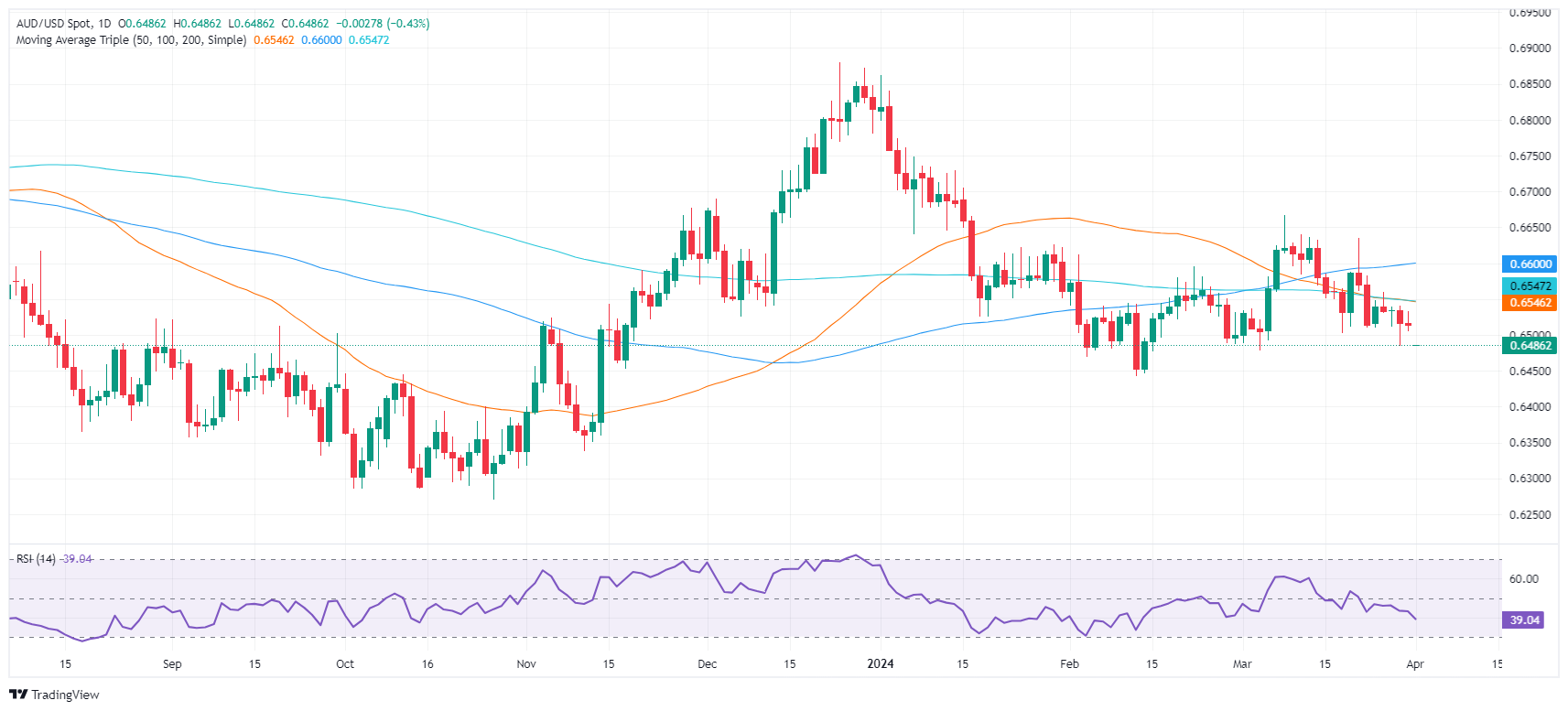
The AUD/USD seems to have bottomed out at around current levels, yet the Relative Strength Index (RSI) is bearish. If sellers push prices below the March 5 low of 0.6477, look for a pullback toward the February 13 low of 0.6442, ahead of 0.6400. On the flip side, the first resistance would be the 0.6500 mark, followed by the confluence of the 50 and 200-day moving averages (DMAs) at 0.6544.
Australian Dollar FAQs
One of the most significant factors for the Australian Dollar (AUD) is the level of interest rates set by the Reserve Bank of Australia (RBA). Because Australia is a resource-rich country another key driver is the price of its biggest export, Iron Ore. The health of the Chinese economy, its largest trading partner, is a factor, as well as inflation in Australia, its growth rate and Trade Balance. Market sentiment – whether investors are taking on more risky assets (risk-on) or seeking safe-havens (risk-off) – is also a factor, with risk-on positive for AUD.
The Reserve Bank of Australia (RBA) influences the Australian Dollar (AUD) by setting the level of interest rates that Australian banks can lend to each other. This influences the level of interest rates in the economy as a whole. The main goal of the RBA is to maintain a stable inflation rate of 2-3% by adjusting interest rates up or down. Relatively high interest rates compared to other major central banks support the AUD, and the opposite for relatively low. The RBA can also use quantitative easing and tightening to influence credit conditions, with the former AUD-negative and the latter AUD-positive.
China is Australia’s largest trading partner so the health of the Chinese economy is a major influence on the value of the Australian Dollar (AUD). When the Chinese economy is doing well it purchases more raw materials, goods and services from Australia, lifting demand for the AUD, and pushing up its value. The opposite is the case when the Chinese economy is not growing as fast as expected. Positive or negative surprises in Chinese growth data, therefore, often have a direct impact on the Australian Dollar and its pairs.
Iron Ore is Australia’s largest export, accounting for $118 billion a year according to data from 2021, with China as its primary destination. The price of Iron Ore, therefore, can be a driver of the Australian Dollar. Generally, if the price of Iron Ore rises, AUD also goes up, as aggregate demand for the currency increases. The opposite is the case if the price of Iron Ore falls. Higher Iron Ore prices also tend to result in a greater likelihood of a positive Trade Balance for Australia, which is also positive of the AUD.
The Trade Balance, which is the difference between what a country earns from its exports versus what it pays for its imports, is another factor that can influence the value of the Australian Dollar. If Australia produces highly sought after exports, then its currency will gain in value purely from the surplus demand created from foreign buyers seeking to purchase its exports versus what it spends to purchase imports. Therefore, a positive net Trade Balance strengthens the AUD, with the opposite effect if the Trade Balance is negative.
Author

Christian Borjon Valencia
FXStreet
Markets analyst, news editor, and trading instructor with over 14 years of experience across FX, commodities, US equity indices, and global macro markets.















