AUD/USD hovers around 0.6750s as Wall Street edges lower
- AUD/USD clings to decent gains as the mood shifts sour.
- A jump in US Treasury bond yields underpins the US Dollar and weighs on the Australian Dollar.
- AUD/USD: Struggles at the 0.6800 and tumbles 50 pips beneath the 0.6750 mark.

The Australian Dollar (AUD) appears to have bottomed around the 0.6680 area since December 19 and advanced toward the 0.6800 region amid an upbeat sentiment. Nevertheless, the choppiness of the last trading week of 2022 keeps traders at bay from opening fresh longs ahead of the month, quarter, and year-end flow, which usually benefits the US Dollar (USD). At the time of writing, the AUD/USD is trading at 0.6785.
Market sentiment shifted sour following the release of US Pending Home Sales for November, which plunged to 37.8% YoY contraction, compared to a previous reading of a 37% fall, while on a monthly basis, dived slightly improved but remained at -4% vs. expectations of -4.6%. According to the National Association of Realtors report, signings decreased to the lowest level outside of the pandemic in data back to 2001.
Aside from this, the Richmond Fed Manufacturing Index improved to 1, exceeding the previous month’s contraction to -9.
Even though sentiment improved throughout the Asian and European sessions, courtesy of China’s relaxing Covid-19 restrictions, of late shifted sour. Fears that the full reopening of China could unleash another raft of higher prices turned Wall Street into negative territory. Chinese authorities began to issue travel permits to Hong Kong residents and passports as it prepares to reopen borders on January 8.
The US Dollar Index, a gauge of the American Dollar (USD) value against a basket of peers, is recovering some ground back above 104.000, gaining 0.12%, underpinned by US yields. The 10-year benchmark note rate is up three and a half bps, at 3.879%.
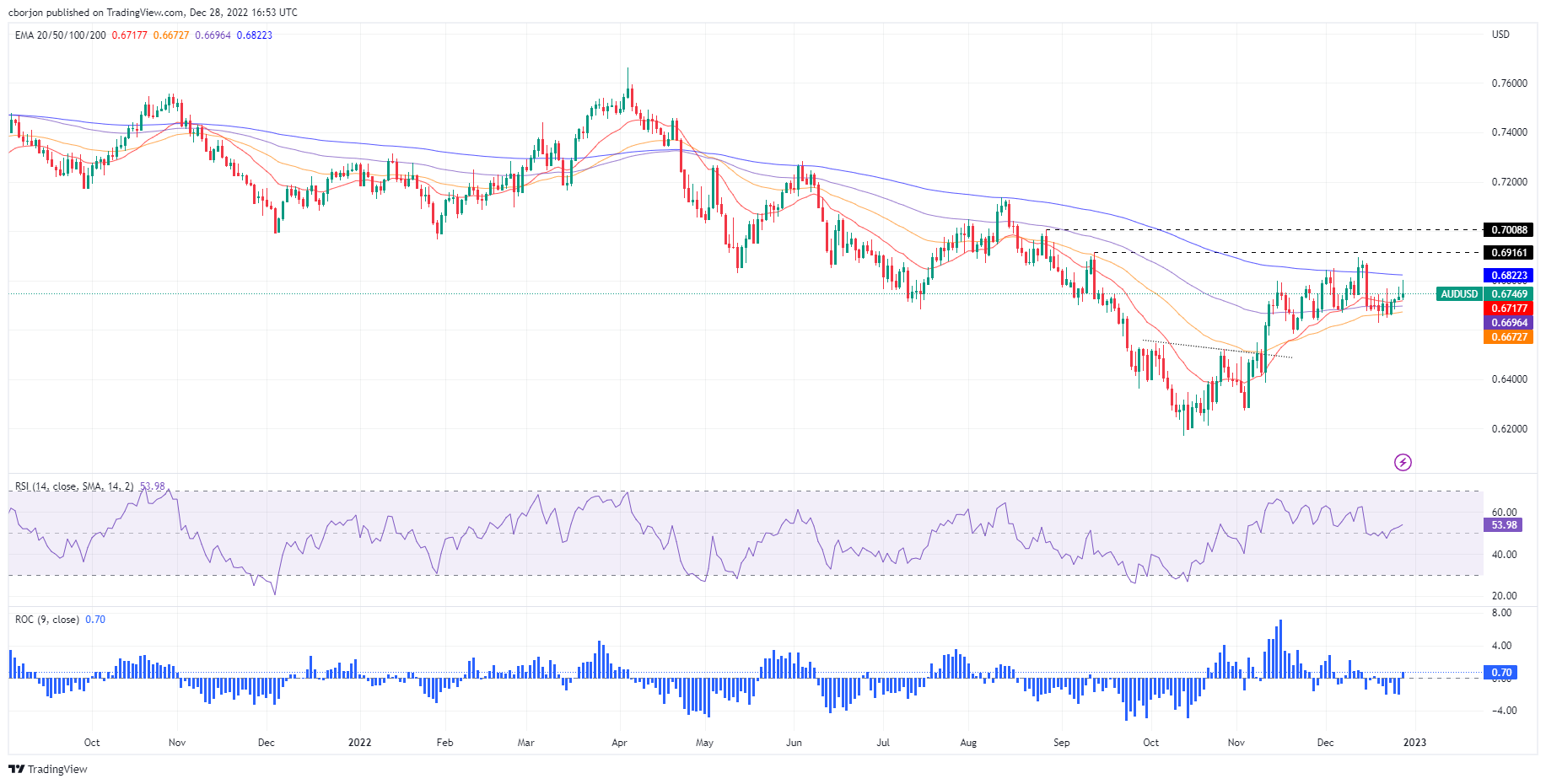
AUD/USD Price Analysis: Technical outlook
From a technical perspective, the AUD/USD trades within the boundaries of the 200-day Exponential Moving Average (EMA) and the 20-day EMA, each at 0.6822 and 0.6718. After peaking at a two-week high of 0.6801, the AUD/USD edged lower, while the Relative Strength Index (RSI) has been unable to crack above the 60 mark, signaling that buying pressure is abating. If the AUD/USD tumbles below 0.6750, the next support would be 20-day EMA at 0.6718. Breach of the latter will expose the 0.6700 mark.
As an alternate scenario, the AUD/USD first resistance would be 0.6800, followed by the 200-day EMA at 0.6822.
Author

Christian Borjon Valencia
FXStreet
Markets analyst, news editor, and trading instructor with over 14 years of experience across FX, commodities, US equity indices, and global macro markets.