AUD/USD falls back to lows of the day after release of US data
- AUD/USD declines back down to the 0.6580s.
- Aussie employment data and Fed meeting outcome had boosted the pair early on Thursday.
- Upbeat US data saw AUD/USD fall back down, however, during the US session.

AUD/USD trades back down at the lows of the day, during the US session on Thursday, after a batch of relatively strong American data helped the US Dollar (USD) claw back lost ground.
The pair had been rising after the Australian Dollar (AUD) got a boost from data showing an unexpected fall in Australian unemployment and a much higher-than-expected increase in the number of people in employment down under.
The release of US PMI data for March, Initial Jobless Claims and the Philadelphia Fed Manufacturing Index all supported the USD and saw the pair fall back close to the day’s lows in the 0.6580s.
US S&P Global Composite PMI came out at 52.2, holding above the 50 level that distinguishes expansion from contraction. US Manufacturing PMI came out at 52.5, beating estimates and previous figures. Services PMI, however, undershot expectations and previous results, coming out at 51.7 in March.
The Philadelphia Fed Manufacturing Survey came out higher than estimated at 3.2, and Initial Jobless Claims at 210K were lower than the 215K forecast.
AUD/USD rallied on Wednesday, triggered by US Dollar (USD) weakness after the Federal Reserve (Fed) March policy meeting.
At the meeting the Fed reaffirmed they would still be cutting interest rates by roughly three quarters of a percent in 2024 despite speculation they would reduce rate cuts because of recent warmer-than-expected inflation reading.
Early on Thursday the pair continued rising after it was revealed Australia added 116,500 new employees in February and saw its Unemployment Rate fall to 3.7% from 4.1%, according to data from the Australian Bureau of Statistics.
The figures beat economists expectations of a 40,000 increase in employees and unemployment at 4.0%.
The data supports the outlook for the Australian economy, is likely indicative of higher wage inflation going forward and suggests the Reserve Bank of Australia (RBA) will have to keep interest rates higher for longer. Higher interest rates are positive for currencies as they attract greater inflows of foreign capital.
The technical picture shows the AUD/USD pair oscillating in a range between roughly 0.6480 and 0.6650.
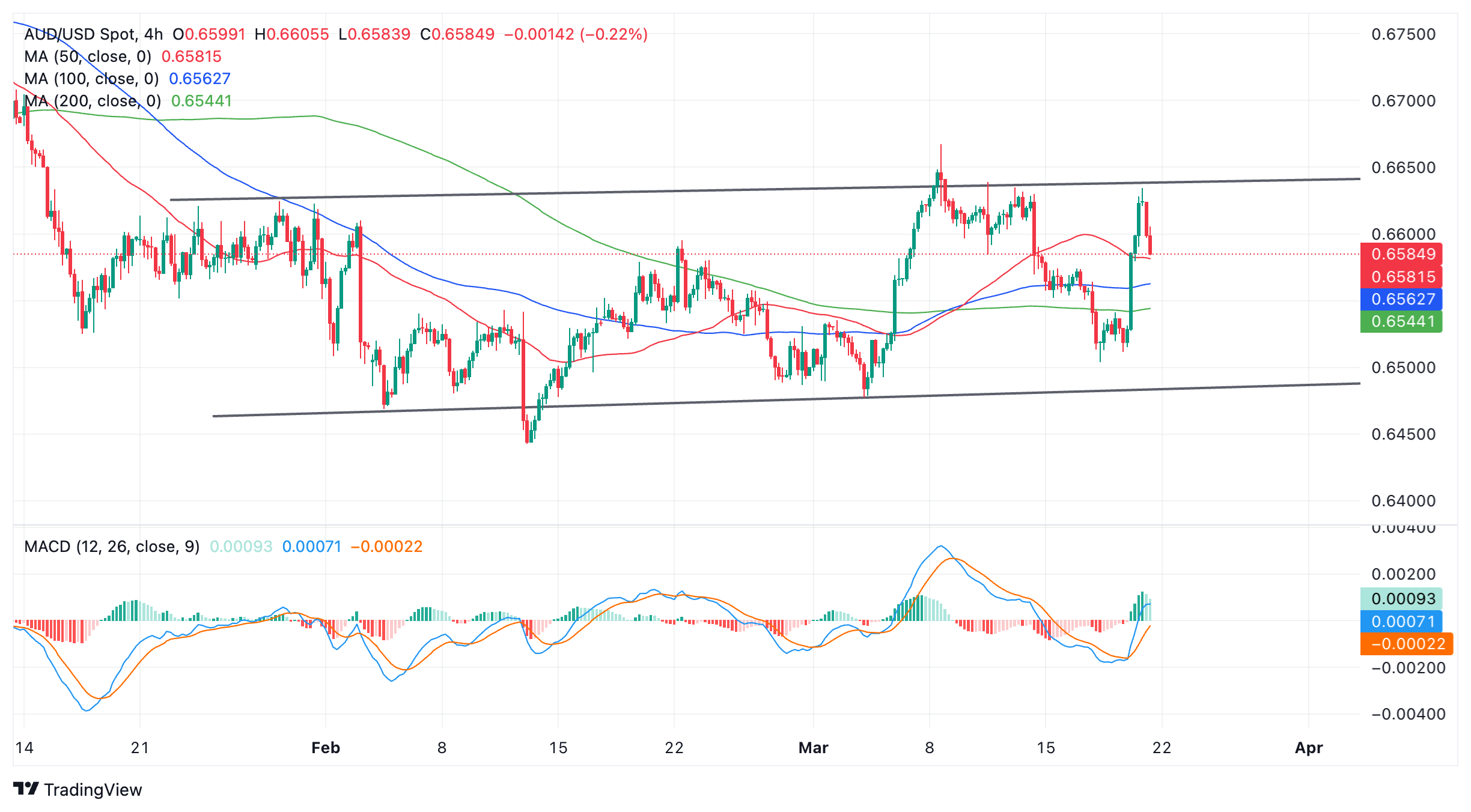
Australian Dollar versus US Dollar: 4-hour chart
The pair is currently turning around at the range highs and looking vulnerable to selling off.
A continued move lower could see it return to the base of the range. Alternatively a break above the 0.6668 highs would provide confirmation of a higher high and the formation of a bullish short-term trend.
Author

Joaquin Monfort
FXStreet
Joaquin Monfort is a financial writer and analyst with over 10 years experience writing about financial markets and alt data. He holds a degree in Anthropology from London University and a Diploma in Technical analysis.