|

AUD/NZD Price Analysis: Pair remains under pressure below key moving averages

  • AUD/NZD was seen trading near the 1.0840 zone, mildly recovering after earlier losses
  • The pair maintains a strong bearish outlook, trading below all major moving averages
  • Momentum indicators suggest continued downside, though RSI signals nearing oversold conditions

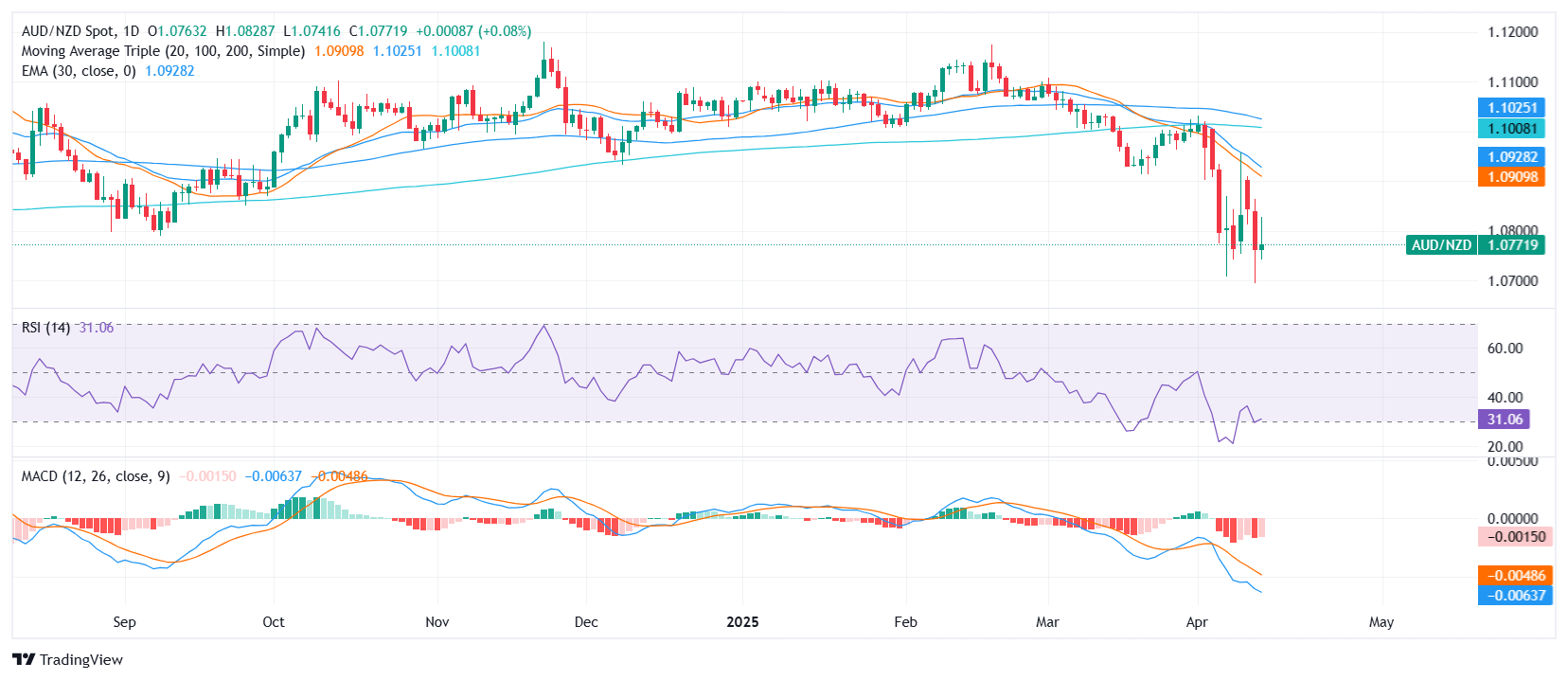
The AUD/NZD pair continues to reflect bearish dynamics on Monday’s session , with price action hovering near the 1.0800 region. Despite a modest rebound, the broader technical structure remains tilted to the downside.

The pair is firmly capped by all major moving averages — both simple and exponential — from short to long-term periods. Notably, the 10-day EMA at 1.08495, 50-day EMA at 1.09701, and 100-day SMA at 1.10280 all point south, while the 200-day SMA at 1.10080 reinforces the longer-term bearish bias. Price has failed to break above any of these key averages, confirming sustained downside pressure.

Momentum indicators are aligned with the bearish theme. The MACD continues to print red bars, while the Momentum oscillator at −0.02370 also suggests weak buying interest. Meanwhile, the RSI sits at 33.10 approaching oversold territory, which may slow the pace of losses but does not yet support a reversal.

Support is seen at 1.0800 and 1.0765, with deeper losses eyeing the 1.0720 zone. Resistance levels are stacked at 1.0850, 1.0900, and 1.0970 (50-day EMA). For now, the technical landscape favors sellers while the pair remains suppressed below these moving averages.

Daily chart
Author

Patricio Martín

Patricio is an economist from Argentina passionate about global finance and understanding the daily movements of the markets.


More from Patricio Martín
Share:

Markets move fast. We move first.

Orange Juice Newsletter brings you expert driven insights - not headlines. Every day on your inbox.

By subscribing you agree to our Terms and conditions.

Editor's Picks

EUR/USD eases from around 1.1800 after US GDP figures

The US Dollar is finding some near-term demand after the release of the US Q3 GDP. According to the report, the economy expanded at an annualized rate of 4.3% in the three months to September, well above the 3.3% forecast by market analysts.

GBP/USD retreats below 1.3500 on modest USD recovery

GBP/USD retreats from session highs and trades slightly below 1.3500 in the second half of the day on Tuesday. The US Dollar stages a rebound following the better-than-expected Q3 growth data, limiting the pair's upside ahead of the Christmas break.

Gold: Record rally sustains above $4,500 on safe-haven flows

Gold sustains the record-setting rally above $4,500 in the Asian session on Wednesday. The Israel-Iran conflict and the escalating US-Venezuela tensions boost safe-haven flows into Gold. Furthermore, US Q3 GDP data fails to lift the US Dollar amid growing bets for two Fed rate cuts in 2026, underpinning the non-yielding bullion. 

The crypto market is preparing us for a deeper global sell-off

The crypto market capitalisation fell by 1.4% to $2.97T, falling below the $3T mark once again. The market was unable to repeat the robust rebound from the local bottom, as it did after 23 November and 2 December, indicating increased pressure from sellers.

Ten questions that matter going into 2026

2026 may be less about a neat “base case” and more about a regime shift—the market can reprice what matters most (growth, inflation, fiscal, geopolitics, concentration). The biggest trap is false comfort: the same trades can look defensive… right up until they become crowded.

Dogecoin ticks lower as low Open Interest, funding rate weigh on buyers

Dogecoin extends its decline as risk-off sentiment dominates across the crypto market. DOGE’s derivatives market remains weak amid suppressed futures Open Interest and perpetual funding rate.















