Advanced Micro Devices Stock Forecast: AMD sinks to 50-day moving average as Nvidia unveils Blackwell GPU
- Advanced Micro Devices stock lost nearly 5% on Tuesday.
- AMD was chosen by Sony to partner on an autonomous driving system.
- Nvidia announced its new Blackwell GPU architecture to replace Hopper.
- CEO Huang calls B200 'world's most powerful chip'.

Advanced Micro Devices (AMD) stock dipped more than 4.8% on Tuesday as the market for semiconductors consolidated following the launch of Nvidia’s (NVDA) annual GTC conference. Nvidia announced its new Blackwell GPU, which should enlarge the overall market for artificial intelligence chips but possible at the expense of its competitors.
The NASDAQ added 0.2% on Tuesday, while the S&P 500 advanced close to double that level. Nvidia gained 1% despite selling off earlier in the session, while Super Micro Computer (SMCI) plunged 9%.
AMD stock news: LiDAR partnership with Sony
On Tuesday, Advanced Micro Devices announced that it had entered into a partnership with Sony Semiconductor Solutions to supply the latter with “adaptive computer technology” used in its LiDAR system for autonomous driving.
AMD’s technology allows for faster data processing and better accuracy, based on Sony’s initial testing, and the semiconductor company beat out other unnamed competitors to secure Sony’s business.
"By incorporating AMD adaptive computing technology into our LiDAR reference design, we are poised to set new standards in performance, reliability, and adaptability,” said Takayoshi Ozone, general manager of the Automotive Development Department at Sony Semiconductor Solutions.
Nvidia GTC Conference introduces new tech
It would appear that Nvidia’s Blackwell announcement, however, overshadowed AMD’s LiDAR news on Tuesday. The new Blackwell architecture is destined to replace the current state-of-the-art Hopper architecture for AI-specialized chips.
Nvidia CEO Jensen Huang called the new Blackwell-based B200 GPU “the world’s most powerful chip.” By adding two of them alongside a Grace CPU on a single board, Nvidia announced its new GB200 “superchip”.
Jensen said that Nvidia would be packaging 36 Grace CPUs and 72 Blackwell GPUs into a complete system with 72-GPU NVLinks. Called the GB200 NVL72, the new system is able to process large language models (LLMs) about thirty times faster than current leading tech.
These new products could make it tough for Advanced Micro Devices to keep up. Analysts from several investment banks said in regard to the GTC conference that Nvidia was continuing to outflank all of its opponents.
Semiconductor stocks FAQs
A semiconductor is a term for various types of computer chips. Officially called semiconductor devices, these computer chips rely on semiconductor materials like silicon and gallium arsenide to process the electrical current that produces the modern world of computing. They come in many shapes, sizes, enhancements and configurations such as diodes, transistors and integrated circuits to more complicated applications like DRAM memory, simple processors and even GPUs.
First, there are the pure chip designers, such as Nvidia, AMD, Broadcom and Qualcomm. These companies use sophisticated software to design and test chips. Second, there are the equipment manufacturers that provide the machines necessary to build computer chips. These include ASML and Lam Research. Then, there are foundries that manufacture the chips. These include Taiwan Semiconductor and GlobalFoundries. Last of all are the integrated device manufacturers who design their own chips and additionally manufacture themselves. These include Samsung and Intel.
It is the observation that the number of transistors in an integrated circuit doubles every two years. The “law” is named after Gordon Moore, who founded Fairchild Semiconductor and later Intel. The doubling is possible due to the shrinking size of process nodes or parts in the computer chip. In 1971 the advanced commercial manufacturing had reached 10 microns in width. In 1987 semiconductor technology had advanced to 800 nanometers in width. By 1999, this process had moved to 180 nanometers. By 2007, the size had dropped to 32 nanometers, and this fell all the way to 3 nanometers in 2022, which is close to the size of human DNA.
In 2022, the global semiconductor industry had revenues just under $600 billion. In total, the industry shipped 1.15 trillion semiconductor units in 2021. The leading nations involved in the semiconductor supply chain are Taiwan, the United States, China, the Netherlands, South Korea, Japan and Israel.
AMD stock forecast
AMD stock reached down to the 50-day Simple Moving Average on Tuesday for the first time in six months. This proves that the pullback was more severe than any others witnessed this year.
The sell-off will likely continue for a few reasons. First, AMD stock closed below the January 25 range high just below $185. That level held significance after showing up as resistance once again in late February. Secondly, the Moving Average Convergence Divergence (MACD) has witnessed a clear, bearish turnover.
If the downturn continues, AMD stock could cascade through lower lows to the $162.50 level that acted as support twice in January and once in late February. You can bet on it if AMD closes below the 50-day SMA later this week.
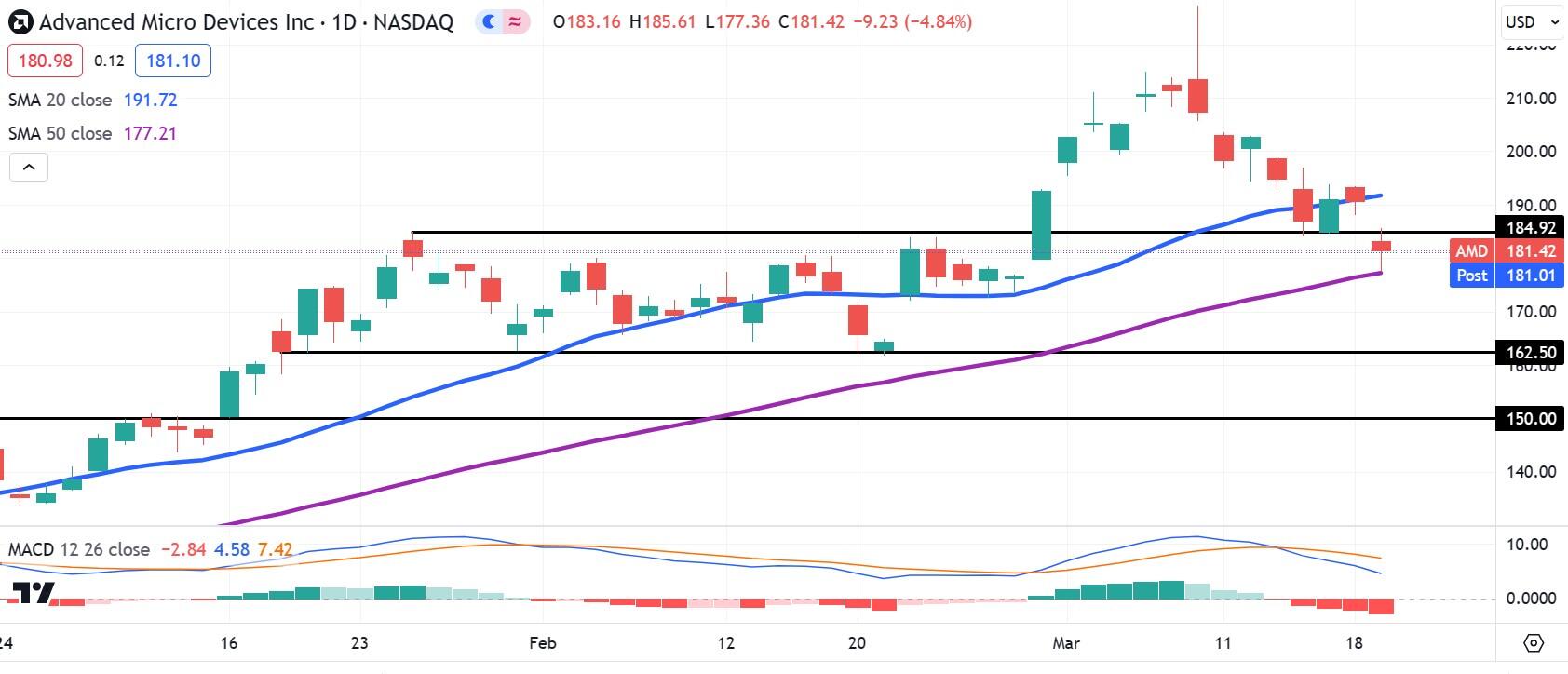
AMD daily stock chart
Author

Clay Webster
FXStreet
Clay Webster grew up in the US outside Buffalo, New York and Lancaster, Pennsylvania. He began investing after college following the 2008 financial crisis.