A benefit of hearing from traders is being reminded of what the real issues are.

Stuff we’ve all dealt with.

Received an email this week about a current approach being too ambiguous.

Ambiguity erodes mental resilience

It’s hard to think in odds when you don’t have clarity.

You find yourself invested in the outcome of each trade.

You end up unsure of the best decision instead of knowing the right one — all while in the heat of battle.

That’s what made me look back at the two trades I’d just taken during today’s trading session, while we were waiting on the Bank of Japan rate decision.

You can see the two trades below. They're nothing-special trades, but you’ll see the connection in a moment.
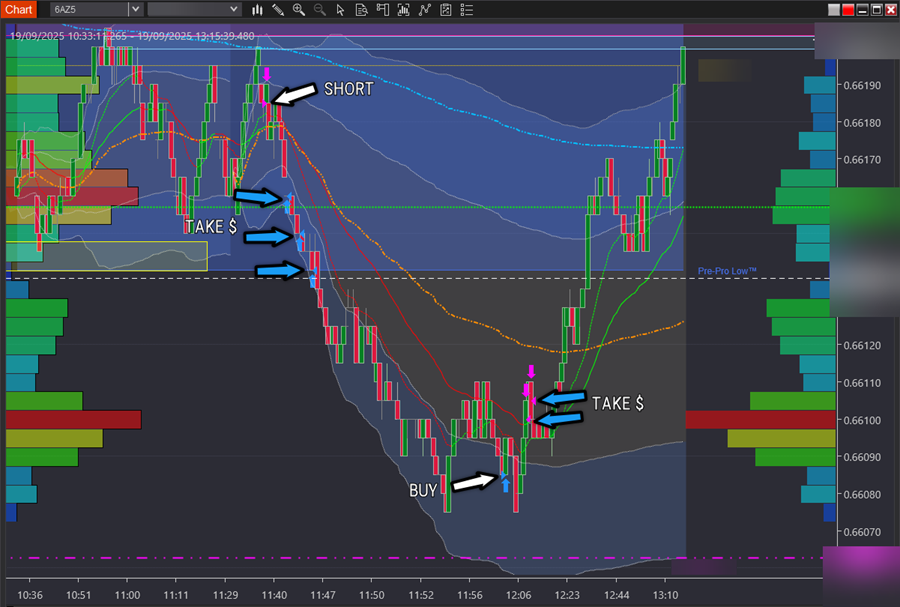
Two nothing-special trades

The first was "The House" playbook trade.
That was followed by fading bad trading—a playbook trade where you know in the moment it’s bad trading you can take the other side of.

Now imagine you’d made those trades. Would your focus be:

Look what I missed out on the short. And how much did I just leave on the table for that long?

But it’s not about that.

Consistent profitable trading year after year is about frequently taking money out of the market.

That’s the gig. Taking money, over and over.

Every week, there are trades that pay well.
Once or twice a month, there are monster payouts.

But most profitable trades are nothing to write home about.
And equally, losers are nothing to get caught up in—because the playbook trades are designed to keep losses to papercuts.

Every experienced trader will say the same.
And not because it sounds good. Because they’ve lived it.
Ever wonder why they sound so indifferent about outcomes? That's why.

The point is this

Trading is already hard enough.

You want to offload as much of the decision-making as possible.
That’s why I operate from a framework of principles and rules of thumb, and only enter specific and repeatable playbook trades.

Even if I get the narrative wrong and I’m on the wrong side, the nuanced specifics of every playbook trade tell you.
That’s enough. I don’t need to think harder. I just get out.

You still have to comprehend the narrative. But even if you get it wrong, the playbook protects you.
That’s the point.

And that changes you.
It moulds you into someone who no longer fixates on the monetary outcome of each trade.
You prefer how it feels to trade with the certainty of systems and odds.
Because you’ve lived it.

I got reminded of that again reading that email.

You can’t think in odds until you’ve done enough reps to prove your process is worth trusting.
If your framework and repeatable trades are ambiguous, you never get black-and-white numbers on how your trading stacks up.
And without that, there’s no real confidence. No trust in what you’re doing.

But once you’ve done enough reps in something that is precisely clear — with no ambiguity — you reach a point where any individual trade means nothing.

Not the two trades I just made.
Not the losses I make regularly either.

Why give a damn?

It’s meaningless.

But I can say that because I’ve done enough of the 'reps'.

Yet there’s no magic number or reps.
Everyone’s different.

All I know is it has to be enough to change your thinking.

And that doesn’t happen because you want it to. It happens because you do it.

I attended Ashtanga yoga classes with Peter Sanson.
He's one of the most advanced practitioners of Ashtanga globally.
But of all the advanced postures he can do, there was this one far less advanced posture that took him four years to do.

Some aspects of trading can come quickly. Others don’t.
It doesn’t mean you stop.
You just keep doing it.

The most important shift in trading is thinking in odds

Not caring about if this trade wins, wins bigger, didn’t win enough, loses—whatever it is.

It’s a shift in how you think about trading and how you go about trading.

You stop assigning meaning to outcomes.

Because you’re thinking in odds.
There is the uncertainty of the next trade outcome.
But there is the certainty of odds.

And once you’ve done it enough, it’s in your DNA.
Even though it’s the shift most traders never make, you're now thinking and acting like the traders you most admire.


Forex and derivatives trading is a highly competitive and often extremely fast-paced environment. It only rewards individuals who attain the required level of skill and expertise to compete. Past performance is not indicative of future results. There is a substantial risk of loss to unskilled and inexperienced players. The high degree of leverage can work against you as well as for you. Before deciding to trade any such leveraged products you should carefully consider your investment objectives, level of experience, and risk appetite. The possibility exists that you could sustain a loss of some or all of your initial investment and therefore you should not invest money that you cannot afford to lose. You should be aware of all the risks associated with trading on margin, and seek advice from an independent

Editors’ Picks

EUR/USD moves sideways below 1.1800 on Christmas Eve

EUR/USD moves sideways below 1.1800 on Christmas Eve

EUR/USD struggles to find direction and trades in a narrow channel below 1.1800 after posting gains for two consecutive days. Bond and stock markets in the US will open at the usual time and close early on Christmas Eve, allowing the trading action to remain subdued. 

GBP/USD keeps range around 1.3500 amid quiet markets

GBP/USD keeps range around 1.3500 amid quiet markets

GBP/USD keeps its range trade intact at around 1.3500 on Wednesday. The Pound Sterling holds the upper hand over the US Dollar amid pre-Christmas light trading as traders move to the sidelines heading into the holiday season. 

USD/JPY corrects further to near 155.80, gives up entire BoJ policy-led gains

USD/JPY corrects further to near 155.80, gives up entire BoJ policy-led gains

USD/JPY surrenders its entire gains made on the BoJ policy announcement day, and retraces to near 155.80. Investors are in vogue over the outlook of the BoJ’s monetary tightening campaign. The Fed is expected to cut interest rates by at least 50 bps next year.


Editors’ Picks

EUR/USD Price Annual Forecast: Growth to displace central banks from the limelight in 2026

EUR/USD Price Annual Forecast: Growth to displace central banks from the limelight in 2026 Premium

What a year! Donald Trump’s return to the United States (US) Presidency was no doubt what led financial markets throughout 2025. His not-always-unexpected or surprising decisions shaped investors’ sentiment, or better said, unprecedented uncertainty.

Gold Price Annual Forecast: 2026 could see new record-highs but a 2025-like rally is unlikely

Gold Price Annual Forecast: 2026 could see new record-highs but a 2025-like rally is unlikely Premium

Gold hit multiple new record highs throughout 2025. Trade-war fears, geopolitical instability and monetary easing in major economies were the main drivers behind Gold’s rally.

GBP/USD Price Annual Forecast: Will 2026 be another bullish year for Pound Sterling?

GBP/USD Price Annual Forecast: Will 2026 be another bullish year for Pound Sterling? Premium

Having wrapped up 2025 on a positive note, the Pound Sterling (GBP) eyes another meaningful and upbeat year against the US Dollar (USD) at the start of 2026.

US Dollar Price Annual Forecast: 2026 set to be a year of transition, not capitulation

US Dollar Price Annual Forecast: 2026 set to be a year of transition, not capitulation Premium

The US Dollar (USD) enters the new year at a crossroads. After several years of sustained strength driven by US growth outperformance, aggressive Federal Reserve (Fed) tightening, and recurrent episodes of global risk aversion, the conditions that underpinned broad-based USD appreciation are beginning to erode, but not collapse.

Bitcoin Price Annual Forecast: BTC holds long-term bullish structure heading into 2026

Bitcoin Price Annual Forecast: BTC holds long-term bullish structure heading into 2026

Bitcoin (BTC) is wrapping up 2025 as one of its most eventful years, defined by unprecedented institutional participation, major regulatory developments, and extreme price volatility.

RECOMMENDED LESSONS

5 Forex News Events You Need To Know

In the fast moving world of currency markets where huge moves can seemingly come from nowhere, it is extremely important for new traders to learn about the various economic indicators and forex news events and releases that shape the markets. Indeed, quickly getting a handle on which data to look out for, what it means, and how to trade it can see new traders quickly become far more profitable and sets up the road to long term success.

Top 10 Chart Patterns Every Trader Should Know

Chart patterns are one of the most effective trading tools for a trader. They are pure price-action, and form on the basis of underlying buying and selling pressure. Chart patterns have a proven track-record, and traders use them to identify continuation or reversal signals, to open positions and identify price targets.

7 Ways to Avoid Forex Scams

The forex industry is recently seeing more and more scams. Here are 7 ways to avoid losing your money in such scams: Forex scams are becoming frequent. Michael Greenberg reports on luxurious expenses, including a submarine bought from the money taken from forex traders. Here’s another report of a forex fraud. So, how can we avoid falling in such forex scams?

What Are the 10 Fatal Mistakes Traders Make

Trading is exciting. Trading is hard. Trading is extremely hard. Some say that it takes more than 10,000 hours to master. Others believe that trading is the way to quick riches. They might be both wrong. What is important to know that no matter how experienced you are, mistakes will be part of the trading process.

Strategy

Money Management

Psychology

Best Brokers of 2025