Hello traders! This week’s newsletter comes to you from sunny southern California where I’m teaching a futures class. Today we talked about trendlines, so guess what this week’s letter is about?

In the world of trading, trendlines actually have many uses. For example, you can use them to help define a trend, be it up or down; you can use them to help with trade management, meaning, staying in a trade; you can also use them to help you decide when to get into a trade. Let’s explore these, shall we?

How to Use Trendline to Define a Trend

First of all, way back when you were in second grade and your teacher was showing you how to draw a line, how many points did you need to draw that first line? If you answered 2, congratulations you got it right. However, in the world of trading we need to add a little extra. In trading, we will draw an upward sloping trendline off of two swing lows on the chart, and a downward sloping trend line off of two swing highs on a chart.
AUDUSD

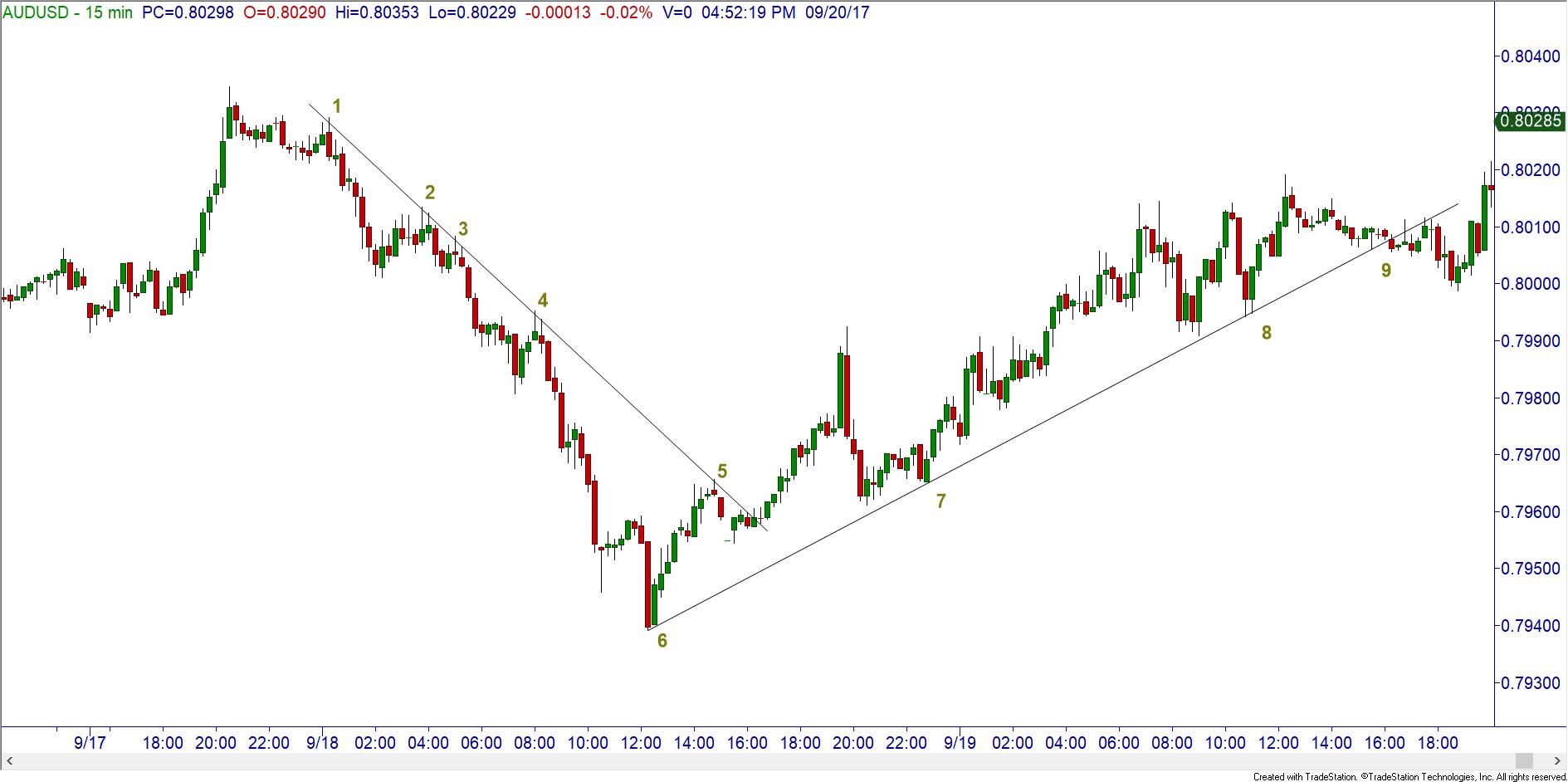
On this AUDUSD 15-minute chart, I’ve drawn in a down trendline off of the highs marked 1, 2, 3, 4 and 5. I’ve also drawn in an up trendline off of the lows marked 6, 7, 8 and 9. Now, the EARLIEST I could have drawn in the down trendline is at point 2. Remember, it takes two points to DRAW the line. However, in trading we need at least one more touch of the trendline to CONFIRM that the trendline is valid – meaning that someone with more money than us is drawing in the same trendline and trading off of it. As you can see, price bounced off this trendline at points 3, 4 and 5, confirming that this was a tradable line.

It’s the same but the opposite with an up trendline. The earliest we could have drawn in this line is at point 7, with points 8 and 9 confirming this trendline. There are numerous other potential trendlines on this chart, I hope with a little practice you will be able to spot them in seconds!

Earlier in the newsletter it was mentioned that we can use trendlines for several different things in trading. The first was defining the trend. As long as price is below a downward sloping trendline, we can say the trend is down and we should look for short trades; if price is above an upward sloping trendline, we can say the trend is up and we should look for long trades. Simple enough.

How to Use Trendlines to Keep You in a Trade

The next previously mentioned use for trendlines is a bit trickier. How can we use them to keep us in a trade? In this 480 minute chart of the EURUSD, you could have gone long in the demand zone at the blue arrow. Part of your trade could have been exited at the supply zone where the green arrow is located. But haven’t we heard that “letting our winners run” is how to make the big money? Of course we have. Now, as long as price stays ABOVE the drawn in trendline, we could hold on to part of our position. By following this simple rule, we should have stayed in this trade all the way up to where the red circle is marked, where we broke below/closed beneath that trendline. Not a bad trade at all!

EURUSD

How to Use Trendline to Decide When to Enter a Trade

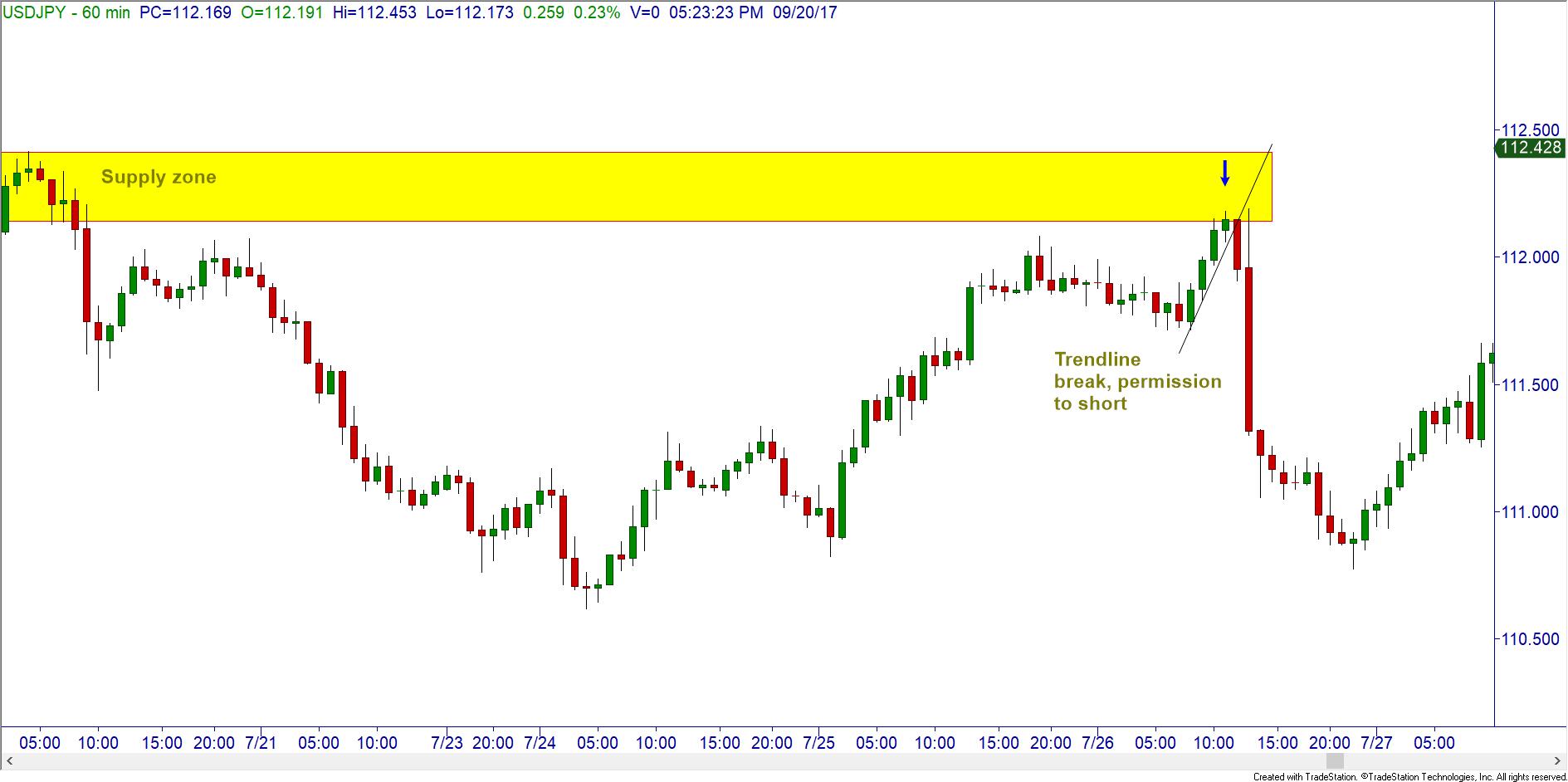
The third potential use for trendlines is to help decide when to get into a trade. On this 60 minute USDJPY chart, a supply zone has been defined that we would consider going short against.
USDJPY

As price is moving UP to our supply zone, we are in a short term uptrend. You can use a trendline break to give yourself “permission” to go short. If price would have stayed above the trendline, you would have to patiently wait for a break to hit the short button. If price didn’t break the line before trading all of the way through the supply zone, YOU WOULDN’T HAVE TAKEN THE TRADE, which would have prevented a losing trade. Cool trick, huh?

There you have it traders! Three easy ways to use trendlines. For more in depth applications, I’ll see you in class!

Learn to Trade Now


This content is intended to provide educational information only. This information should not be construed as individual or customized legal, tax, financial or investment services. As each individual's situation is unique, a qualified professional should be consulted before making legal, tax, financial and investment decisions. The educational information provided in this article does not comprise any course or a part of any course that may be used as an educational credit for any certification purpose and will not prepare any User to be accredited for any licenses in any industry and will not prepare any User to get a job. Reproduced by permission from OTAcademy.com click here for Terms of Use: https://www.otacademy.com/about/terms

Editors’ Picks

EUR/USD trades with negative bias around 1.1730 amid recovering USD; downside seems limited

EUR/USD trades with negative bias around 1.1730 amid recovering USD; downside seems limited

The EUR/USD pair kicks off the new week on a softer note, though it remains within striking distance of the highest level since early October, touched last Thursday. Spot prices currently trade around the 1.1730 region, down less than 0.10% for the day.

GBP/USD holds steady above mid-1.3300s as traders await key data and BoE this week

GBP/USD holds steady above mid-1.3300s as traders await key data and BoE this week

The GBP/USD pair remains on the defensive during the Asian session on Monday, though it lacks bearish conviction and holds above the 200-day Simple Moving Average pivotal support. Spot prices currently trade around the 1.3360 region, nearly unchanged for the day.

USD/JPY drops toward 155.50 amid Fed-BoJ monetary policy divergence

USD/JPY drops toward 155.50 amid Fed-BoJ monetary policy divergence

USD/JPY stays under pressure toward 155.50 in the Asian session on Monday. The pair remains on the back foot as the Japanese Yen continues to draw support from the expectations of Fed-BoJ monetary policy divergence and a risk-off market profile. Fedspeak is next in focus.


Editors’ Picks

AUD/USD hovers around 0.6650, unfazed by poor China's activity data

AUD/USD hovers around 0.6650, unfazed by poor China's activity data

AUD/USD is keeping its range around 0.6650 in Monday's Asian trading. little affected by downbeat China's activity data for November. The country's Retail Sales, Fixed Asset Investment and Industrial Production data came in below forecasts and refuelled economic growth concerns. 

USD/JPY drops toward 155.50 amid Fed-BoJ monetary policy divergence

USD/JPY drops toward 155.50 amid Fed-BoJ monetary policy divergence

USD/JPY stays under pressure toward 155.50 in the Asian session on Monday. The pair remains on the back foot as the Japanese Yen continues to draw support from the expectations of Fed-BoJ monetary policy divergence and a risk-off market profile. Fedspeak is next in focus.

Gold regains traction toward $4,350 in the final full week of 2025

Gold regains traction toward $4,350 in the final full week of 2025

Gold price picks up bids once again toward $4,350 in Asian trading on Monday. The precious metal extends its upside to the highest since October 21 amid the prospect of interest rate cuts by the US Federal Reserve next year. The delayed US Nonfarm Payrolls report for October will be in the spotlight later on Tuesday. 

Week ahead: US NFP and CPI, BoE, ECB and BoJ mark a busy week

Week ahead: US NFP and CPI, BoE, ECB and BoJ mark a busy week

After Fed decision, dollar traders lock gaze on NFP and CPI data. Will the BoE deliver a dovish interest rate cut? ECB expected to reiterate “good place” mantra. Will a BoJ rate hike help the yen recover some of its massive losses?

Big week ends with big doubts

Big week ends with big doubts

The S&P 500 continued to push higher yesterday as the US 2-year yield wavered around the 3.50% mark following a Federal Reserve (Fed) rate cut earlier this week that was ultimately perceived as not that hawkish after all. The cut is especially boosting the non-tech pockets of the market.

RECOMMENDED LESSONS

5 Forex News Events You Need To Know

In the fast moving world of currency markets where huge moves can seemingly come from nowhere, it is extremely important for new traders to learn about the various economic indicators and forex news events and releases that shape the markets. Indeed, quickly getting a handle on which data to look out for, what it means, and how to trade it can see new traders quickly become far more profitable and sets up the road to long term success.

Top 10 Chart Patterns Every Trader Should Know

Chart patterns are one of the most effective trading tools for a trader. They are pure price-action, and form on the basis of underlying buying and selling pressure. Chart patterns have a proven track-record, and traders use them to identify continuation or reversal signals, to open positions and identify price targets.

7 Ways to Avoid Forex Scams

The forex industry is recently seeing more and more scams. Here are 7 ways to avoid losing your money in such scams: Forex scams are becoming frequent. Michael Greenberg reports on luxurious expenses, including a submarine bought from the money taken from forex traders. Here’s another report of a forex fraud. So, how can we avoid falling in such forex scams?

What Are the 10 Fatal Mistakes Traders Make

Trading is exciting. Trading is hard. Trading is extremely hard. Some say that it takes more than 10,000 hours to master. Others believe that trading is the way to quick riches. They might be both wrong. What is important to know that no matter how experienced you are, mistakes will be part of the trading process.

Strategy

Money Management

Psychology

Best Brokers of 2025
















