The evolving AI narrative: From semis to software

Key points
Shift from hardware to software: AI enthusiasm is moving from semiconductors like NVIDIA and AMD to software leaders such as Salesforce and Palantir, signaling a maturing market narrative.
Why software? Software companies are driving AI adoption with tools for data utilization, enterprise integration, and scalable revenue models, making them indispensable in the AI ecosystem.
Potential emerging winners: Cloud giants like Microsoft and Oracle, AI-powered cybersecurity firms like Crowdstrike, and generative AI pioneers like Adobe are poised to benefit from this shift.
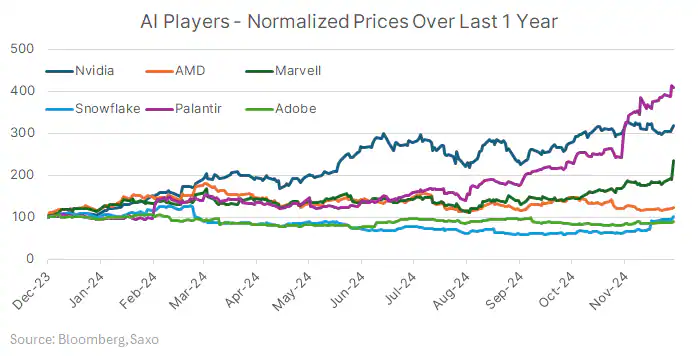
The market's obsession with AI is evolving. After fueling a massive rally in semiconductor stocks like NVIDIA and AMD, the enthusiasm is now shifting toward software companies, with names like Marvell, Snowflake and Palantir leading the charge. This pivot underscores the growing realization that AI's true potential lies in its application across industries, not just in the hardware powering it.
The semiconductor surge
Semiconductors were the initial winners of the AI boom, driven by the race to develop the processing power needed for advanced AI models. NVIDIA's leadership in GPUs and AMD's innovations positioned them as the flagship names of the rally. While these "shovels" remain essential tools in the ongoing AI gold rush, the spotlight is shifting. As the focus moves to delivering real-world AI applications, investor enthusiasm is increasingly turning toward software companies that bring AI to life.
Why software is the next frontier
Data utilization: Snowflake specializes in data storage and analytics, providing the critical infrastructure to harness and deploy AI effectively. Its strong position in the data space enables companies to leverage AI for business intelligence and analytics at scale.
AI monetization success: Salesforce’s AgentForce, launched in October, is an early success in AI monetization, enhancing sales processes with AI-driven automation and personalization capabilities.
AI integration: Palantir has established itself as a leader in operational AI and decision-making tools, helping enterprises integrate AI seamlessly into their workflows. With its stock up 300% YTD, Palantir's AI platform is gaining traction in government, defense, and enterprise sectors, positioning it as a standout in the AI ecosystem.
Broader applications: Unlike semis, whose primary growth is tied to hardware sales, software companies benefit from recurring revenues and diverse use cases across sectors.
As adoption deepens, the focus will likely move toward companies offering scalable AI solutions for enterprises. Investors looking to ride this wave should consider a barbell strategy—balancing exposure between the hardware providers (semiconductors) and the enablers (software companies).
Who could be the next winners in the AI revolution?
The next wave of AI winners will likely span industries that incorporate AI into their operations and products. Cloud computing, cybersecurity, healthcare, and generative AI remain key areas of focus.
1. Cloud providers
Cloud infrastructure is critical for storing, processing, and deploying AI solutions. These giants stand to benefit as AI adoption grows.
-
Microsoft (MSFT): Integrating OpenAI’s models into Azure, driving enterprise AI adoption.
-
Amazon (AMZN): AWS’s suite of AI and machine learning tools like SageMaker continues to lead.
-
Oracle (ORCL): Positioned well with its AI-powered cloud solutions and strong focus on enterprise clients.
-
Alphabet (GOOGL): Google Cloud leverages its deep AI expertise and market-leading research.
2. AI-powered cybersecurity
The surge in AI adoption raises the stakes for protecting systems and data, making AI-driven cybersecurity solutions a critical growth area.
-
CrowdStrike (CRWD): Pioneering predictive threat detection with AI.
-
Palo Alto Networks (PANW): Expanding its use of AI to enhance network security and threat prevention.
3. Generative AI applications
Generative AI is transforming industries, from content creation to drug discovery, offering immense growth potential for enabling platforms.
-
Adobe (ADBE): Its Firefly tools cater to the growing demand for generative content creation.
-
ServiceNow (NOW): Using generative AI to automate workflows and enhance productivity.
4. AI-oriented SaaS and data companies
As AI adoption scales, SaaS and data companies providing the foundation for AI solutions are becoming indispensable.
-
Snowflake (SNOW): Enabling data-driven AI applications with its robust platform.
-
Palantir (PLTR): Operational AI and decision-making tools make it a standout in enterprise markets.
5. AI-powered healthcare
The healthcare sector is poised for disruption as AI transforms diagnostics, drug discovery, and personalized medicine.
-
Intuitive Surgical (ISRG): AI-powered robotics enhance surgical precision.
-
Moderna (MRNA): Using AI to accelerate vaccine development and mRNA innovations.
6. Hardware beyond semiconductors
AI requires a broader ecosystem of specialized hardware beyond semiconductors, creating new opportunities.
-
Arista Networks (ANET): Providing networking solutions tailored for AI-scale workloads.
-
Pure Storage (PSTG): Gaining traction for its AI-optimized storage solutions.
7. AI-powered consumer products
As AI integrates into consumer technologies, companies leveraging AI in smart devices, AR/VR, and autonomous vehicles stand to gain.
-
Apple (AAPL): Innovating AI-driven features in its ecosystem and exploring AR/VR.
-
Tesla (TSLA): Advancing AI in autonomous driving and energy solutions.
ETF opportunities
-
For semis exposure: Consider ETFs like SOXX (iShares Semiconductor ETF) or SMH (VanEck Semiconductor ETF).
-
For AI software: Look at funds like AIQ (Global X Artificial Intelligence & Technology ETF) or BOTZ (Global X Robotics & Artificial Intelligence ETF).
-
For cloud growth: Consider CLOU (Global X Cloud Computing ETF).
-
For AI-driven cybersecurity: HACK (ETFMG Prime Cyber Security ETF).
-
For automation and robotics exposure: ROBO (Global X Robotics & AI ETF).
By focusing on these next-wave beneficiaries, investors can position themselves to capitalize on AI’s transformative potential across the economy.
Read the original analysis: The evolving AI narrative: From semis to software
Author

Saxo Research Team
Saxo Bank
Saxo is an award-winning investment firm trusted by 1,200,000+ clients worldwide. Saxo provides the leading online trading platform connecting investors and traders to global financial markets.