‘Never turn a profit into a loss. Never change your stop. Never turn a day trade into a strategic position’. These and other market clichés point to the perennial danger of letting a desire for greater profits corrupt your trade discipline. A trader can always find a new rationale for sustaining a losing position: tomorrow’s statistic will provide a base; the stop-level was barely breached; the pair rebounded; the next support will surely hold; the moon is in the seventh house--a rather dated joke but with the point that the reasons for keeping a losing position take more from emotion than from any reliable trade intelligence. All belie the key point that it is almost always smarter to close an existing position at a modest profit or with a small loss than to invest emotional capital in a market turn, no matter how secure your new trade logic seems. Pause, reassess and if conditions warrant, open a new position.
In early 2007 Eur/Yen has been in a strong uptrend for more than a year driven higher by the 2%+ interest differential between European and Japanese rates. When the cross broke above the trend channel for the second time in early April 2007 I went long at 157.50, with a stop at 156.25. As the cross moved higher in the second quarter I moved my stop finally placing it at 160.95 in late May. My take profit at 165.00 was reached in mid-June. But instead of executing I abandoned the order. I decided that the ECB’s rate policy, which had steadily increased rates from 2.00% at the end of 2005 and had just hiked again on June 13th to 4.00% would push the cross even higher. The trend seemed unstoppable. The Eur/Yen did move higher reaching 168.96 on July 13th but then it fell sharply, crashing through my now defunct take profit at 165.00 on July 26th. Then on August 1st, in volatile action, it broke through my stop at 160.95, which I did not execute, to 160.44. The rebound that day was sharp closing at 162.46. I felt relieved that I had held the position. As the stop at 160.95 was now just below the top of the trend channel (161.25) and the penetration of the top border of the channel on the 1st (and my stop at 160.95) had been brief and the recovery had been both rapid and substantial I decided that these two conditions had formed a new strong technical base just above 161.00. I left the stop at 160.95, confident that my long position was now supported by technical and fundamental considerations and that the plunge had been normal profit taking in an otherwise strong uptrend.
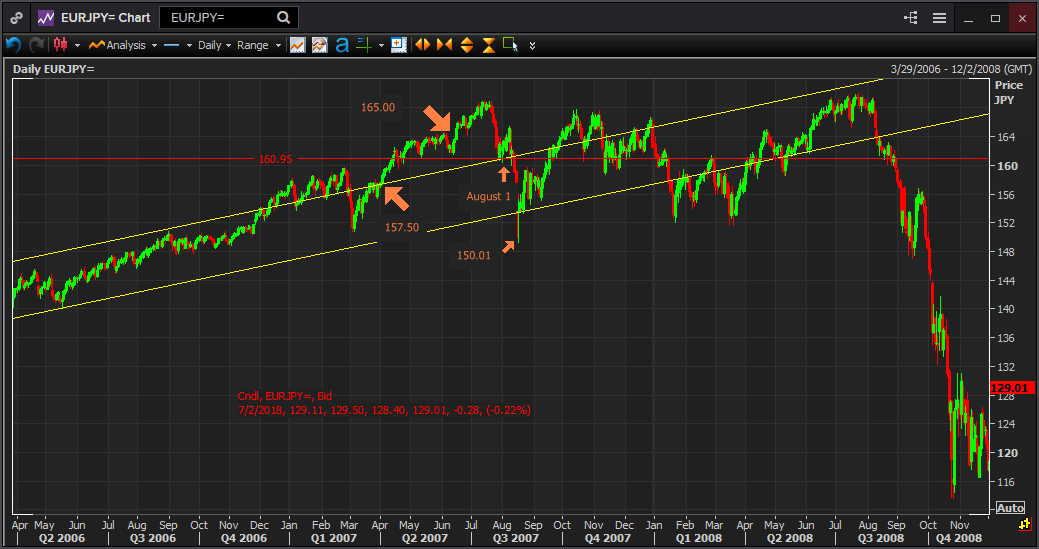
Since this is a cautionary tale we know that my assumption was almost immediately disproved. The cross did move higher touching 165.40 on August 8th. I did not take profit, now operating on my new technical and fundamental assumptions. On the 9th it dropped three and a half figures (open 165.03, close 161.57). On the 10th it moved up about 50 points ending at 162.10. On Monday the 13th the descent began in earnest, closing at 160.88. Still, I did not execute my stop at 160.95. But on the 14th, 15th and 16th the cross cascaded lower shedding ten figures from the open on the 14th (160.72) to the low on the 16th (150.01) closing at 153.34. As the market crashed on the 16th I executed my original stop at 156.25.
Information on these pages contains forward-looking statements that involve risks and uncertainties. Markets and instruments profiled on this page are for informational purposes only and should not in any way come across as a recommendation to buy or sell in these assets. You should do your own thorough research before making any investment decisions. FXStreet does not in any way guarantee that this information is free from mistakes, errors, or material misstatements. It also does not guarantee that this information is of a timely nature. Investing in Open Markets involves a great deal of risk, including the loss of all or a portion of your investment, as well as emotional distress. All risks, losses and costs associated with investing, including total loss of principal, are your responsibility. The views and opinions expressed in this article are those of the authors and do not necessarily reflect the official policy or position of FXStreet nor its advertisers. The author will not be held responsible for information that is found at the end of links posted on this page.
If not otherwise explicitly mentioned in the body of the article, at the time of writing, the author has no position in any stock mentioned in this article and no business relationship with any company mentioned. The author has not received compensation for writing this article, other than from FXStreet.
FXStreet and the author do not provide personalized recommendations. The author makes no representations as to the accuracy, completeness, or suitability of this information. FXStreet and the author will not be liable for any errors, omissions or any losses, injuries or damages arising from this information and its display or use. Errors and omissions excepted.
The author and FXStreet are not registered investment advisors and nothing in this article is intended to be investment advice.
Editors’ Picks
How will US Dollar react to October and November NFP? – LIVE
The US Bureau of Labor Statistics (BLS) will publish the official employment report for the first time since the government reopened. Nonfarm Payrolls figures for October and November could provide key insights into the labor market conditions and influence the market pricing of the Fed's rate outlook.
EUR/USD holds around 1.1750 after weak German and EU PMI data
EUR/USD maintains its range trade at around 1.1750 in European trading on Tuesday. Weaker-than-expected December PMI data from Germany and the Eurozone make it difficult for the Euro to find demand, while investors refrain from taking large USD positions ahead of key employment data.
GBP/USD climbs above 1.3400 after upbeat UK PMI data
GBP/USD gains traction and trades in positive territory above 1.3400 on Tuesday as the British Pound benefits from upbeat PMI data. Later in the day, crucial data releases from the US, including Nonfarm Payrolls, Retail Sales and PMI, could trigger the next big action in the pair.
Gold retreats from seven week highs on profit-taking; all eyes on US NFP release
Gold price loses momentum below $4,300 during the early European trading hours on Tuesday, pressured by some profit-taking and weak long liquidation from the shorter-term futures traders. Furthermore, optimism around Ukraine peace talks could weigh on the safe-haven asset like Gold.
NFP preview: Complex data release will determine if Fed was right to cut rates
The long wait is over, and the Bureau of Labor Statistics in the US will release nonfarm payrolls reports for both November and October at 1330 GMT on Tuesday. The overall NFP figure for October is expected to be -10k, however, it is expected to be influenced by a massive 130k drop in federal department workers.
RECOMMENDED LESSONS
Making money in forex is easy if you know how the bankers trade!
I’m often mystified in my educational forex articles why so many traders struggle to make consistent money out of forex trading. The answer has more to do with what they don’t know than what they do know. After working in investment banks for 20 years many of which were as a Chief trader its second knowledge how to extract cash out of the market.
5 Forex News Events You Need To Know
In the fast moving world of currency markets where huge moves can seemingly come from nowhere, it is extremely important for new traders to learn about the various economic indicators and forex news events and releases that shape the markets. Indeed, quickly getting a handle on which data to look out for, what it means, and how to trade it can see new traders quickly become far more profitable and sets up the road to long term success.
Top 10 Chart Patterns Every Trader Should Know
Chart patterns are one of the most effective trading tools for a trader. They are pure price-action, and form on the basis of underlying buying and selling pressure. Chart patterns have a proven track-record, and traders use them to identify continuation or reversal signals, to open positions and identify price targets.
7 Ways to Avoid Forex Scams
The forex industry is recently seeing more and more scams. Here are 7 ways to avoid losing your money in such scams: Forex scams are becoming frequent. Michael Greenberg reports on luxurious expenses, including a submarine bought from the money taken from forex traders. Here’s another report of a forex fraud. So, how can we avoid falling in such forex scams?
What Are the 10 Fatal Mistakes Traders Make
Trading is exciting. Trading is hard. Trading is extremely hard. Some say that it takes more than 10,000 hours to master. Others believe that trading is the way to quick riches. They might be both wrong. What is important to know that no matter how experienced you are, mistakes will be part of the trading process.
The challenge: Timing the market and trader psychology
Successful trading often comes down to timing – entering and exiting trades at the right moments. Yet timing the market is notoriously difficult, largely because human psychology can derail even the best plans. Two powerful emotions in particular – fear and greed – tend to drive trading decisions off course.