What is Spread?
For many beginner traders, there are usually some questions around spreads and how some accounts have low spreads and some accounts have high spreads. In this article, we will cover what spread and pips are to get a better understanding of these concepts.
A spread is defined as the difference between the bid and ask price of a currency pair. It is usually measured in pips, which is the smallest unit of price movement of a currency pair.
What are Pips/Pipettes?
A pip is short for “point in percentage”. It is the standardised unit measuring a change (both gains and losses) of a currency pair in the Forex market.
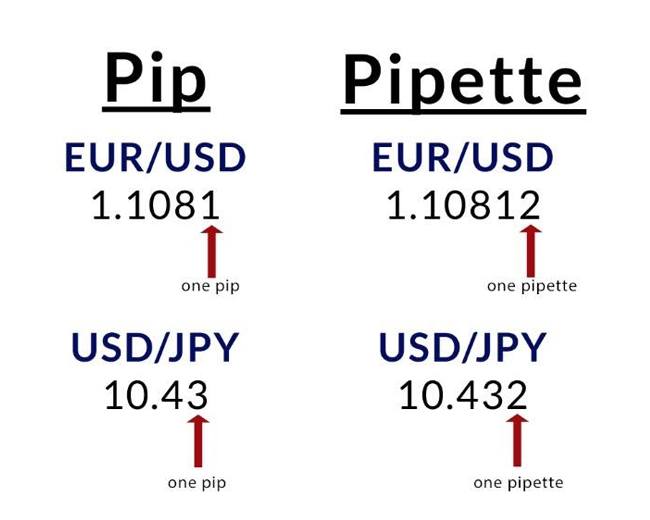
A pip measures the amount of change in the exchange rate of a currency pair, calculated using its 4th decimal (in JPY pairs, it is calculated using the 2nd decimal).
It is important to note that pips do not represent any actual cash value - that depends on the position size of the trade, which would affect the pip value.
Pipettes are fractional pips. It is 1/10 of a pip, usually calculated using the 5th decimal (in JPY pairs, it is calculated using the 3rd decimal).
This means that in EUR/USD, a movement from 1.14562 to 1.14572 is an increase of 1 pip. A movement from 1.14562 to 1.14563 would then be an increase of 1 pipette.
How to identify and calculate the spread?
Before looking at any spread, a beginner trader must understand the concept of bid and ask price.
The “bid” is the price at which you can sell the base currency, whereas the “ask” is the price at which you can buy the base currency. The bid and ask prices can usually be found at a corner of your MetaTrader 4 trading platform.
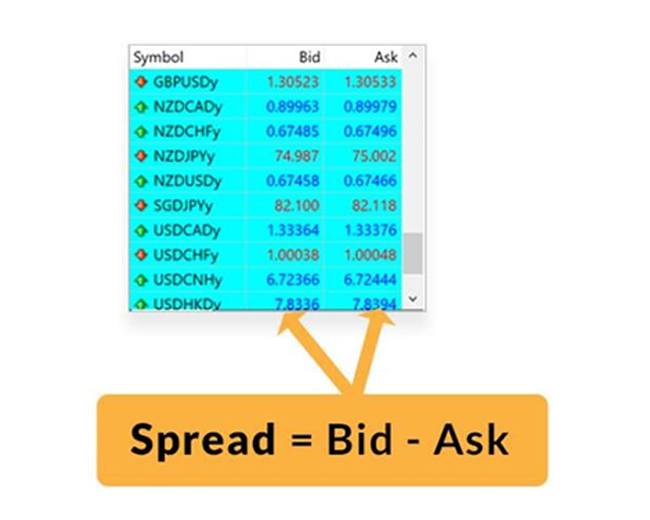
As seen in the image above, GBP/USD has a bid price of 1.30523 and an ask price of 1.30533.
Given that 1 pip in a GBP/USD pair is in the 4th decimal place (0.0001), this would mean that this GBP/USD quote has a 1-pip spread in this case. (i.e. The number of pips between 1.3053 & 1.3052).
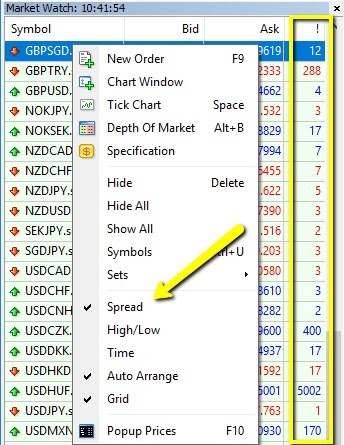
Alternatively, you can right click on the MT4 panel and select “spread” which will show you the spreads:

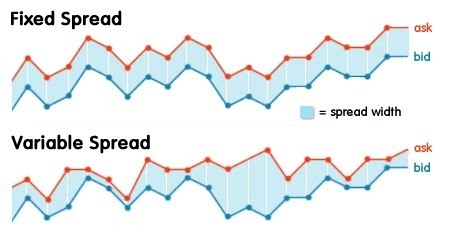
It’s important to note too that there are accounts with fixed spreads and variable spreads. It all depends on your style of trading and no singular style is better than the other. Here’s an illustration of how the spreads on an account looks like.
Final thoughts
Please do note that most brokers offer at least two different account types. Standard accounts will typically have all costs included in the spread. For example, if you trade EUR/USD on a Standard account, you might be charged a spread of 1 pip, which is the total cost of opening the trade.
Other account types (and the name of those vary from broker to broker) might have very low spreads - as low as 0.0 - but place a commission charge instead. For example, if you trade EUR/USD on such an account, you might not pay any spread (i.e. zero spread), but will be charged a certain $ amount per Lot traded.
Therefore, it is important to carry out your own research and determine which broker will be best for you. Feel free to check out Axi’s live spreads here and find out more on how we keep our spreads low!
Losses in derivatives trading can exceed deposits. Refer to www.axitrader.com for legal documentation & licences
Editors’ Picks
EUR/USD clings to small gains near 1.1750
Following a short-lasting correction in the early European session, EUR/USD regains its traction and clings to moderate gains at around 1.1750 on Monday. Nevertheless, the pair's volatility remains low, with investors awaiting this weeks key data releases from the US and the ECB policy announcements.
GBP/USD edges higher toward 1.3400 ahead of US data and BoE
GBP/USD reverses its direction and advances toward 1.3400 following a drop to the 1.3350 area earlier in the day. The US Dollar struggles to gather recovery momentum as markets await Tuesday's Nonfarm Payrolls data, while the Pound Sterling holds steady ahead of the BoE policy announcements later in the week.
Gold stuck around $4,300 as markets turn cautious
Gold loses its bullish momentum and retreats below $4,350 after testing this level earlier on Monday. XAU/USD, however, stays in positive territory as the US Dollar remains on the back foot on growing expectations for a dovish Fed policy outlook next year.
Solana consolidates as spot ETF inflows near $1 billion signal institutional dip-buying
Solana price hovers above $131 at the time of writing on Monday, nearing the upper boundary of a falling wedge pattern, awaiting a decisive breakout. On the institutional side, demand for spot Solana Exchange-Traded Funds remained firm, pushing total assets under management to nearly $1 billion since launch.
Big week ends with big doubts
The S&P 500 continued to push higher yesterday as the US 2-year yield wavered around the 3.50% mark following a Federal Reserve (Fed) rate cut earlier this week that was ultimately perceived as not that hawkish after all. The cut is especially boosting the non-tech pockets of the market.
RECOMMENDED LESSONS
Making money in forex is easy if you know how the bankers trade!
I’m often mystified in my educational forex articles why so many traders struggle to make consistent money out of forex trading. The answer has more to do with what they don’t know than what they do know. After working in investment banks for 20 years many of which were as a Chief trader its second knowledge how to extract cash out of the market.
5 Forex News Events You Need To Know
In the fast moving world of currency markets where huge moves can seemingly come from nowhere, it is extremely important for new traders to learn about the various economic indicators and forex news events and releases that shape the markets. Indeed, quickly getting a handle on which data to look out for, what it means, and how to trade it can see new traders quickly become far more profitable and sets up the road to long term success.
Top 10 Chart Patterns Every Trader Should Know
Chart patterns are one of the most effective trading tools for a trader. They are pure price-action, and form on the basis of underlying buying and selling pressure. Chart patterns have a proven track-record, and traders use them to identify continuation or reversal signals, to open positions and identify price targets.
7 Ways to Avoid Forex Scams
The forex industry is recently seeing more and more scams. Here are 7 ways to avoid losing your money in such scams: Forex scams are becoming frequent. Michael Greenberg reports on luxurious expenses, including a submarine bought from the money taken from forex traders. Here’s another report of a forex fraud. So, how can we avoid falling in such forex scams?
What Are the 10 Fatal Mistakes Traders Make
Trading is exciting. Trading is hard. Trading is extremely hard. Some say that it takes more than 10,000 hours to master. Others believe that trading is the way to quick riches. They might be both wrong. What is important to know that no matter how experienced you are, mistakes will be part of the trading process.
The challenge: Timing the market and trader psychology
Successful trading often comes down to timing – entering and exiting trades at the right moments. Yet timing the market is notoriously difficult, largely because human psychology can derail even the best plans. Two powerful emotions in particular – fear and greed – tend to drive trading decisions off course.