Predicting Major Trend Changes in The Forex Market
I have always been much more interested in big market moves than opportunities for small profits. What’s interesting to me is for most new traders, all they want to do is day trade for small market moves. Day trading is fine but fewer trades with large profit zones has always been easier and much more profitable to me. This is one of, if not, the most important things to consider when speculating in markets. Below is a passive income trade I was in for a couple weeks with a profit target of over 150 ticks in the Canadian Dollar.
Sam Seiden Trade: May 2017 / Profit: $4,000+
Canadian Dollar Futures
The profit zone is the distance in price between the entry point and the profit target price. When looking for trading opportunities, people tend to focus on where the next big turn in price will happen. As I often write about, these turns happen at price levels where supply and demand is out of balance. When looking at charts, you will find that there are many supply and demand levels. By no means are we interested in taking trading opportunities at all the levels we find. In fact, when considering profit zone into the filtering mix, we would ignore most of the supply and demand levels we find and narrow our focus down to the supply and demand levels that have large profit zones associated with them like the trade above.
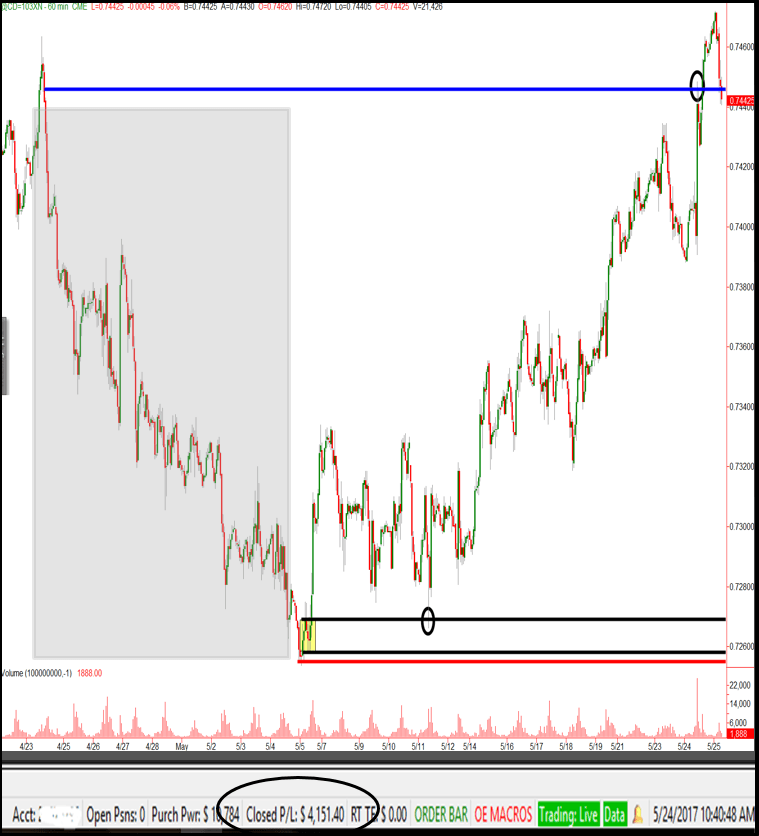
To explain the concept of profit zone and its importance in trading, let’s take a look at the Canadian Dollar (CD) trade above. Here we are looking at a larger time frame chart of CD. Notice the supply level above, just above the blue line which is the profit target. This is where we expected there to be more willing supply than demand. The area in the grey box is the “profit zone” which is basically the distance from the supply level to the demand level. Notice in the grey box, all we have is plenty of trading activity but no supply zones. In other words, there were no supply levels to stop price from moving higher through that area once I bought at demand (little circle on chart). The trading opportunity was to buy at the demand level and profit from a move up in price through that price action in the grey box, the profit zone.
The key element here is to identify where the demand and supply is, then look at current price, and finally determine the “path of least resistance” as that is where the next move in price is likely to go. Meaning, price is likely to have a relatively easy time moving through that grey box price action, the profit zone. Keep in mind a VERY important point here: I am coming to all these conclusions BEFORE entering the trade. You must perform your analysis in advance and make your decisions before its time to push the button or this will never work.
As I mentioned earlier, there are many supply and demand levels on a chart and many large and small profit margins. The key for the astute trader is to be able to identify objective supply and demand levels. Then and only then will you be able to find supply and demand levels that have huge profit zones associated with them. What I do is ignore most supply and demand levels on a chart and only focus on the ones that have a great distance between them. This does two things. First, it obviously offers an attractive risk/reward opportunity. Second and just as important, the larger the profit zone, the greater the probability of the trade working out. This is because when you have a big profit zone, by definition your supply and demand levels are far out on the supply and demand curve. Entering your trades at market price extremes increases the probability of success.
To better understand the concept of profit zones in trading, think of profit margins in any other business. Think of how companies who sell products determine what to sell. Most of the decision if not all of it comes down to profit margin. Think about companies who produce products and how they decide what to produce. Most, if not all, of that decision comes down to profit margin, which I am calling profit zone. The decision on which trading opportunities to put your hard-earned money at risk on is absolutely no different, and in fact, we chart profit margin/zone the same way as any successful company would.
Hope this was helpful. Have a great day.
Note: All information on this page is subject to change. The use of this website constitutes acceptance of our user agreement. Please read our privacy policy and legal disclaimer. Opinions expressed at FXstreet.com are those of the individual authors and do not necessarily represent the opinion of FXstreet.com or its management. Risk Disclosure: Trading foreign exchange on margin carries a high level of risk, and may not be suitable for all investors. The high degree of leverage can work against you as well as for you. Before deciding to invest in foreign exchange you should carefully consider your investment objectives, level of experience, and risk appetite. The possibility exists that you could sustain a loss of some or all of your initial investment and therefore you should not invest money that you cannot afford to lose. You should be aware of all the risks associated with foreign exchange trading, and seek advice from an independent financial advisor if you have any doubts.
Editors’ Picks
GBP/USD stays depressed below 1.3150 after UK CPI inflation data
GBP/USD keeps its downbeat tone intact below 1.3150 in European trading on Wednesday. The UK annual Consumer Price Index (CPI) inflation declined to 3.6% in October, as expected, fanning expectations of a BoE rate cut in December. The focus now shifts to the mid-tier US data and Fed Minutes.
EUR/USD hovers below 1.1600, awaits Fed Minutes
EUR/USD flat lines after three days of losses, trading below 1.1600 in the European trading hours on Wednesday. The pair tracks the subdued price action in the US Dollar. Traders turn cautious and opt to stay on the sidelines ahead of the Minutes of the Fed's October monetary policy meeting.
Gold climbs to $4,100 neighborhood; eyes weekly high ahead of FOMC minutes
Gold builds on the previous day's recovery from levels just below the $4,000 psychological mark, or a one-and-a-half-week low, and gains positive traction for the second straight day. The momentum lifts the bullion to the top end of its weekly range, with bulls now awaiting a sustained move beyond the $4,100 round figure before positioning for further gains as the focus remains on FOMC minutes.
Cronos Price Prediction: CRO nears wedge pattern playout, bulls in focus
Cronos (CRO) ticks lower by 3% at press time on Wednesday, retreating after a 10% surge from the previous day. The short-term fluctuations approach the apex of a falling wedge pattern, which typically results in an upside breakout.
UK inflation boosts chance for rate cut, as risk finally stabilizes
UK inflation cooled as expected last month, headline inflation moderated to 3.6% from 3.8%, the core rate also dropped a notch to 3.4% from 3.5% in September, and service price inflation also moderated to 4.5%, down from 4.7%.
RECOMMENDED LESSONS
Making money in forex is easy if you know how the bankers trade!
I’m often mystified in my educational forex articles why so many traders struggle to make consistent money out of forex trading. The answer has more to do with what they don’t know than what they do know. After working in investment banks for 20 years many of which were as a Chief trader its second knowledge how to extract cash out of the market.
5 Forex News Events You Need To Know
In the fast moving world of currency markets where huge moves can seemingly come from nowhere, it is extremely important for new traders to learn about the various economic indicators and forex news events and releases that shape the markets. Indeed, quickly getting a handle on which data to look out for, what it means, and how to trade it can see new traders quickly become far more profitable and sets up the road to long term success.
Top 10 Chart Patterns Every Trader Should Know
Chart patterns are one of the most effective trading tools for a trader. They are pure price-action, and form on the basis of underlying buying and selling pressure. Chart patterns have a proven track-record, and traders use them to identify continuation or reversal signals, to open positions and identify price targets.
7 Ways to Avoid Forex Scams
The forex industry is recently seeing more and more scams. Here are 7 ways to avoid losing your money in such scams: Forex scams are becoming frequent. Michael Greenberg reports on luxurious expenses, including a submarine bought from the money taken from forex traders. Here’s another report of a forex fraud. So, how can we avoid falling in such forex scams?
What Are the 10 Fatal Mistakes Traders Make
Trading is exciting. Trading is hard. Trading is extremely hard. Some say that it takes more than 10,000 hours to master. Others believe that trading is the way to quick riches. They might be both wrong. What is important to know that no matter how experienced you are, mistakes will be part of the trading process.
The challenge: Timing the market and trader psychology
Successful trading often comes down to timing – entering and exiting trades at the right moments. Yet timing the market is notoriously difficult, largely because human psychology can derail even the best plans. Two powerful emotions in particular – fear and greed – tend to drive trading decisions off course.