Finding an Edge
Trading is a very difficult job, not only because of the technical requirements but also because of the mental toughness and discipline it requires. In this article I'm going to talk about building a sustainable edge.
How can you find one? Where do you start your search for one? Shall you stop once you found one? And how many edges can the marketplace host at any one time? A trader's edge is what defines his style and ultimately what differentiates his decision-making process from a coin-toss. It's his material advantage.
The popular belief about edges is that there is something that a trader knows or uses, that gives him or her an advantage over the entire marketplace. Some retail traders believe that using a particular indicator (e.g. The RSI or Bollinger Bands) in a specific manner (e.g. Shorting when the RSI is above 80 and/or shorting when price exceeds the top Bollinger Band) is “the way to create an edge” because it gives them an advantage over those who are not trading that way. Others believe that by manipulating market data (using algebra to create formulas from the open/high/low/close of the day/week/month) will give them an edge over less quantitatively oriented traders.
My point being that, in my experience, too many people waste too much time (years in some cases) looking for various settings (optimization) that will give them some lasting edge and correct the instances where the market proved them wrong in the past. And the fact is that they never really build an edge for themselves. Why? Because even though they accumulate experience working the market from a certain angle (specializing), they have the wrong mindset and expectations – so they completely miss out on the fact that they are in fact building their own personal edge. Just it's not where they're expecting it to be, so they just fail to see it.
But lets imagine for a minute that this process of constructing some articulate plan to out-think other people were actually the way to proceed. Why in the world would professional traders share their trades, views and knowledge with other people if their very edge comes from doing something other people do not? Instead, many professional traders – like the guys you find on the OrderflowTrading chat – openly share their trade ideas and teach others their same methods. It seems counterproductive and yet it remains totally possible.
In part of the Orderflow Mindset lessons, we speak about liquidity constraints (the available liquidity at any one moment in time is finite) and the problem of large orders (you cannot enter with huge amounts just anywhere you want, because there will not be enough liquidity to cover your total order). So while it is true that professionals can train others to work from the same angle, there is also a limit to how many orders can find a counterparty at the same time. The fact is that the "too big to trade" problem is not one that we have, and it's not really relevant to this article. What we need to keep in mind is that while there are funds that affect the markets when they move, there are also big corporations that operate opposite the funds, and investment banks providing liquidity and hedging positions, and other smaller speculators doing their thing...so basically the comming together of so many different agendas makes it possible to trade relatively large from one single angle, or trade smaller from a multitude of angles.
So rather than spending time trying to find some Holy Grail of trading, why not spend (less) time finding a way to interpret market movements and go with the flow?
I believe a trader's edge must exist withing the realm of cognitive heuristics. Since traders populate the financial markets, we can equally play ball with them without knowing why they are acting the way they are acting.
There are evidently multiple edges to be exploited. The important thing is that you stick with one for some time, and act in a consistent manner, before deciding to discard it or continue with it or modify it. Consistency is the key to building useful trade statistics that will allow you to quantify your edge. But more on that later.
I personally believe that an edge starts with using a low-risk idea. A low risk-idea is an idea with a long-term positive expectancy, which must be traded with an appropriate position sizing method that allows for short term fluctuations without compromizing long-term results.
Some low-risk ideas that come to mind are:
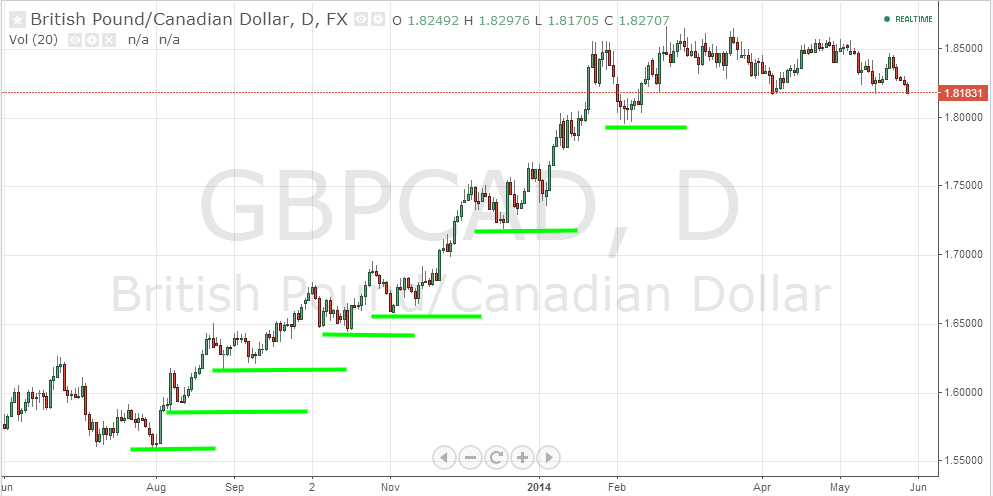
1. Trading with an evident trend
 Source: Tradingview.com
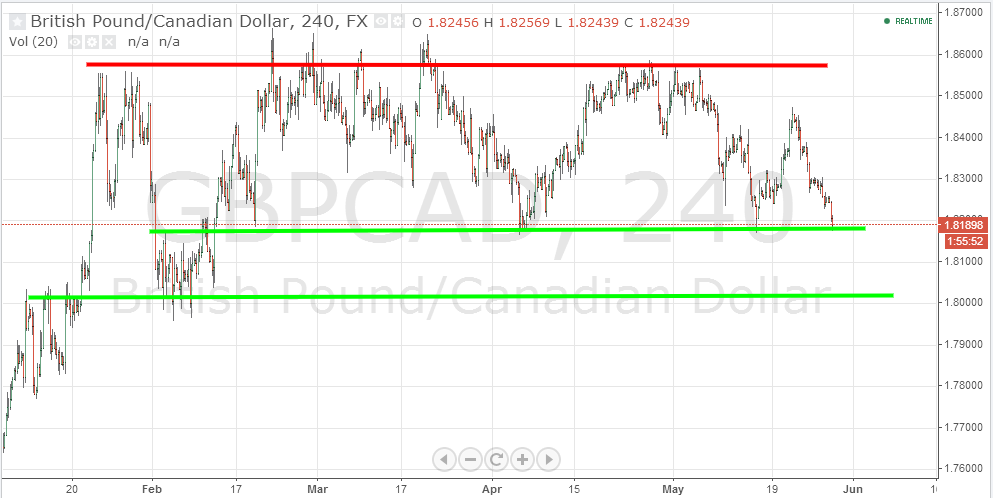
2. Fading the extremes of an evident range
 Source: Tradingview.com
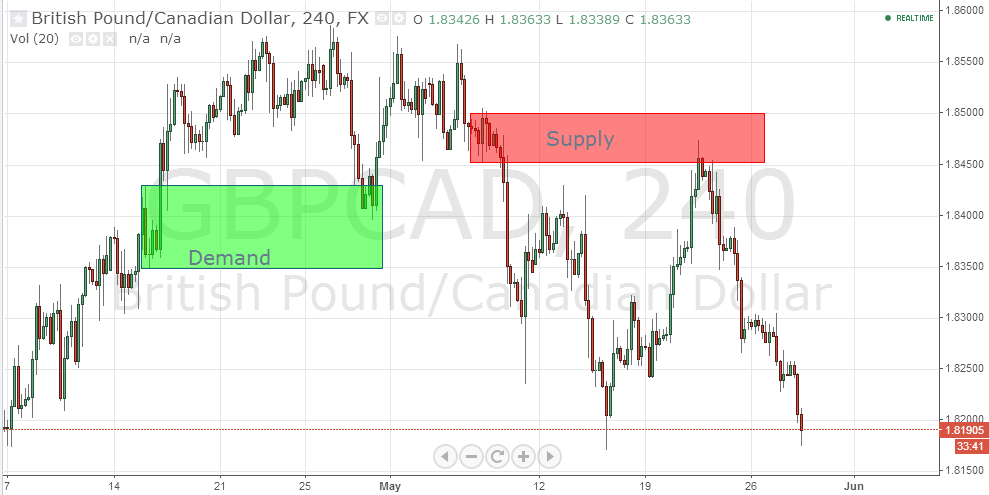
3. Trading orderflow imbalance areas
 Source: Tradingview.com
4. Trading pure OrderflowTrading setups (go to the mindset lessons to find out more)
5. Not having to trade every move of every day (yes, flexibility IS an advantage)
6. Having a good position sizing method (surviving longer than most IS an advantage)
7. Having a good read on Sentiment (having a feel for “why” price should do something)
8. etc....
You get the point. There are many low risk ideas out there. Each one suits a certain personality, so one single person can't work with all of them. Your job is to discover what appeals to you, know how to spot it quickly on a chart, and then test it out over 100 trades in a disciplined manner. You need to determine exactly which camp you belong to.
1. Simplify your low-risk idea to the point where it can be explained to a 5 year old. For example, “i look for deep retracements in an evident trend”.
2. Identify the market conditions that generate the low-risk idea and enhance it's probability of succeeding. For example, “I look for a market that's evidently trending with clear sentiment”.
3. Define your position size criteria. For example, I will usually allocate 0,25% of my equity to any one trade. I may decide to raise it to 0,5% when the setup looks picture perfect but never more than that. My objective is to minimize my risk of ruin and have a steady equity curve. But this is just me.
4. Define your trade management plan. This could incorporate "set and forget" attitutes, trailing stop attitudes, atr stop attitudes...it just depends on the trader and the important thing is that you use the same trade management on each trade. Otherwise you will not end up with a coherent track record.
5. Trade according to your plan and build up a consistent track record, which will help quantify exactly what your edge is.
References:
1. Market Wizards & The New Market Wizards by Jack D. Schwager
2. Trading Beyond the Matrix: The Red Pill for Traders and Investors by Van K. Tharp
3. Definitive Guide to Position Sizing Strategies by Van K. Tharp
4. OrderflowTrading For Fun And Profit by Daemon Goldsmith
How can you find one? Where do you start your search for one? Shall you stop once you found one? And how many edges can the marketplace host at any one time? A trader's edge is what defines his style and ultimately what differentiates his decision-making process from a coin-toss. It's his material advantage.
1. What is an Edge?
An Edge is a combination of elements that you have studied, that gives you a higher probability of a certain outcome. Essentially, you are making decisions based on something that is better than flipping a coin.The popular belief about edges is that there is something that a trader knows or uses, that gives him or her an advantage over the entire marketplace. Some retail traders believe that using a particular indicator (e.g. The RSI or Bollinger Bands) in a specific manner (e.g. Shorting when the RSI is above 80 and/or shorting when price exceeds the top Bollinger Band) is “the way to create an edge” because it gives them an advantage over those who are not trading that way. Others believe that by manipulating market data (using algebra to create formulas from the open/high/low/close of the day/week/month) will give them an edge over less quantitatively oriented traders.
My point being that, in my experience, too many people waste too much time (years in some cases) looking for various settings (optimization) that will give them some lasting edge and correct the instances where the market proved them wrong in the past. And the fact is that they never really build an edge for themselves. Why? Because even though they accumulate experience working the market from a certain angle (specializing), they have the wrong mindset and expectations – so they completely miss out on the fact that they are in fact building their own personal edge. Just it's not where they're expecting it to be, so they just fail to see it.
But lets imagine for a minute that this process of constructing some articulate plan to out-think other people were actually the way to proceed. Why in the world would professional traders share their trades, views and knowledge with other people if their very edge comes from doing something other people do not? Instead, many professional traders – like the guys you find on the OrderflowTrading chat – openly share their trade ideas and teach others their same methods. It seems counterproductive and yet it remains totally possible.
In part of the Orderflow Mindset lessons, we speak about liquidity constraints (the available liquidity at any one moment in time is finite) and the problem of large orders (you cannot enter with huge amounts just anywhere you want, because there will not be enough liquidity to cover your total order). So while it is true that professionals can train others to work from the same angle, there is also a limit to how many orders can find a counterparty at the same time. The fact is that the "too big to trade" problem is not one that we have, and it's not really relevant to this article. What we need to keep in mind is that while there are funds that affect the markets when they move, there are also big corporations that operate opposite the funds, and investment banks providing liquidity and hedging positions, and other smaller speculators doing their thing...so basically the comming together of so many different agendas makes it possible to trade relatively large from one single angle, or trade smaller from a multitude of angles.
So rather than spending time trying to find some Holy Grail of trading, why not spend (less) time finding a way to interpret market movements and go with the flow?
I believe a trader's edge must exist withing the realm of cognitive heuristics. Since traders populate the financial markets, we can equally play ball with them without knowing why they are acting the way they are acting.
2. Is there only 1 Edge in the marketplace?
So now we know that we have a fighting chance at succeeding and gaining some sort of edge in the realm of cognitive heuristics. What the heck does that mean? It means that you don't even have to create something from scratch in order to trade successfully. You can adapt something that's already out there to fit your personality and away you go!There are evidently multiple edges to be exploited. The important thing is that you stick with one for some time, and act in a consistent manner, before deciding to discard it or continue with it or modify it. Consistency is the key to building useful trade statistics that will allow you to quantify your edge. But more on that later.
I personally believe that an edge starts with using a low-risk idea. A low risk-idea is an idea with a long-term positive expectancy, which must be traded with an appropriate position sizing method that allows for short term fluctuations without compromizing long-term results.
Some low-risk ideas that come to mind are:
1. Trading with an evident trend
2. Fading the extremes of an evident range
3. Trading orderflow imbalance areas
4. Trading pure OrderflowTrading setups (go to the mindset lessons to find out more)
5. Not having to trade every move of every day (yes, flexibility IS an advantage)
6. Having a good position sizing method (surviving longer than most IS an advantage)
7. Having a good read on Sentiment (having a feel for “why” price should do something)
8. etc....
You get the point. There are many low risk ideas out there. Each one suits a certain personality, so one single person can't work with all of them. Your job is to discover what appeals to you, know how to spot it quickly on a chart, and then test it out over 100 trades in a disciplined manner. You need to determine exactly which camp you belong to.
3. Exploiting your Edge
So now that we have a low-risk idea to exploit, what's the next step?1. Simplify your low-risk idea to the point where it can be explained to a 5 year old. For example, “i look for deep retracements in an evident trend”.
2. Identify the market conditions that generate the low-risk idea and enhance it's probability of succeeding. For example, “I look for a market that's evidently trending with clear sentiment”.
3. Define your position size criteria. For example, I will usually allocate 0,25% of my equity to any one trade. I may decide to raise it to 0,5% when the setup looks picture perfect but never more than that. My objective is to minimize my risk of ruin and have a steady equity curve. But this is just me.
4. Define your trade management plan. This could incorporate "set and forget" attitutes, trailing stop attitudes, atr stop attitudes...it just depends on the trader and the important thing is that you use the same trade management on each trade. Otherwise you will not end up with a coherent track record.
5. Trade according to your plan and build up a consistent track record, which will help quantify exactly what your edge is.
References:
1. Market Wizards & The New Market Wizards by Jack D. Schwager
2. Trading Beyond the Matrix: The Red Pill for Traders and Investors by Van K. Tharp
3. Definitive Guide to Position Sizing Strategies by Van K. Tharp
4. OrderflowTrading For Fun And Profit by Daemon Goldsmith
Author
_Profile.jpg)
JupaFX
Independent Analyst
More from JupaFX