What are Options and Why Trade Them

Congratulations! You have decided to learn about options. This may be your first lesson ever or a refresher course, but our goal is to make learning options interesting and easy.
Did you know options are another way to trade the markets but they empower a trader to create new strategies to do a lot more than follow price direction?
What is an option?
An option is a contract sold by one party (the writer) to another party (the holder). The contract offers the buyer the right, but not the obligation, to buy or sell a financial asset at an agreed upon price in the future. The financial asset in our case is the currency or commodity.
Option contracts can be described as an insurance policy to insure the price of a financial asset and, similar to an insurance policy, the buyer has to pay the seller a premium. Premium is the value of an option contract.
Companies, in which you purchase products from, are trading options to hedge their costs, e.g. Jewellers have to purchase gold often and they may secure future prices, eliminating risk, by buying options.
How can buying an option help a jeweller limit risk? An option is a financial contract giving the buyer the right but not the obligation to buy gold at an agreed price over a certain period of time. For example, the jeweller could have bought an option contract last month giving him the right to buy 10 oz of gold at $1210 for one month.
Exercising an option means you are putting into effect the right of the contract. The jeweller has the right, but is not obliged, to exercise his option. Hence, if the price of gold rises, he will exercise the option to buy gold at a lower price. Conversely, if the price of gold falls, he will not exercise his option since he is able to buy at a cheaper price in the market. Either way the jeweller is getting the best price!
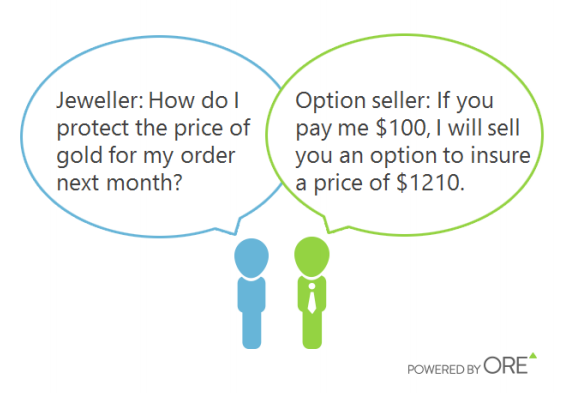
You could view buying an option as a form of insurance; the option contract is insuring a gold price. You have to pay for the contract; the amount you pay is called the Premium.
The amount of Premium will depend on the amount of gold and the price you want to insure as well as the duration of the contract. Option contracts, which insure for a better price and a larger amount of gold over a longer period of time, cost more.
The Premium will also depend on other factors, such as volatility in the market. For example, if the gold price is expected to be volatile over the duration of the contract, then the premium will be higher.
The above example uses a tangible asset and it is much easier to imagine buying and selling physical assets. When you transcend to Over-the-Counter trading (electronic trading), you will be trading intangible assets since you will never actually receive the goods you are buying or selling.
If you are wondering if you can just simply buy and sell options to make money, yes you can! Our lessons start by teaching you the most simple buy strategies to trade market movements.
Many people think of the stock market when they think of options. However, the foreign exchange market also offers the opportunity to trade forex options and our lessons will focus mostly on these unique derivatives. Since forex options are traded over-the-counter (OTC), traders can choose the specific market rate and date on which an option is to be valid, then receive a quote stating the premium they must pay to obtain the option.
Option contracts can be described as an insurance policy to insure the price of a financial asset and, similar to an insurance policy, the buyer has to pay the seller a premium. Premium is the value of an option contract.
Companies, in which you purchase products from, are trading options to hedge their costs, e.g. Jewellers have to purchase gold often and they may secure future prices, eliminating risk, by buying options.
How can buying an option help a jeweller limit risk? An option is a financial contract giving the buyer the right but not the obligation to buy gold at an agreed price over a certain period of time. For example, the jeweller could have bought an option contract last month giving him the right to buy 10 oz of gold at $1210 for one month.
Exercising an option means you are putting into effect the right of the contract. The jeweller has the right, but is not obliged, to exercise his option. Hence, if the price of gold rises, he will exercise the option to buy gold at a lower price. Conversely, if the price of gold falls, he will not exercise his option since he is able to buy at a cheaper price in the market. Either way the jeweller is getting the best price!
You could view buying an option as a form of insurance; the option contract is insuring a gold price. You have to pay for the contract; the amount you pay is called the Premium.
The amount of Premium will depend on the amount of gold and the price you want to insure as well as the duration of the contract. Option contracts, which insure for a better price and a larger amount of gold over a longer period of time, cost more.
The Premium will also depend on other factors, such as volatility in the market. For example, if the gold price is expected to be volatile over the duration of the contract, then the premium will be higher.
The above example uses a tangible asset and it is much easier to imagine buying and selling physical assets. When you transcend to Over-the-Counter trading (electronic trading), you will be trading intangible assets since you will never actually receive the goods you are buying or selling.
If you are wondering if you can just simply buy and sell options to make money, yes you can! Our lessons start by teaching you the most simple buy strategies to trade market movements.
Many people think of the stock market when they think of options. However, the foreign exchange market also offers the opportunity to trade forex options and our lessons will focus mostly on these unique derivatives. Since forex options are traded over-the-counter (OTC), traders can choose the specific market rate and date on which an option is to be valid, then receive a quote stating the premium they must pay to obtain the option.
Why trade options?
You may be wondering, “Why trade an option and not the underlying asset?” Good question, because…
- When buying an option, your downside risk is limited to the option premium (the amount you paid to purchase the option).
- When buying an option, you have unlimited profit potential.
- You can pay less money up front than for a forex position.
- You can build strategies to trade many different market outlooks, such as a strategy profiting from a move in either direction.
- Options can be used to insure an open forex deal (or a portfolio of deals), to trap profit, and/or limit risk.
So now that you know what an option is, our next lesson will begin to explain the building blocks of an option.
Author

Davina Becker is a Product Specialist at ORE with over 10 years of experience in the financial markets.
More from Davina Becker