 Rick Wright
Online Trading Academy

This week has been a special week for me as it marks my first week of a new life emigrating from the UK to my new home in the USA. To kick things off, I have had the pleasure of taking a trip out to Irvine, California to the Online Trading Academy HQ to teach the on-location Professional Forex Trader class. As you may already know, one of the most attractive aspects of trading the global currency markets is the level of flexibility it offers us, with time of day and that it is a market that is pretty much open 24 hours a day for almost 6 days a week. With it opening around 5pm EST on a Sunday early evening and then trading continuously though the week until the following Friday late afternoon; you can see that almost anytime is a good time to trade and why so many people are attracted to it and want a piece of the action, as it never really stops!
Now while it may be open for the majority of the week, the market also has its peaks and troughs of liquidity and movement. The currency market is widely regarded as being made up of 3 main trading centers across the globe, those being Asia, Europe and the USA, with the Far East kicking the proceedings off and the States wrapping things up at the end. In general, the time zones occur in the following segments:
Asia: 9pm – 2am
EST Europe: 3am – 11am
EST USA: 8am – 4pm EST
The Asian session is generally regarded as the quietest session of the 3, with Europe being the most volatile and USA quieter but a little higher than Asia. If you are a day trader, this means that you would probably focus most of your attention on the European sessions for the most movement and volatility. When I lived in London, I enjoyed access to all 3 sessions and had the luxury of being actively awake for the European session everyday. Now that I live in the USA I am on a very different time zone, but for me, my time to trade has not changed all that much because as a FX trader, when you know what to look for it really does not matter what part of the world you live in at all. Let me explain further.
One of the best things any aspiring trader can learn to do is to understand how to develop a rules-based strategy, put it to action and then simply walk away and allow it to do its thing. Getting in the way of the plan is when we run into trouble. This is why we encourage our students at OTA to approach the market using our patented core strategy in a “set and forget” manner. With this in mind, I get plenty of questions from students asking how my FX trading is impacted when I travel to teach and, more importantly, now that I have moved to a completely different continent. The answer is simple: it does not change at all! When I was living in the UK I would do my analysis during the “dead zone” hours, these being the 2 hours between the US close and the open of the next Asian session, roughly 4pm to 6pm Eastern time, which was 9pm to 11pm UK time. Living in the States my time zone may be different but I am actually doing the analysis and setting up the trades at exactly the same point of the day.
What a fantastic aspect of the FX markets, especially when you begin to realize over time that when you set and forget your trades, you don’t even need to be there to see it happen, irrespective of whether the trade wins or loses. In fact, I have always said that it is better to not be there to watch the position, as this will ensure that you stick to the plan and allow the opportunity to develop as it should. Below is an example of a setup we looked at this week in the class on GBPNZD:
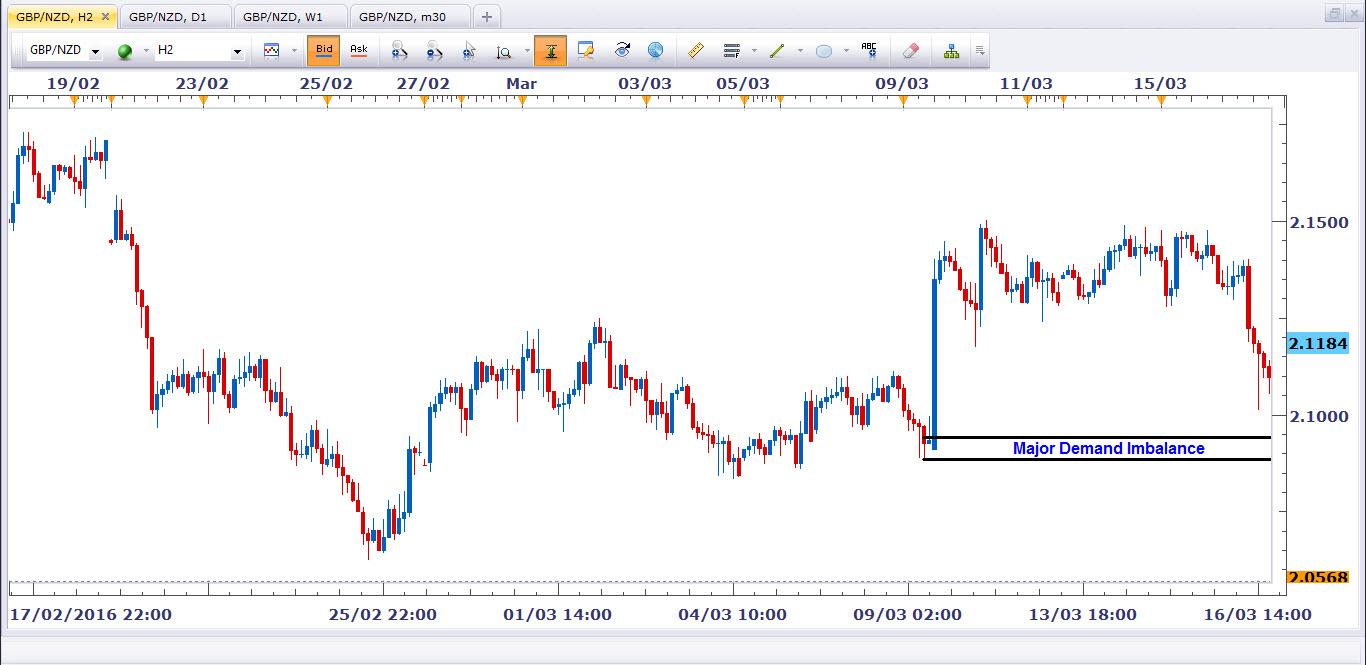
The highlighted Demand zone showed us a major imbalance between the willing buyers and sellers, indicating that the buyers did not get all of their orders filled, meaning we were looking to buy a pullback to the area if it returned to the zone. Not knowing how long this would take, we had to set the entry, stop and target and then leave the rest to do its thing. The trade triggered overnight with a nice reaction:
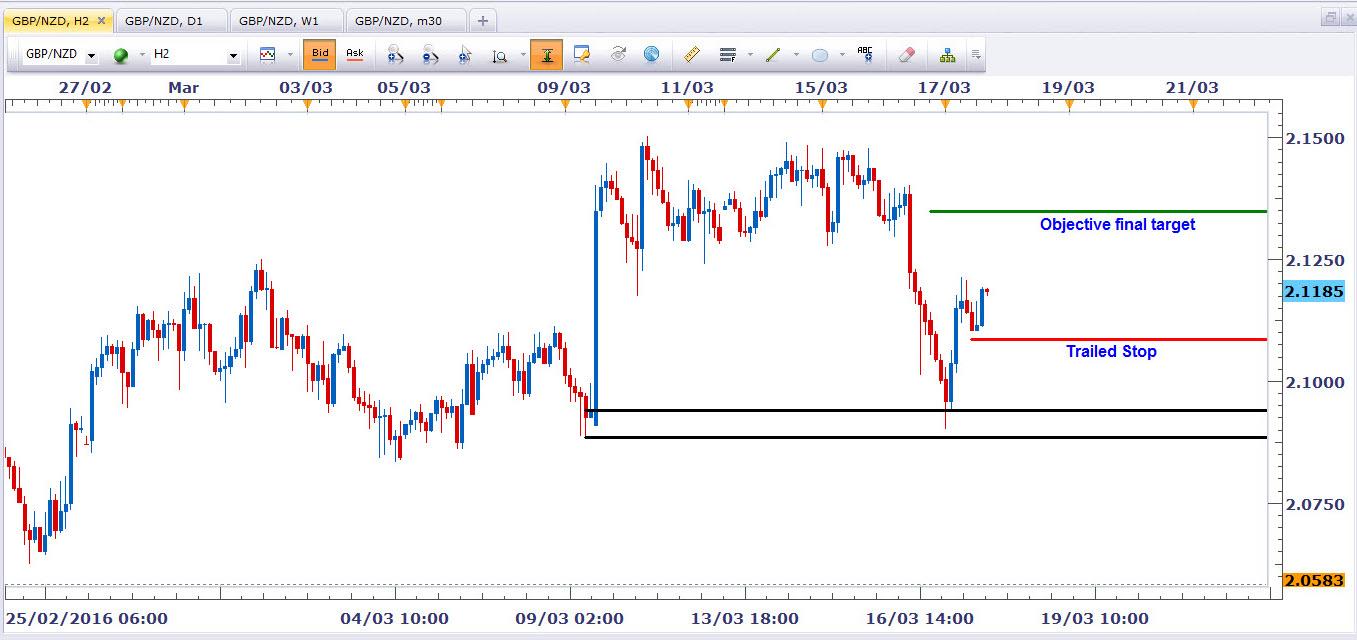
At the time of taking the above screenshot, the pair has already risen around 250 pips, and that all happened during the Euro session while we were asleep in California. We then had the option to trail the stop and lock in some profit, allowing the GBPNZD the chance to hit its final target a few hundred pips higher. So, did we need to be there to see this happen or did the plan take care of this automatically? I think the result clearly speaks for itself. Be mindful that if you decide to embark on the FX markets journey, the more you allow things to fit into your life rather than the other way around, the better it is likely to be for you in the long run. FX offers flexibility and opportunity to choose your time to trade, around the clock, no mater how hands-on or hands-off you want to be. It doesn’t get much better than that.
This content is intended to provide educational information only. This information should not be construed as individual or customized legal, tax, financial or investment services. As each individual's situation is unique, a qualified professional should be consulted before making legal, tax, financial and investment decisions. The educational information provided in this article does not comprise any course or a part of any course that may be used as an educational credit for any certification purpose and will not prepare any User to be accredited for any licenses in any industry and will not prepare any User to get a job. Reproduced by permission from OTAcademy.com click here for Terms of Use: https://www.otacademy.com/about/terms
Editors’ Picks

EUR/USD hits two-day highs near 1.1820
EUR/USD picks up pace and reaches two-day tops around 1.1820 at the end of the week. The pair’s move higher comes on the back of renewed weakness in the US Dollar amid growing talk that the Fed could deliver an interest rate cut as early as March. On the docket, the flash US Consumer Sentiment improves to 57.3 in February.

GBP/USD reclaims 1.3600 and above
GBP/USD reverses two straight days of losses, surpassing the key 1.3600 yardstick on Friday. Cable’s rebound comes as the Greenback slips away from two-week highs in response to some profit-taking mood and speculation of Fed rate cuts. In addition, hawkish comments from the BoE’s Pill are also collaborating with the quid’s improvement.

USD/JPY drops back below 157.00, as focus shifts to Japan snap election
USD/JPY is back in the red below 157.00 in the Asian session on Friday. The Japanese Yen recovers ground against the US Dollar amid some profit-taking ahead of Japan's snap general election on Sunday. The preliminary reading of the Michigan Consumer Sentiment Index report for February will be released later on Friday.
Editors’ Picks

EUR/USD: US Dollar to remain pressured until uncertainty fog dissipates Premium
The EUR/USD pair lost additional ground in the first week of February, settling at around 1.1820. The reversal lost momentum after the pair peaked at 1.2082 in January, its highest since mid-2021.

Gold: Volatility persists in commodity space Premium
After losing more than 8% to end the previous week, Gold (XAU/USD) remained under heavy selling pressure on Monday and dropped toward $4,400. Although XAU/USD staged a decisive rebound afterward, it failed to stabilize above $5,000.

GBP/USD: Pound Sterling tests key support ahead of a big week Premium
The Pound Sterling (GBP) changed course against the US Dollar (USD), with GBP/USD giving up nearly 200 pips in a dramatic correction.

Bitcoin: The worst may be behind us
Bitcoin (BTC) price recovers slightly, trading at $65,000 at the time of writing on Friday, after reaching a low of $60,000 during the early Asian trading session. The Crypto King remained under pressure so far this week, posting three consecutive weeks of losses exceeding 30%.

Three scenarios for Japanese Yen ahead of snap election Premium
The latest polls point to a dominant win for the ruling bloc at the upcoming Japanese snap election. The larger Sanae Takaichi’s mandate, the more investors fear faster implementation of tax cuts and spending plans.
RECOMMENDED LESSONS
Making money in forex is easy if you know how the bankers trade!

I’m often mystified in my educational forex articles why so many traders struggle to make consistent money out of forex trading. The answer has more to do with what they don’t know than what they do know. After working in investment banks for 20 years many of which were as a Chief trader its second knowledge how to extract cash out of the market.
5 Forex News Events You Need To Know

In the fast moving world of currency markets where huge moves can seemingly come from nowhere, it is extremely important for new traders to learn about the various economic indicators and forex news events and releases that shape the markets. Indeed, quickly getting a handle on which data to look out for, what it means, and how to trade it can see new traders quickly become far more profitable and sets up the road to long term success.
Top 10 Chart Patterns Every Trader Should Know

Chart patterns are one of the most effective trading tools for a trader. They are pure price-action, and form on the basis of underlying buying and selling pressure. Chart patterns have a proven track-record, and traders use them to identify continuation or reversal signals, to open positions and identify price targets.
7 Ways to Avoid Forex Scams

The forex industry is recently seeing more and more scams. Here are 7 ways to avoid losing your money in such scams: Forex scams are becoming frequent. Michael Greenberg reports on luxurious expenses, including a submarine bought from the money taken from forex traders. Here’s another report of a forex fraud. So, how can we avoid falling in such forex scams?
What Are the 10 Fatal Mistakes Traders Make
Trading is exciting. Trading is hard. Trading is extremely hard. Some say that it takes more than 10,000 hours to master. Others believe that trading is the way to quick riches. They might be both wrong. What is important to know that no matter how experienced you are, mistakes will be part of the trading process.
The challenge: Timing the market and trader psychology

Successful trading often comes down to timing – entering and exiting trades at the right moments. Yet timing the market is notoriously difficult, largely because human psychology can derail even the best plans. Two powerful emotions in particular – fear and greed – tend to drive trading decisions off course.