 Rick Wright
Online Trading Academy

Hello traders! I’m writing this week’s newsletter from beautiful Norwalk, Connecticut, while watching the sunset on Wednesday of a futures class. In this class there is a student who loves to use Bollinger Bands® as his own odds enhancer when trading, so I thought I would share a few helpful tips for this tool, applied to the spot forex market.
First let’s define what Bollinger Bands are. Investopedia defines Bollinger Bands as, “A band plotted two standard deviations away from a simple moving average, developed by famous technical trader John Bollinger.” If you’ve ever seen a bell curve showing a distribution of measurements of something, for example, people’s heights, incomes, home sizes, whatever, most of the data will be stacked in the middle of the bell curve. The further you go from the median/midpoint of the bell curve either above or below, the fewer data points you will get. If the average height of men in America is 5’9”, most men you meet here will be about that height. How many 7’2” men do you meet? One a month? One a year? The point is the further away from the median data point, the less likely it is to find these measurements. In trading, if prices go above or below the Bollinger Bands, those readings of price action are unusual, and prices should revert back to “normal” or inside the bands, if not all the way to the median. In statistics, the two standard deviations above and below the median (in this case, a moving average) should hold about 96% of all the data. Let’s take a look at a chart, which should be easier to understand!
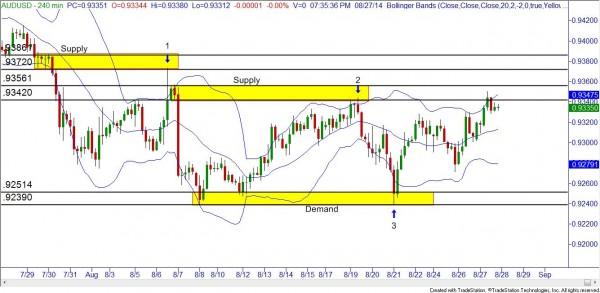
This is a four hour chart of the AUDUSD, with a Bollinger Band overlaid on the price action. The middle blue wiggly line is a 20 period moving average, and the other two wiggly lines are showing two standard deviations above and below the moving average. So, most (~96%) of the price action should be inside of the bands. Whenever price is outside of the bands, especially on fast moves outside of the bands, price action tends to quickly revert back inside the bands, usually to the moving average. If price action moves above the upper wiggly line, prices are considered overbought, and if price action moves below the lower wiggly line, prices are considered oversold.
In addition to the Bollinger Bands on the chart, I have also marked in two of our supply zones and one demand zone. Using the bands as an odds enhancer for your trading can definitely help, otherwise I wouldn’t have written this article! At the blue arrow labeled “1,” you can see that price action rapidly moved up to supply, well past the upper band. So…would you take that short trade? Price moved quickly to a clean supply zone, deep into “overbought” territory on our Bollinger Band tool. I hope you would be interested in this trade! As mentioned previously, a potential first target would be the moving average; however, I prefer to use previous demand for a target on short trades, and previous supply for targets on long trades.
At the second blue arrow, marked “2,” price again moved up into supply, but this time just barely peaked out above the Bollinger Band. While I would prefer a faster, farther move out of the band to take a trade, this example still did fit our criteria.
At the third arrow, marked “3,” price quickly fell into a demand zone and again, well outside the Bollinger Band. This would have fit the criteria of trading with our patented core strategy, plus with the added bonus of being “oversold” with the bands.
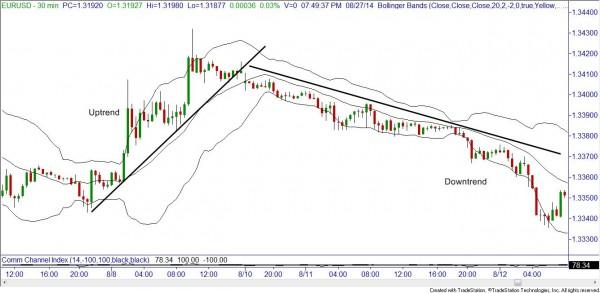
Another helpful use for the Bollinger Band tool is to help you stay with a trending market. In an uptrend, very often the trend will be held between the moving average and the upper band. In a downtrend, usually the move is held between the moving average and the lower band. Both examples are demonstrated in the following chart.
So there you have a breakdown on a couple of easy ways to use the Bollinger Bands to help you trade: first, to help with entering trades, and second, to help you stay with a trending market. Please don’t try to only use Bollinger Bands to make your trading decisions! There have been thousands of traders out there who have tried to use just one indicator or oscillator to make their trading decisions for them; why do you think you don’t hear about those traders? Because using just one thing that comes FREE with your trading platform won’t consistently make you money! Combined with our supply and demand strategy can make these bands a very powerful tool. Yes, there are a few more tricks to these bands, but we’ll have to save those for our live classrooms or our Extended Learning Track online training rooms.
This content is intended to provide educational information only. This information should not be construed as individual or customized legal, tax, financial or investment services. As each individual's situation is unique, a qualified professional should be consulted before making legal, tax, financial and investment decisions. The educational information provided in this article does not comprise any course or a part of any course that may be used as an educational credit for any certification purpose and will not prepare any User to be accredited for any licenses in any industry and will not prepare any User to get a job. Reproduced by permission from OTAcademy.com click here for Terms of Use: https://www.otacademy.com/about/terms
Editors’ Picks

EUR/USD hits two-day highs near 1.1820
EUR/USD picks up pace and reaches two-day tops around 1.1820 at the end of the week. The pair’s move higher comes on the back of renewed weakness in the US Dollar amid growing talk that the Fed could deliver an interest rate cut as early as March. On the docket, the flash US Consumer Sentiment improves to 57.3 in February.

GBP/USD reclaims 1.3600 and above
GBP/USD reverses two straight days of losses, surpassing the key 1.3600 yardstick on Friday. Cable’s rebound comes as the Greenback slips away from two-week highs in response to some profit-taking mood and speculation of Fed rate cuts. In addition, hawkish comments from the BoE’s Pill are also collaborating with the quid’s improvement.

USD/JPY drops back below 157.00, as focus shifts to Japan snap election
USD/JPY is back in the red below 157.00 in the Asian session on Friday. The Japanese Yen recovers ground against the US Dollar amid some profit-taking ahead of Japan's snap general election on Sunday. The preliminary reading of the Michigan Consumer Sentiment Index report for February will be released later on Friday.
Editors’ Picks

EUR/USD: US Dollar to remain pressured until uncertainty fog dissipates Premium
The EUR/USD pair lost additional ground in the first week of February, settling at around 1.1820. The reversal lost momentum after the pair peaked at 1.2082 in January, its highest since mid-2021.

Gold: Volatility persists in commodity space Premium
After losing more than 8% to end the previous week, Gold (XAU/USD) remained under heavy selling pressure on Monday and dropped toward $4,400. Although XAU/USD staged a decisive rebound afterward, it failed to stabilize above $5,000.

GBP/USD: Pound Sterling tests key support ahead of a big week Premium
The Pound Sterling (GBP) changed course against the US Dollar (USD), with GBP/USD giving up nearly 200 pips in a dramatic correction.

Bitcoin: The worst may be behind us
Bitcoin (BTC) price recovers slightly, trading at $65,000 at the time of writing on Friday, after reaching a low of $60,000 during the early Asian trading session. The Crypto King remained under pressure so far this week, posting three consecutive weeks of losses exceeding 30%.
Three scenarios for Japanese Yen ahead of snap election Premium
The latest polls point to a dominant win for the ruling bloc at the upcoming Japanese snap election. The larger Sanae Takaichi’s mandate, the more investors fear faster implementation of tax cuts and spending plans.
RECOMMENDED LESSONS
Making money in forex is easy if you know how the bankers trade!

I’m often mystified in my educational forex articles why so many traders struggle to make consistent money out of forex trading. The answer has more to do with what they don’t know than what they do know. After working in investment banks for 20 years many of which were as a Chief trader its second knowledge how to extract cash out of the market.
5 Forex News Events You Need To Know

In the fast moving world of currency markets where huge moves can seemingly come from nowhere, it is extremely important for new traders to learn about the various economic indicators and forex news events and releases that shape the markets. Indeed, quickly getting a handle on which data to look out for, what it means, and how to trade it can see new traders quickly become far more profitable and sets up the road to long term success.
Top 10 Chart Patterns Every Trader Should Know

Chart patterns are one of the most effective trading tools for a trader. They are pure price-action, and form on the basis of underlying buying and selling pressure. Chart patterns have a proven track-record, and traders use them to identify continuation or reversal signals, to open positions and identify price targets.
7 Ways to Avoid Forex Scams

The forex industry is recently seeing more and more scams. Here are 7 ways to avoid losing your money in such scams: Forex scams are becoming frequent. Michael Greenberg reports on luxurious expenses, including a submarine bought from the money taken from forex traders. Here’s another report of a forex fraud. So, how can we avoid falling in such forex scams?
What Are the 10 Fatal Mistakes Traders Make
Trading is exciting. Trading is hard. Trading is extremely hard. Some say that it takes more than 10,000 hours to master. Others believe that trading is the way to quick riches. They might be both wrong. What is important to know that no matter how experienced you are, mistakes will be part of the trading process.
The challenge: Timing the market and trader psychology

Successful trading often comes down to timing – entering and exiting trades at the right moments. Yet timing the market is notoriously difficult, largely because human psychology can derail even the best plans. Two powerful emotions in particular – fear and greed – tend to drive trading decisions off course.