

Hello everybody and welcome to another week’s edition of Lessons from The Pros. I hope you’re well and have not been too troubled by the lack of volatility currently residing in the worldwide currency markets? The quiet nature of the FX market has definitely been causing a few issues for some traders looking for bigger moves that aren’t really happening. However I would advise you to be patient because when things do pick up, you will probably be overwhelmed by the amount of opportunity out there. Sometimes as a trader you have to just accept that the markets won’t be moving as much as you’d like them to. That is why we capitalize on the opportunities when they are there and we have to learn to sit on our hands when the opportunities are not there. Successful trading is just as much about waiting as it is being active and taking trades.
While the Forex market has been quiet, you have no doubt been aware of the World Cup 2014 in Brazil? If you’ve been looking for somewhere full of excitement and volatility then you haven’t had to look much further than the greatest show on earth! At the time of writing this article, I am anticipating a fantastic final between Germany and Argentina. By the time you read this piece, we will have our World Cup champions. It has, without a doubt being the greatest World Cup I’ve ever seen.
Of all the surprise results that we witnessed in this World Cup, the greatest was no doubt when Brazil was beaten by Germany in the semi-finals 1-7. It sent shockwaves around the world and many media outlets were quick to criticize the performance of Brazil’s football team for the poor result. However, I personally do not think enough credit has been given to the way that Germany played against Brazil. As an Englishman I’ve watched my national soccer team being beaten by Germany on countless occasions and rather than become bitter about it, my appreciation has just continued to grow out of respect for the style of football and resilience with which Germany plays over and over again. When it comes to reliability Germany holds no equal. It must be great to be a German football fan! Here is a team that has won the World Cup three times (at the time of writing this article), finalists 8 times over and runners-up 4 times (at the time of writing) and came third 4 times. Who would not want a track record like that?
The one thing that Germany does time and time again, is show consistency. They very rarely play erratically, they score goals, and they defend and play as a team. Coming back to my original point of having defeated Brazil, the thing I noticed the most about watching that game was how simple they kept it. They had a few lapses in concentration and I think that can be forgiven, as they were probably elated to be winning by such a large score line. However they kept control of the ball, they created space and took their time passing the ball to one another and waiting for the right opportunity to come along. Let’s face it; if the German football team were a FX trader, you wouldn’t be able to ask for a better set of skills. Watching their performance through this tournament and how they picked apart Brazil with simplicity and consistency, just made me see the parallels of what is required to be a consistent speculator in the currency markets as well. Time and time again I see examples in this wonderful world we live in, of people and institutions taking something which seems to be quite complex, making it very simple and then becoming very good at it. If you want to be a successful trader, you need to learn to do the same.
When teaching at Online Trading Academy, my fellow instructors and myself teach our students to tackle the world wide financial markets with the same mentality, using a simple rules based strategy which allows us to achieve consistency and effective results in the marketplace. Our core strategy, allows us to simply and objectively recognize institutional patterns of buying and selling. We know these patterns as levels of Supply and Demand. When we find a level of demand, we expect prices to rise so we’re willing buyers at that zone. Likewise, when we identify a level of supply we expect prices to fall, so this is where we are placing our orders to sell. When we have recognized our opportunities, all that is left to do is to place our order to enter, enter the stop-loss if we are wrong and our profit objective if we are right. We do this consistently and without question, knowing that if we keep it simple and objective, we will have success in the long run.
Let’s take a look at an example of a quality demand area which played out a little while ago:
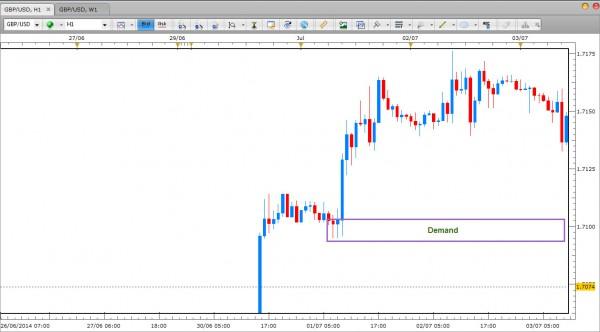
The above opportunity on the GBPUSD showed us a strong imbalance around the price of 1.7100, suggesting to us that we had a low risk, high potential reward buying opportunity on our hands. With this identified, we simply buy when prices enter the zone, with our stop-loss just below the lows and our profit target situated at the most recent supply around 1.7165. We then let things play out and see what the results are:
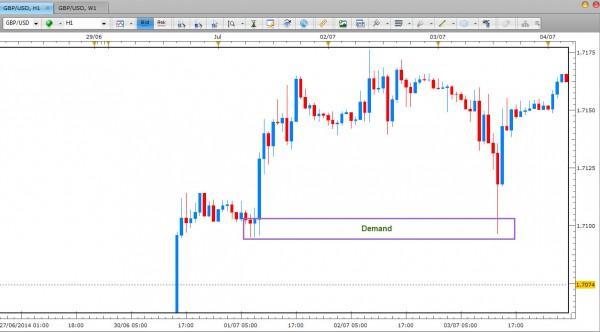
As we can see from the above screenshot things could not have worked out any better. Prices dropped nicely into our buying zone, going nowhere near our protective stop-loss order and then rallied to our profit target in a relatively short space of time. The risk was well worth the reward we achieved on this opportunity. However, not every opportunity works out as picture perfect as this. Just like Germany managed to score 7 goals against Brazil they also had one scored against them. As traders we have to expect to take losses as well, irrespective of whether or not we like it. Here is another setup of an objectively identified institutional supply zone, which also offered a low risk and high potential reward trading opportunity:
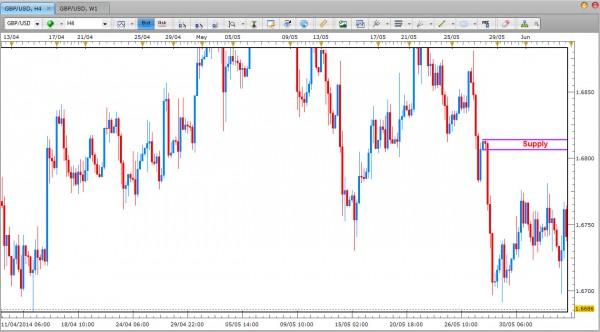
The structure of the zone suggested a large imbalance between the willing buyers and the willing sellers, allowing us a very tight low-risk entry for a great short. There is nothing any different from this selling setup to the previous example to buy. We would approach this level exactly the same way irrespective of our thoughts or emotions. We just play out trades with consistency. Here is the result:
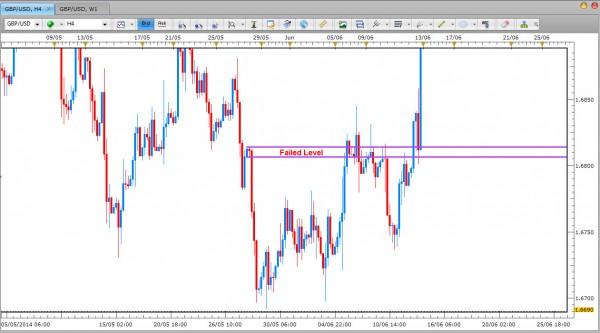
As you can see from the results above, the level completely failed, resulting in a small loss and nothing more. The trade matched the plan and we took it accordingly. We can afford to take the small loss because when we do win, we win at least three times what we lose. This level of efficiency is required in trading just like it’s required in anything else that you want to do successfully and consistently.
One can look back at Germany’s campaign through this World Cup and not every game they played was as spectacular as the one against Brazil. There were one or two times when they looked like they could’ve been beaten. However, they stuck to their plan, kept things simple and got the job done. Yes they had some goals scored against them but they also scored plenty themselves. These tactics are similar to what is required in the world of trading. We will always take losses and we will also take decent wins. What we need more than anything is to be consistent, simple and disciplined. Treat your trading like the Germans treat their football and maybe you’ll develop the level of consistency that you’re aspiring for.
The information provided is for informational purposes only. It does not constitute any form of advice or recommendation to buy or sell any securities or adopt any investment strategy mentioned. It is intended only to provide observations and views of the author(s) or hosts at the time of writing or presenting, both of which are subject to change at any time without prior notice. The information provided does not have regard to specific investment objectives, financial situation, or specific needs of any specific person who may read it. Investors should determine for themselves whether a particular service or product is suitable for their investment needs or should seek such professional advice for their particular situation. Please see our website for more information: https://bustamanteco.com/privacy-policy/
Editors’ Picks

EUR/USD hits two-day highs near 1.1820
EUR/USD picks up pace and reaches two-day tops around 1.1820 at the end of the week. The pair’s move higher comes on the back of renewed weakness in the US Dollar amid growing talk that the Fed could deliver an interest rate cut as early as March. On the docket, the flash US Consumer Sentiment improves to 57.3 in February.

GBP/USD reclaims 1.3600 and above
GBP/USD reverses two straight days of losses, surpassing the key 1.3600 yardstick on Friday. Cable’s rebound comes as the Greenback slips away from two-week highs in response to some profit-taking mood and speculation of Fed rate cuts. In addition, hawkish comments from the BoE’s Pill are also collaborating with the quid’s improvement.

USD/JPY drops back below 157.00, as focus shifts to Japan snap election
USD/JPY is back in the red below 157.00 in the Asian session on Friday. The Japanese Yen recovers ground against the US Dollar amid some profit-taking ahead of Japan's snap general election on Sunday. The preliminary reading of the Michigan Consumer Sentiment Index report for February will be released later on Friday.
Editors’ Picks

EUR/USD: US Dollar to remain pressured until uncertainty fog dissipates Premium
The EUR/USD pair lost additional ground in the first week of February, settling at around 1.1820. The reversal lost momentum after the pair peaked at 1.2082 in January, its highest since mid-2021.

Gold: Volatility persists in commodity space Premium
After losing more than 8% to end the previous week, Gold (XAU/USD) remained under heavy selling pressure on Monday and dropped toward $4,400. Although XAU/USD staged a decisive rebound afterward, it failed to stabilize above $5,000.

GBP/USD: Pound Sterling tests key support ahead of a big week Premium
The Pound Sterling (GBP) changed course against the US Dollar (USD), with GBP/USD giving up nearly 200 pips in a dramatic correction.

Bitcoin: The worst may be behind us
Bitcoin (BTC) price recovers slightly, trading at $65,000 at the time of writing on Friday, after reaching a low of $60,000 during the early Asian trading session. The Crypto King remained under pressure so far this week, posting three consecutive weeks of losses exceeding 30%.

Three scenarios for Japanese Yen ahead of snap election Premium
The latest polls point to a dominant win for the ruling bloc at the upcoming Japanese snap election. The larger Sanae Takaichi’s mandate, the more investors fear faster implementation of tax cuts and spending plans.
RECOMMENDED LESSONS
Making money in forex is easy if you know how the bankers trade!

I’m often mystified in my educational forex articles why so many traders struggle to make consistent money out of forex trading. The answer has more to do with what they don’t know than what they do know. After working in investment banks for 20 years many of which were as a Chief trader its second knowledge how to extract cash out of the market.
5 Forex News Events You Need To Know

In the fast moving world of currency markets where huge moves can seemingly come from nowhere, it is extremely important for new traders to learn about the various economic indicators and forex news events and releases that shape the markets. Indeed, quickly getting a handle on which data to look out for, what it means, and how to trade it can see new traders quickly become far more profitable and sets up the road to long term success.
Top 10 Chart Patterns Every Trader Should Know

Chart patterns are one of the most effective trading tools for a trader. They are pure price-action, and form on the basis of underlying buying and selling pressure. Chart patterns have a proven track-record, and traders use them to identify continuation or reversal signals, to open positions and identify price targets.
7 Ways to Avoid Forex Scams

The forex industry is recently seeing more and more scams. Here are 7 ways to avoid losing your money in such scams: Forex scams are becoming frequent. Michael Greenberg reports on luxurious expenses, including a submarine bought from the money taken from forex traders. Here’s another report of a forex fraud. So, how can we avoid falling in such forex scams?
What Are the 10 Fatal Mistakes Traders Make
Trading is exciting. Trading is hard. Trading is extremely hard. Some say that it takes more than 10,000 hours to master. Others believe that trading is the way to quick riches. They might be both wrong. What is important to know that no matter how experienced you are, mistakes will be part of the trading process.
The challenge: Timing the market and trader psychology

Successful trading often comes down to timing – entering and exiting trades at the right moments. Yet timing the market is notoriously difficult, largely because human psychology can derail even the best plans. Two powerful emotions in particular – fear and greed – tend to drive trading decisions off course.