Understanding what the “market positioning” in financial market is crucial for any trader who wishes to take advantage of temporary dislocations of asset prices (i.e., buy low/sell high). We can think of financial markets as a manmade jungles, filled with overwhelming data flow, where algorithms and sophisticated traders lurk in the dark, ready to hunt. If we don’t want to become a prey, we should use whatever we have in our disposal to navigate safely and survive.

Our biggest problem is to understand how the market is positioned, what forces drive the price action of the different assets, and how to use that knowledge to initiate successful trades. It is hard to assess the market positioning due to the lack of transparency in the different markets. Unlike the equity market (and some of the commodity market), which is mostly traded and cleared through exchanges, the Foreign Exchange market is mostly traded OTC (Over-the-Counter). A 3.2 trillion USD turnover is not visible for us to analyze.

With that said, we can still have a small peek into the market positioning, using the CFTC (US Commodity Futures Trading Committee) data. Every trade that goes through the US exchanges (whether it is Equity, Commodity, Bond or Currency) must be reported, and every firm on the exchange is being categorized based on its type (Bank, Asset Manager, Insurance Company or Non-Commercial).

Our main interest is to understand what the “Net Speculative position” is. Why do we want to know that?

As speculative traders are the ones that dominate the short-term dynamic of the market (fast moving, quickly adapting to the market, and mostly following medium-term trends). The Commercial type accounts (Banks, Insurance companies and Asset Managers) will be slow to react, investing for the long term and not change their portfolio quickly. For that reason we will look at the difference between the Non-Commercial position and the Commercial position. The difference between these positon, in most cases, is high correlated to the trend of the underlying asset. Two caveats that we need to note:

  1. This data is published on Friday afternoon (NY time), based on the end-of-day of the previous Tuesday, meaning that the data is subject to 3-days lag.
  2. The data represents only a small fraction of the entire market (meaning, that we assume it is a proxy to the true position).

Let’s look at two examples of the relation between the CFTC positioning and the underlying price action


The below chart shows the JPY CFTC net position, alongside the JPY-USD spot price.
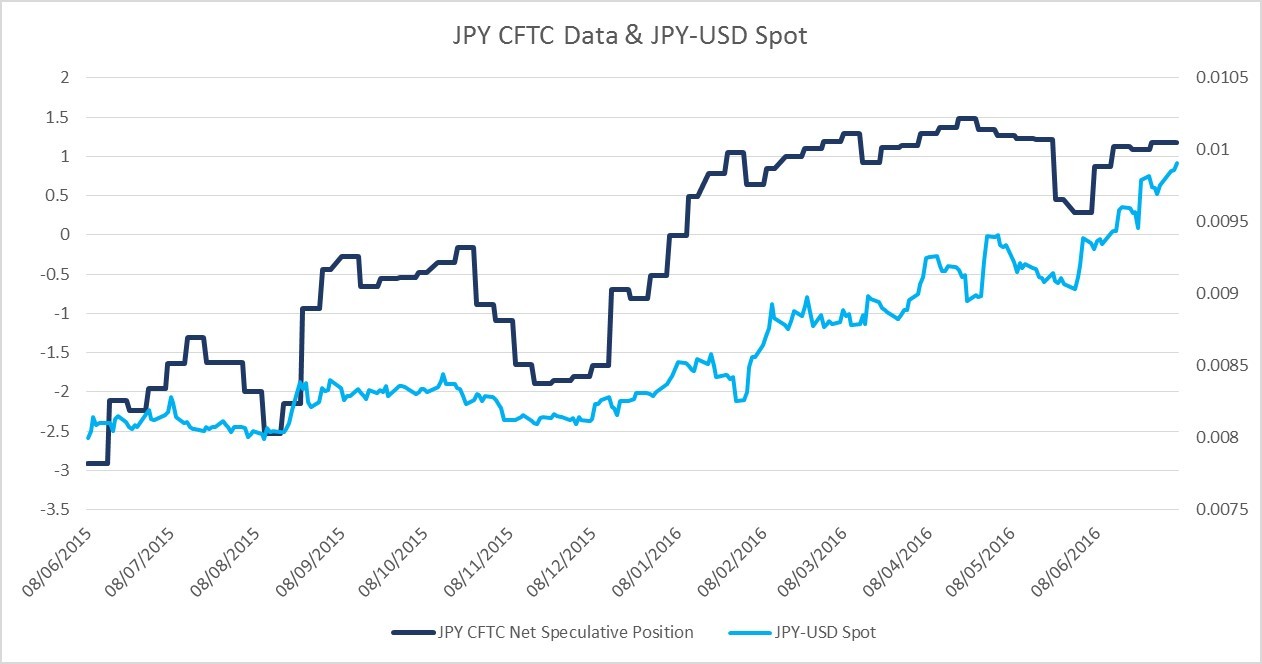
We can clearly see a strong correlation between the trends in positioning and spot price. Obviously they will not go in lock-steps, but the positioning index will, in most cases, indicate about the trend in spot.


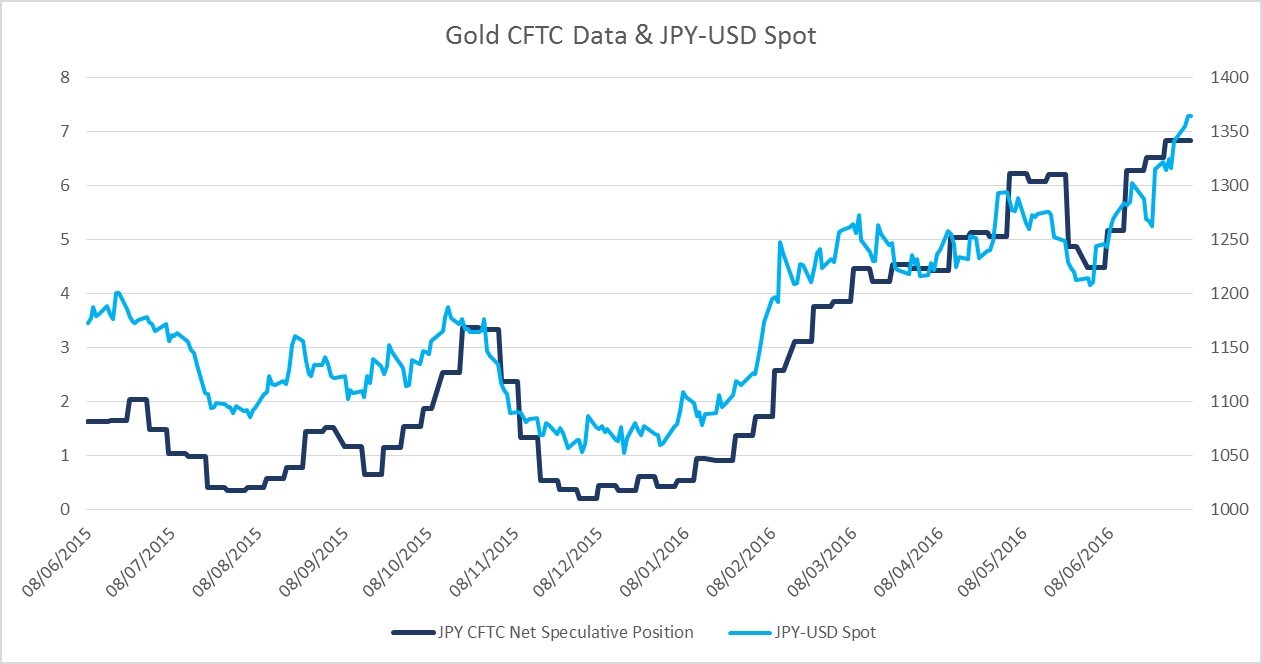
Looking at the correlation between Gold CFTC data and Gold spot price reveals extremely high correlation between the Net Speculative position and the Gold Spot price. This leads us to believe that the recent move in Gold (and Silver) was driven by fast-money type accounts, and not long-term investors.


Understanding the positioning and the flows can help traders establish medium-long term positions, either in options on in spot.
EZTRADER Market Analysis Team will publish a weekly report about the CFTC positions, alongside insights regarding the different currencies, commodities, equities, and will try to shed some light about the market sentiment using cutting edge quantitative methods and indicators.


1. Introduction This risk disclosure and warning notice is provided to you (our Client and prospective Client) in compliance to the Provision of Investment Services, the Exercise of Investment Activities, the Operation of Regulated Markets and Other Related Matters Law 144(I)/2007, as subsequently amended from time to time (“the Law”), which is applicable in WGM Services Limited (“the Company”). All Clients and prospective Clients should read carefully the following risk disclosure and warnings contained in this document, before applying to the Company for a trading account and before they begin to trade with the Company. However, it is noted that this document cannot and does not disclose or explain all of the risks and other significant aspects involved in dealing in Binary Options. The notice was designed to explain in general terms the nature of the risks involved when dealing in Binary Options on a fair and non-misleading basis.

2. Risks 2.1. Trading in Binary Options is VERY SPECULATIVE AND HIGHLY RISKY and is not suitable for all members of the general public but only for those investors who: (a) understand and are willing to assume the economic, legal and other risks involved. (b) taking into account their personal financial circumstances, financial resources, life style and obligations are financially able to assume the loss of their entire investment. (c) have the knowledge to understand Binary Options trading and the underlying assets and markets. 2.2. The Company will not provide the Client with any advice relating to Binary Options, the underlying assets and markets or make investment recommendations of any kind. So, if the Client does not understand the risks involved he should seek advice and consultation from an independent financial advisor. If the Client still does not understand the risks involved in trading in Binary Options, he should not trade at all. 2.3. Binary Option are derivative financial instruments deriving their value from the prices of the underlying assets/markets in which they refer to (for example currency, equity indices, stocks, metals, indices futures, forwards etc.). Although the prices at which the Company trades are set by an algorithm developed by the Company, the prices are derived from the underlying assets /market. It is important therefore that the Client understands the risks associated with trading in the relevant underlying asset/ market because fluctuations in the price of the underlying asset/ market will affect the profitability of his trade.

Editors’ Picks

EUR/USD hits two-day highs near 1.1820

EUR/USD hits two-day highs near 1.1820

EUR/USD picks up pace and reaches two-day tops around 1.1820 at the end of the week. The pair’s move higher comes on the back of renewed weakness in the US Dollar amid growing talk that the Fed could deliver an interest rate cut as early as March. On the docket, the flash US Consumer Sentiment improves to 57.3 in February.

GBP/USD reclaims 1.3600 and above

GBP/USD reclaims 1.3600 and above

GBP/USD reverses two straight days of losses, surpassing the key 1.3600 yardstick on Friday. Cable’s rebound comes as the Greenback slips away from two-week highs in response to some profit-taking mood and speculation of Fed rate cuts. In addition, hawkish comments from the BoE’s Pill are also collaborating with the quid’s improvement.

USD/JPY drops back below 157.00, as focus shifts to Japan snap election

USD/JPY drops back below 157.00, as focus shifts to Japan snap election

USD/JPY is back in the red below 157.00 in the Asian session on Friday. The Japanese Yen recovers ground against the US Dollar amid some profit-taking ahead of Japan's snap general election on Sunday. The preliminary reading of the Michigan Consumer Sentiment Index report for February will be released later on Friday. 


Editors’ Picks

EUR/USD: US Dollar to remain pressured until uncertainty fog dissipates

EUR/USD: US Dollar to remain pressured until uncertainty fog dissipates Premium

The EUR/USD pair lost additional ground in the first week of February, settling at around 1.1820. The reversal lost momentum after the pair peaked at 1.2082 in January, its highest since mid-2021.

Gold: Volatility persists in commodity space

Gold: Volatility persists in commodity space Premium

After losing more than 8% to end the previous week, Gold (XAU/USD) remained under heavy selling pressure on Monday and dropped toward $4,400. Although XAU/USD staged a decisive rebound afterward, it failed to stabilize above $5,000.

GBP/USD: Pound Sterling tests key support ahead of a big week

GBP/USD: Pound Sterling tests key support ahead of a big week Premium

The Pound Sterling (GBP) changed course against the US Dollar (USD), with GBP/USD giving up nearly 200 pips in a dramatic correction.

Bitcoin: The worst may be behind us

Bitcoin: The worst may be behind us

Bitcoin (BTC) price recovers slightly, trading at $65,000 at the time of writing on Friday, after reaching a low of $60,000 during the early Asian trading session. The Crypto King remained under pressure so far this week, posting three consecutive weeks of losses exceeding 30%.

Three scenarios for Japanese Yen ahead of snap election

Three scenarios for Japanese Yen ahead of snap election Premium

The latest polls point to a dominant win for the ruling bloc at the upcoming Japanese snap election. The larger Sanae Takaichi’s mandate, the more investors fear faster implementation of tax cuts and spending plans. 

RECOMMENDED LESSONS

5 Forex News Events You Need To Know

In the fast moving world of currency markets where huge moves can seemingly come from nowhere, it is extremely important for new traders to learn about the various economic indicators and forex news events and releases that shape the markets. Indeed, quickly getting a handle on which data to look out for, what it means, and how to trade it can see new traders quickly become far more profitable and sets up the road to long term success.

Top 10 Chart Patterns Every Trader Should Know

Chart patterns are one of the most effective trading tools for a trader. They are pure price-action, and form on the basis of underlying buying and selling pressure. Chart patterns have a proven track-record, and traders use them to identify continuation or reversal signals, to open positions and identify price targets.

7 Ways to Avoid Forex Scams

The forex industry is recently seeing more and more scams. Here are 7 ways to avoid losing your money in such scams: Forex scams are becoming frequent. Michael Greenberg reports on luxurious expenses, including a submarine bought from the money taken from forex traders. Here’s another report of a forex fraud. So, how can we avoid falling in such forex scams?

What Are the 10 Fatal Mistakes Traders Make

Trading is exciting. Trading is hard. Trading is extremely hard. Some say that it takes more than 10,000 hours to master. Others believe that trading is the way to quick riches. They might be both wrong. What is important to know that no matter how experienced you are, mistakes will be part of the trading process.

Strategy

Money Management

Psychology

Best Brokers of 2025