"The Z-Signal creates a predictive model that tries to anticipate the 'fair' price of Bitcoin" - Interview with Hans Hauge


The 2019 forecasting season is approaching and we asked one of our most interesting Crypto contributors. Mr. Hauge is the creator of the Z-Signal and Z-score indicators.
- What particularities has the Bitcoin when analyzing it technically. Do you think that the classic technical analysis is valid? If you don't consider it valid, what recommendations would you make for our readers to improve their analysis?
I think Technical Analysis is like Voodoo. If you think it works, then it does. In a group setting, if enough people believe the price will behave in a certain way, then you might actually see that manifest in the market. Since most people don’t know about the fundamental approach (which is my focus), they are not aware of any alternative. I would just like to widen the scope of the conversation a bit, and maybe wrangle a few technical traders into looking into the fundamental models, which I believe are the best long-term tool we have today.
- Can you explain your Bitcoin Z-Signal indicator in a way that an unaccustomed reader can understand?
Sure. I believe that the value of Bitcoin is in the network. Think about Facebook and Twitter. How much are those companies worth if they have zero users? Not much, right? What if Facebook and Twitter have many users or all the users? How much are they worth now? A lot, right?
It’s the same thing with Bitcoin. If nobody has it, sends it, accepts it, works on it, mines it; then it’s pretty much useless. However, if we see growing participation levels (which is what I track), then it’s a good sign for future prospects. What the Z-Signal does is that it takes in raw data from the network and combines that with an element of time. The theory comes in three parts.
1. We need users to have a network, the more the better.
2. Users have to do something, or they’re not helping much. The more transactions, the better.
3. The longer Bitcoin survives, the larger the user base can become, the more likely it is to persist (this is called the Lindy Effect).
When we combine these three elements and look at the data in log scale, magic happens. Suddenly we can see some very powerful relationships between the number of users (I use the number of unique addresses as a proxy here), the activity level of the users (I use daily confirmed transactions on the blockchain here, not fake transactions from exchanges), and the total number of transactions even confirmed (this is one way to conceptualize the age of Bitcoin).
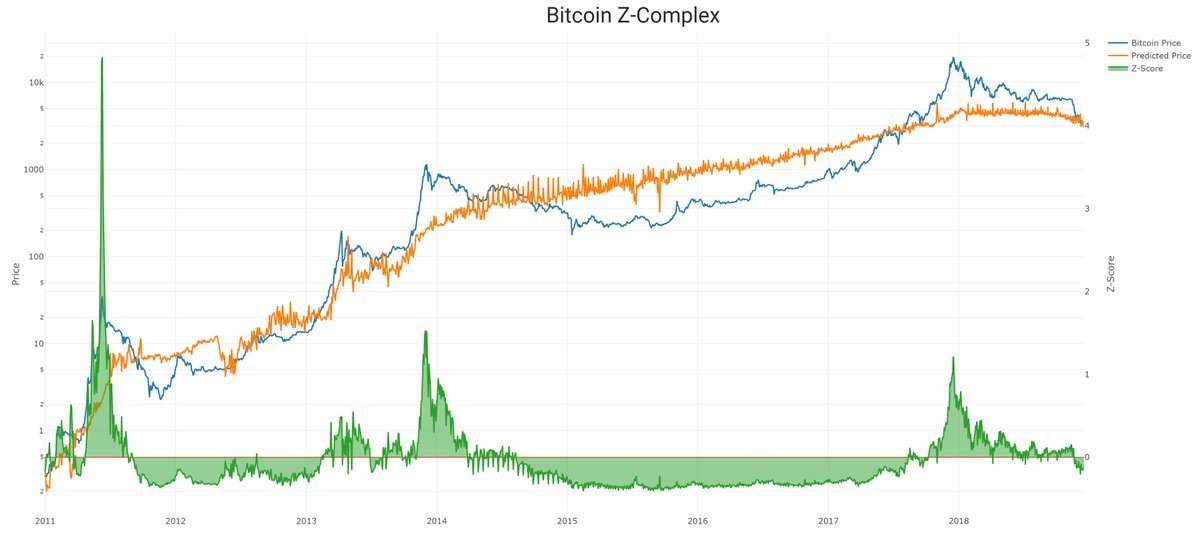
The Z-Signal creates a predictive model that tries to anticipate the “fair” price of Bitcoin at a certain point in time based on those three inputs. Then, I take the actual price and divide it by the predicted price.
This is the price/predicted ratio. The price/predicted ratio tells you when the price might be too high, or too low based on the model’s prediction. I then standardize those ratios, and that’s where the Z-scores come from.
At any point, the Z-score tells you how far away the price is from the prediction. That’s pretty much it.
- From what I've been observing in your articles, the indicators you've created are quite reliable when it comes to forecasting movements. Could you give us your forecast for the price of Bitcoin for next year?
Sure. First let me say that the floor of the Bitcoin price and the ceiling are changing every day. This means that a low price right now might have been a high price in the past. Also, a high price now might seem low in the future. So, when it comes to the bottom of the market, I think we’re more likely to see a low price in December of 2018 than it would be to see that same price in July of 2019.
Going off the low Z-scores from the last two bubbles, and the fact that bubbles have the strange property of deflating to just above the last peak, I would say that the floor for Bitcoin in the near term is probably around $2,000 (the bubble before this peaked around $1,100).
2019 Could be a year of quiet gains, or we could see things get crazy. The most likely scenario, if I had to guess, would be that we see positive movement in 2019, but then real big gains in 2020. Typically, after a bubble people get burnt out psychologically. It takes time for them to sort of reset and get back into it. Also, the next block reward halving will be in 2020, and that event is much anticipated. The block reward halving will send a supply shock through the system as the new Bitcoins issued every ten minutes suddenly drops in half.
The last thing is that futures contracts have been getting more popular month over month, and we should be seeing Bakkt launch in January of 2019. This will add an option for futures settled in Bitcoin, rather than just in cash. If we see the same growth pattern with these contracts as the cash settled versions, it could be a key driver growth.
Sometime in 2019, or 2020; I predict Bitcoin will reach $100k for a single coin.
Author

FXStreet Team
FXStreet
Composed of a group of economic journalists and FX experts, the FXStreet content team produces and oversees all content published on FXStreet. It provides a purely journalistic approach to the Forex market.