XRP price losing $0.600 could result in Ripple investors losing 24% of their recent profits
- Ripple was defeated by Polkadot, which emerged as the foremost crypto asset banks are exposed to.
- The Basel Committee on Banking Supervision report, made up of 19 banks, noted $10.2 billion worth of crypto asset exposure.
- XRP price has been on a downtrend since the beginning of the month and is close to losing the key support of $0.600.

XRP price is close to losing the profits the altcoin witnessed in the first week of November. One of the biggest catalysts when it comes to price action is the use cases of Ripple and XRP among banks, as well as their exposure to this altcoin. However, by the looks of it, Ripple has lost that crown to Polkadot.
Ripple loses to Polkadot
Ripple, according to a recent report from The Basel Committee on Banking Supervision (BCBS), has been eclipsed by Polkadot. The Committee is a bank regulation authority with about 45 top banks across the globe as members.
Their report accounted for the crypto asset data from 19 banks, of which ten belonged to North America, seven to Europe, and three others from other regions of the world. Collectively, these banks have reported $10.27 billion in crypto asset exposure at the moment.
Interestingly, Polkadot accounts for a smidge more exposure than Ripple, coming up to 2.1% of the total amount. Ripple, on the other hand, only contributed 1.9% to the $10.27 billion crypto exposure. This speaks to the adoption of not just crypto assets but also XRP among the banks, as these financial institutions remain cautious.
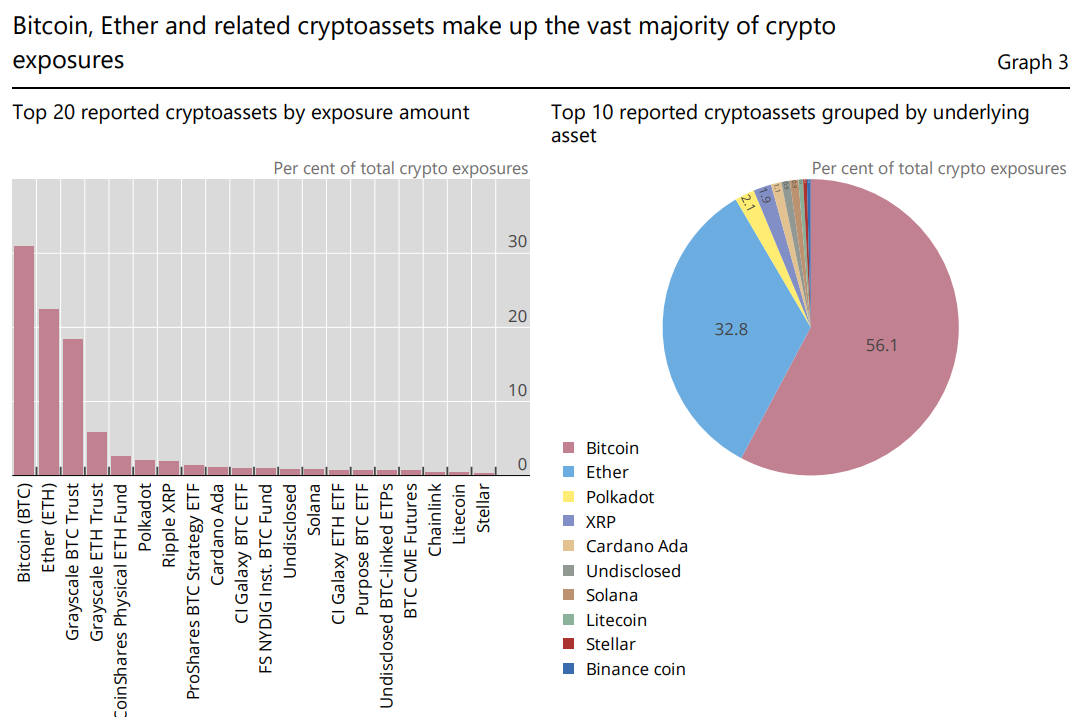
Crypto asset exposure
Earlier last week, the Federal Reserve Vice Chairman for Supervision, Michael Barr, commented on the risks of crypto to the banks, saying that most banks are taking a careful and cautious approach when it comes to digital assets, saving them from witnessing major risks.
The recent rally was expected to jumpstart Ripple’s bull run. However, until broader market cues, as well as macro-financial conditions, turn bullish, the rally might not stick.
XRP price slides further
XRP price has noted a 13.67% decline in the past two weeks, falling from $0.715 to trade at $0.616 at the time of writing. The drawdown has wiped out nearly half of the gains witnessed by Ripple investors in the past couple of days, bringing the altcoin close to falling through the support line at $0.600.
This level has been tested as both support and resistance in the past and presently acts as a crucial support line. Bouncing off this line would save Ripple investors from registering further losses on their holdings and revive the price rise to push XRP toward $0.644.
The Relative Strength Index (RSI) has not broken below the neutral line at 50.0, which suggests it has a shot at noting a bullish outcome.
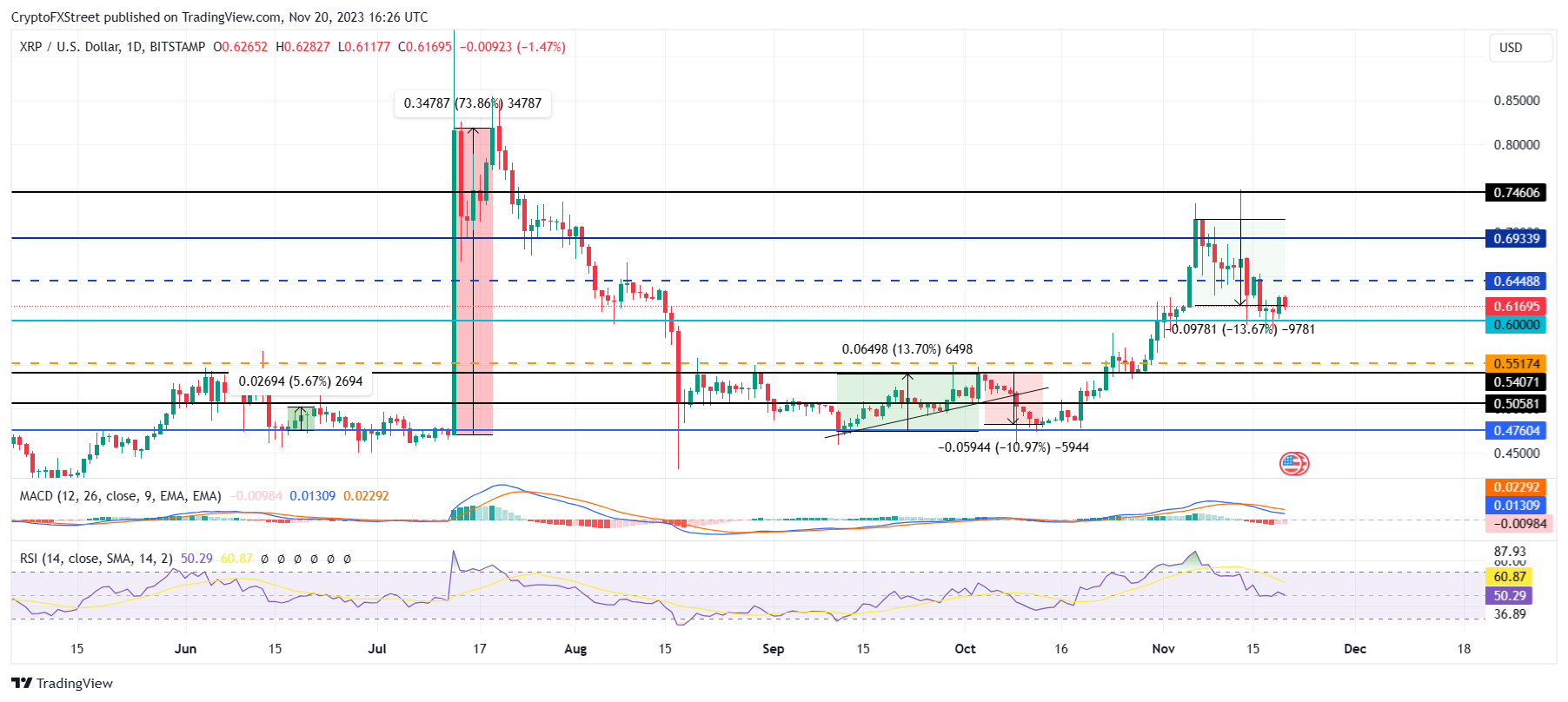
XRP/USD 1-day chart
However, if the $0.600 support line is lost, the bullish thesis would be invalidated on the short-term scale. RSI falling below the 50.0 mark would serve as a confirmation of the same and might draw XRP price down to $0.551, potentially wiping out all the gains noted at the beginning of the month.
Cryptocurrency prices FAQs
How do new token launches or listings affect cryptocurrency prices?
Token launches like Arbitrum’s ARB airdrop and Optimism OP influence demand and adoption among market participants. Listings on crypto exchanges deepen the liquidity for an asset and add new participants to an asset’s network. This is typically bullish for a digital asset.
How do hacks affect cryptocurrency prices?
A hack is an event in which an attacker captures a large volume of the asset from a DeFi bridge or hot wallet of an exchange or any other crypto platform via exploits, bugs or other methods. The exploiter then transfers these tokens out of the exchange platforms to ultimately sell or swap the assets for other cryptocurrencies or stablecoins. Such events often involve an en masse panic triggering a sell-off in the affected assets.
How do macroeconomic releases and events affect cryptocurrency prices?
Macroeconomic events like the US Federal Reserve’s decision on interest rates influence risk assets like Bitcoin, mainly through the direct impact they have on the US Dollar. An increase in interest rate typically negatively influences Bitcoin and altcoin prices, and vice versa. If the US Dollar index declines, risk assets and associated leverage for trading gets cheaper, in turn driving crypto prices higher.
How do major crypto upgrades like halvings, hard forks affect cryptocurrency prices?
Halvings are typically considered bullish events as they slash the block reward in half for miners, constricting the supply of the asset. At consistent demand if the supply reduces, the asset’s price climbs. This has been observed in Bitcoin and Litecoin.
Author

Aaryamann Shrivastava
FXStreet
Aaryamann Shrivastava is a Cryptocurrency journalist and market analyst with over 1,000 articles under his name. Graduated with an Honours in Journalism, he has been part of the crypto industry for more than a year now.