Here’s why AVAX price crash could be a blessing in disguise
- AVAX price is consolidating in a range, extending from $31 to $39.
- After a failed breakout, Avalanche price has crashed by 13%.
- Investors can expect an 11% crash and a potential deviation of the range low at $31.
- A flip of the $31 support level will invalidate the bullish thesis.

Avalanche (AVAX) price action shows no signs of a directional bias as it moves sideways. The optimism generated due to the breakout attempt on May 20 has died down as AVAX continues its descent. But patient buyers might be rewarded soon.
Also read: Avalanche set to gain wider reach with its Stripe integration
Avalanche price needs to set the stage
Avalanche price crashed 56% between March 18 and April 13 and has been in a sideways movement since then. This six-week consolidation almost ended as AVAX shot up 11.53% on May 20, triggering a breakout and setting up a local top of $41. But as time passed, this move was undone by bears, evolving this breakout into a failed attempt, leading ot a 13% crash.
Now, AVAX trades inside the aforementioned range. Long-term investors are likely to wait before buying the dips. A sweep of the range low of $31 will be a key pivotal point that could trigger a lot of buy-the-dip orders.
The resulting bounce could see Avalanche price to retest the range high of $39 as its first move. Beyond this, AVAX could also attempt to retest the $47 hurdle, which is the next key resistance level. This move would constitute a 47% run-up and is likely where AVAX could form a local top.
The Relative Strength Index (RSI) and Awesome Oscillator (AO) are both below their respective mean levels of 50 and 0, showing bearish momentum is in play. Whales tend to buy the dips here and complete their accumulation,
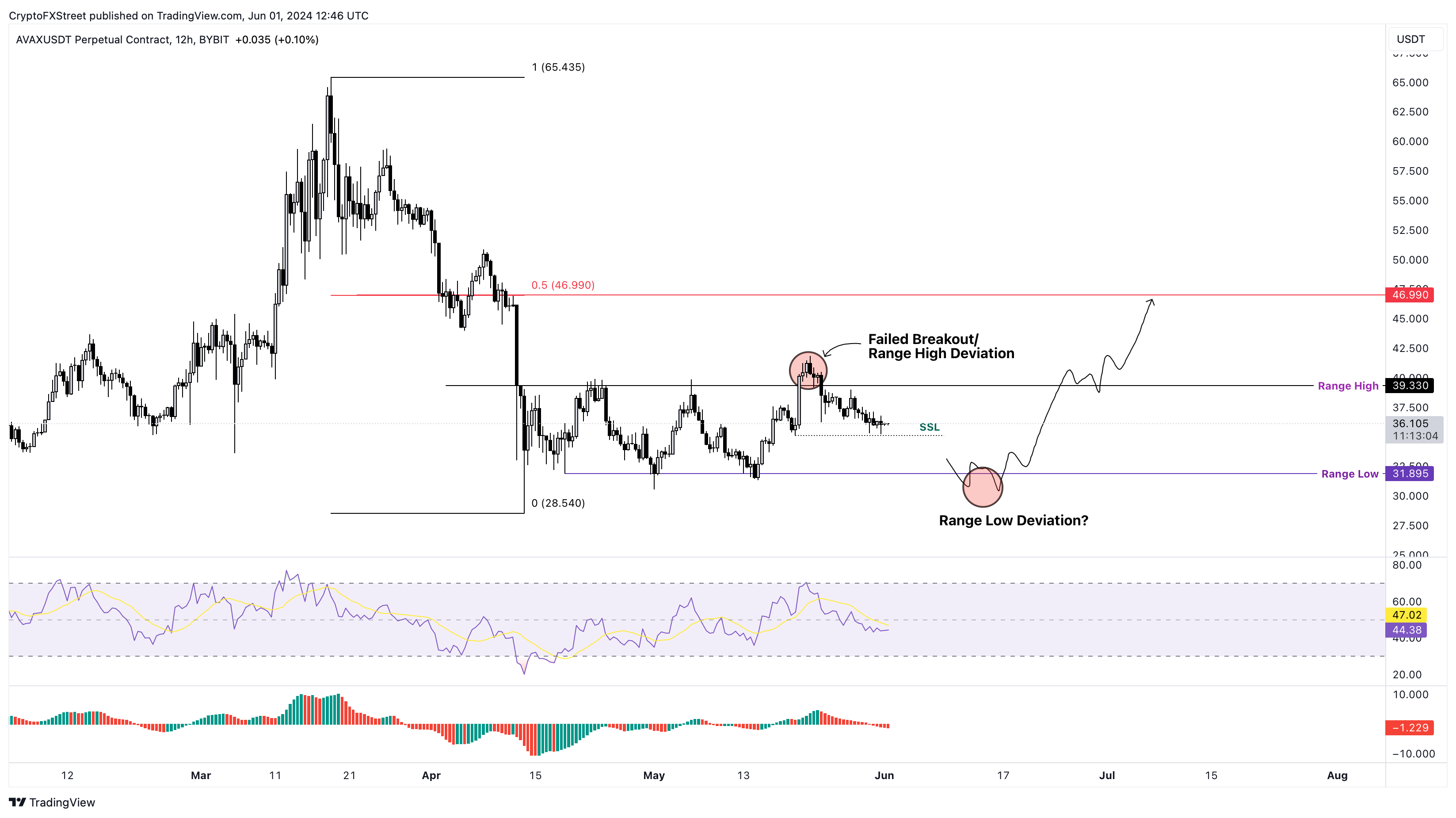
AVAX/USDT 1-day chart
Regardless of the short-term bearish outlook, the mid-to-long-term scenario remains bullish for Avalanche price. However, if AVAX produces a daily candlestick close below $31, leading to a flip of the support barrier into a resistance level, it will invalidate the uptrend. Such a development could see Avalanche price revisit the April 13 swing low of $28, roughly 10% from $31.
Read more: Avalanche price might need to drop 5% to 10% before AVAX bulls eye retest of $80
Author

Akash Girimath
FXStreet
Akash Girimath is a Mechanical Engineer interested in the chaos of the financial markets. Trying to make sense of this convoluted yet fascinating space, he switched his engineering job to become a crypto reporter and analyst.