Global Ethereum ETFs experience surge in net inflows as Hashdex files for combined spot ETH and Bitcoin ETF
- Hashdex filed for a market-weighted ETF that will track both spot Ethereum and Bitcoin prices.
- Ethereum exchange reserves approach an all-time low following massive inflows across global ETH ETFs.
- Ethereum's decline is likely caused by high correlation with Bitcoin and short-term speculative trading.

Ethereum (ETH) is down 3% on Tuesday as Hashdex submitted a market-weighted crypto ETF to the SEC, aiming to track the price of ETH and Bitcoin. Additionally, global investors have increasingly purchased ETH ETFs amid declining exchange reserves.
Daily digest market movers: Combined ETH & BTC ETFs, Global Ethereum ETF net inflow
Hashdex submitted a 19b-4 filing for a combined spot BTC and ETH ETF, Hashdex Nasdaq Crypto Index US ETF. According to the filing, Bitcoin will account for 70.54% and Ethereum 29.46% of the Index's weight.
Also read: Spot Ethereum ETF anticipation wipes nearly $70 million worth of ETH
Hashdex's crypto index filings come after the asset manager withdrew its initial spot ETH ETF application on May 24, a day after the SEC approved 19b-4 filings of similar products from eight other issuers, including VanEck, Franklin Templeton, Invesco & Galaxy, BlackRock, 21Shares, Fidelity, Grayscale and Bitwise.
While the SEC has yet to approve S-1 registration statements that will enable these issuers to launch spot ETH ETFs for trading, Bloomberg analyst Eric Balchunas confirmed that the SEC has already sent in their first round of comments on the drafts. He also speculated that ETH ETFs could go live on or before July 2.
On the other hand, Matthew Sigel, Head of Digital Asset Research at Van Eck, said, "Hedge funds are front-running the ETH ETF approvals." He made this claim by citing data from K33 Research, which shows that the 4-week net flow of global ETH ETFs has reached 86,472 ETH.
Read more: Ethereum resumes downtrend as Canada sees another staked ETH ETF launch
Additionally, Ethereum exchange reserve has dropped significantly, reaching an eight-year low. In other words, ETH on exchanges has reached its lowest level since the number one altcoin became mainstream.
Meanwhile, Ethereum reached new heights in Q1 2024 in terms of total transaction count. The total number of transactions in the whole Ethereum ecosystem reached over 800 million in Q1 2024, an 85% growth YoY.
ETH technical analysis: Ethereum's downward pressure may be caused by Bitcoin
Ethereum is trading around $3,420 on Tuesday following massive liquidations across the crypto market. ETH liquidations reached over $91.07 million in the past 24 hours, with long liquidations accounting for $74.11 million and shorts at $16.96 million, according to data from Coinglass.
Despite several market catalysts, including buying pressure across global ETH ETFs, declining exchange reserves, and imminent spot ETH ETF approval, Ethereum's price is still lagging.
Also read: Ethereum ETFs could go live before July 2 after SEC send issuers comments on S-1s
One reason may be Bitcoin's increasing dominance over the crypto market, which is now at 52%. A decline in the number one digital asset often causes a decline in the price of ETH and other crypto assets, signaling a high positive correlation. Bitcoin has been on a downward trend in the past week, and ETH has followed it in the same move.
Another reason for the decline may be a speculative move from traders shorting ETH in the short term due to the wider crypto market outlook.
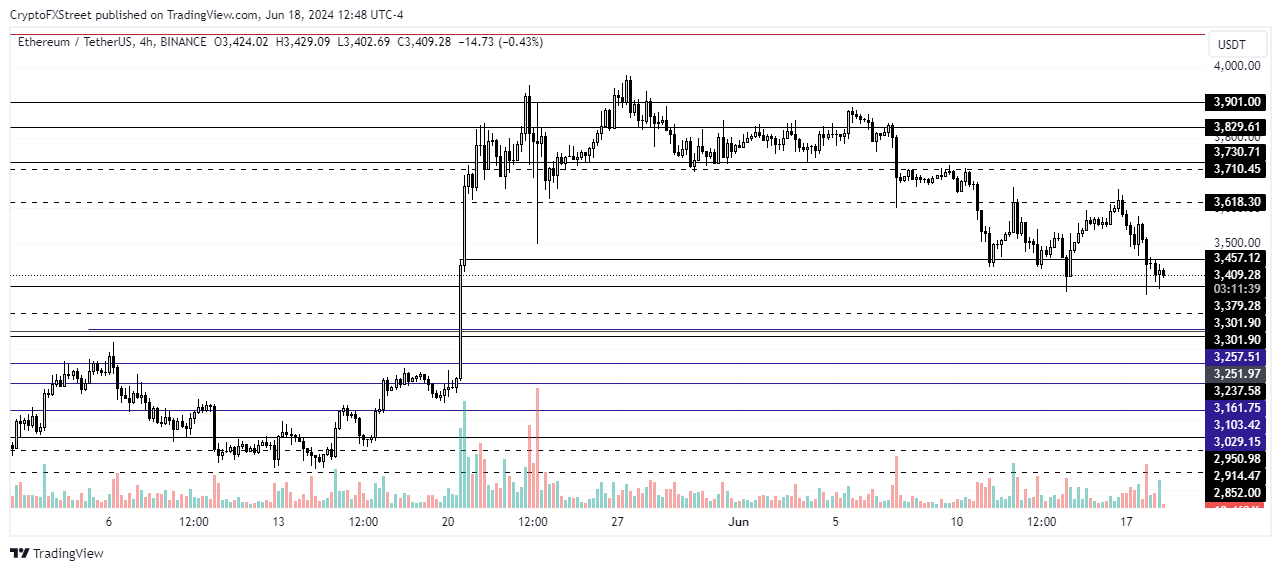
ETH/USDT 4-hour chart
The $3,300 support remains key for ETH in the coming days. A breach below this level may cause ETH to sustain a further downward movement. A breakout above the $3,900 resistance is key to validating any potential bullish move.
Ethereum FAQs
Ethereum is a decentralized open-source blockchain with smart contracts functionality. Serving as the basal network for the Ether (ETH) cryptocurrency, it is the second largest crypto and largest altcoin by market capitalization. The Ethereum network is tailored for scalability, programmability, security, and decentralization, attributes that make it popular among developers.
Ethereum uses decentralized blockchain technology, where developers can build and deploy applications that are independent of the central authority. To make this easier, the network has a programming language in place, which helps users create self-executing smart contracts. A smart contract is basically a code that can be verified and allows inter-user transactions.
Staking is a process where investors grow their portfolios by locking their assets for a specified duration instead of selling them. It is used by most blockchains, especially the ones that employ Proof-of-Stake (PoS) mechanism, with users earning rewards as an incentive for committing their tokens. For most long-term cryptocurrency holders, staking is a strategy to make passive income from your assets, putting them to work in exchange for reward generation.
Ethereum transitioned from a Proof-of-Work (PoW) to a Proof-of-Stake (PoS) mechanism in an event christened “The Merge.” The transformation came as the network wanted to achieve more security, cut down on energy consumption by 99.95%, and execute new scaling solutions with a possible threshold of 100,000 transactions per second. With PoS, there are less entry barriers for miners considering the reduced energy demands.
Author

Michael Ebiekutan
FXStreet
With a deep passion for web3 technology, he's collaborated with industry-leading brands like Mara, ITAK, and FXStreet in delivering groundbreaking reports on web3's transformative potential across diverse sectors. In addition to