Ethereum bulls defend key support level as technical indicators indicate bullish reversal
- Ethereum ETFs saw net outflows of $23.7 million as Grayscale ETHE flows continued downtrend move.
- Ethereum buyers are soaking up the sell pressure from capitulated whales and Jump Crypto.
- Ethereum bulls returned to defend key support level as technical indicators signal ETH is staging bullish reversal.

Ethereum (ETH) is up nearly 10% on Thursday as buyers accumulate the selling pressure from capitulated whales and Jump Crypto. Meanwhile, ETH technical indicators suggest that ETH has seen a bottom and is staging a bullish reversal.
Daily digest market movers: ETH ETF flows, buyers soak up selling pressure
Ethereum ETFs' net flows turned negative on Wednesday after recording outflows of $23.7 million. BlackRock's ETHA, which has led inflows in the past two days, saw zero flows, while Grayscale's ETHE outflows further declined to $31.9 million. The total net asset value of the nine Ethereum ETFs dropped to $6.6 billion.
The net outflow follows the New York Stock Exchange (NYSE) filing to list and trade options for Bitwise and Grayscale Ethereum ETFs. This comes a few days after the Nasdaq filed for a similar options trading for BlackRock's ETHA.
Meanwhile, some whales capitulated following the market dip. Lookonchain reports that a whale who accumulated 14,384 ETH at an average price of $3,291 between June 22 and August 4 sold all of his holdings on Binance at $2,417 after the market crashed. The move saw the whale realize a loss of $12.57 million.
Additionally, Jump Trading, which has been on an ETH selling spree in the past four days, withdrew 32.6 million USDC from Binance after transferring ETH to the exchange. This suggests the firm may have already sold the ETH as it looks to unstake its remaining holdings from Lido.
However, buyers appear to be soaking up the selling pressure as exchanges have continued to experience net ETH outflows in the past four days, according to CryptoQuant's data.
 - All Exchanges (SMA 30) (1)-638587455211205578.png)
ETH Exchange Netflow
The ETH Coinbase Premium Index, which measures the difference between ETH's price in Coinbase Pro and Binance, has also been above the 0 line. It reached 0.04 on August 6 before declining mildly to 0.03. The index above the 0 line indicates strong ETH buying pressure from US investors as the top altcoin continues recovering.
ETH technical analysis: Ethereum bulls could help initiate bullish reversal
Ethereum is trading around $2,580, up nearly 10% on the day. In the past 24 hours, ETH has seen $55.77 million in liquidations, with long and short liquidations accounting for $34.65 million and $21.12 million, respectively.
Bulls returned to defend the $2,300 price level after ETH took a 6% decline on Wednesday. The $2,300 price is a crucial support level for ETH, considering that 2.12 million addresses have accumulated 50.08 million ETH around this price, according to IntoTheBlock's data.
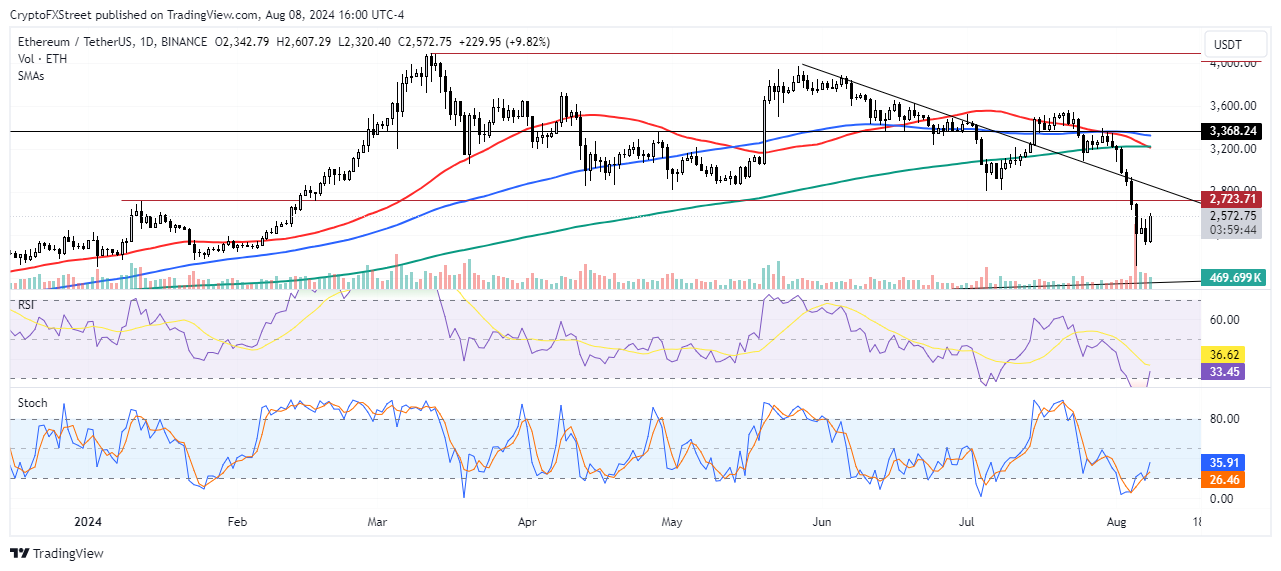
ETH/USDT Daily chart
ETH's Relative Strength Index (RSI) has moved from the oversold region and indicates a bullish reversal as it looks to cross above its moving average. The RSI crossing above the yellow moving average line often indicates bullish momentum.
The Stochastic Oscillator is also moving in a direction that suggests ETH could rally. After indicating a bullish divergence on August 7, when it made a higher low while ETH's price made a lower low, it has moved away from the oversold region.
The ETH Long/Short Ratio also suggests a similar move, as it has risen to 1.02, indicating that futures traders are becoming bullish.
As a result, ETH could rally to flip the resistance around $2,723. A successful move above this level could see ETH tackling the resistance around $3,368 — around which the 50, 100 and 200-day Simple Moving Averages (SMAs) are looking to converge.
The $2,000 psychological level could serve as a key support on the downside in case of prevailing bearish sentiment. A daily candlestick close below the $2,000 level will invalidate the bullish thesis.
Ethereum FAQs
Ethereum is a decentralized open-source blockchain with smart contracts functionality. Serving as the basal network for the Ether (ETH) cryptocurrency, it is the second largest crypto and largest altcoin by market capitalization. The Ethereum network is tailored for scalability, programmability, security, and decentralization, attributes that make it popular among developers.
Ethereum uses decentralized blockchain technology, where developers can build and deploy applications that are independent of the central authority. To make this easier, the network has a programming language in place, which helps users create self-executing smart contracts. A smart contract is basically a code that can be verified and allows inter-user transactions.
Staking is a process where investors grow their portfolios by locking their assets for a specified duration instead of selling them. It is used by most blockchains, especially the ones that employ Proof-of-Stake (PoS) mechanism, with users earning rewards as an incentive for committing their tokens. For most long-term cryptocurrency holders, staking is a strategy to make passive income from your assets, putting them to work in exchange for reward generation.
Ethereum transitioned from a Proof-of-Work (PoW) to a Proof-of-Stake (PoS) mechanism in an event christened “The Merge.” The transformation came as the network wanted to achieve more security, cut down on energy consumption by 99.95%, and execute new scaling solutions with a possible threshold of 100,000 transactions per second. With PoS, there are less entry barriers for miners considering the reduced energy demands.
Author

Michael Ebiekutan
FXStreet
With a deep passion for web3 technology, he's collaborated with industry-leading brands like Mara, ITAK, and FXStreet in delivering groundbreaking reports on web3's transformative potential across diverse sectors. In addition to



